Best eSIM for Malaysia 2026: 9 Plans Ranked for KL, Borneo and the Islands
Looking for the best eSIM for Malaysia in 2026? We ranked 9 providers by price, data plans, and network coverage across Kuala Lumpur, Penang, Langkawi, and Borneo. Compare deals, avoid costly mistakes, and find the right eSIM before you fly.
November 3, 2026
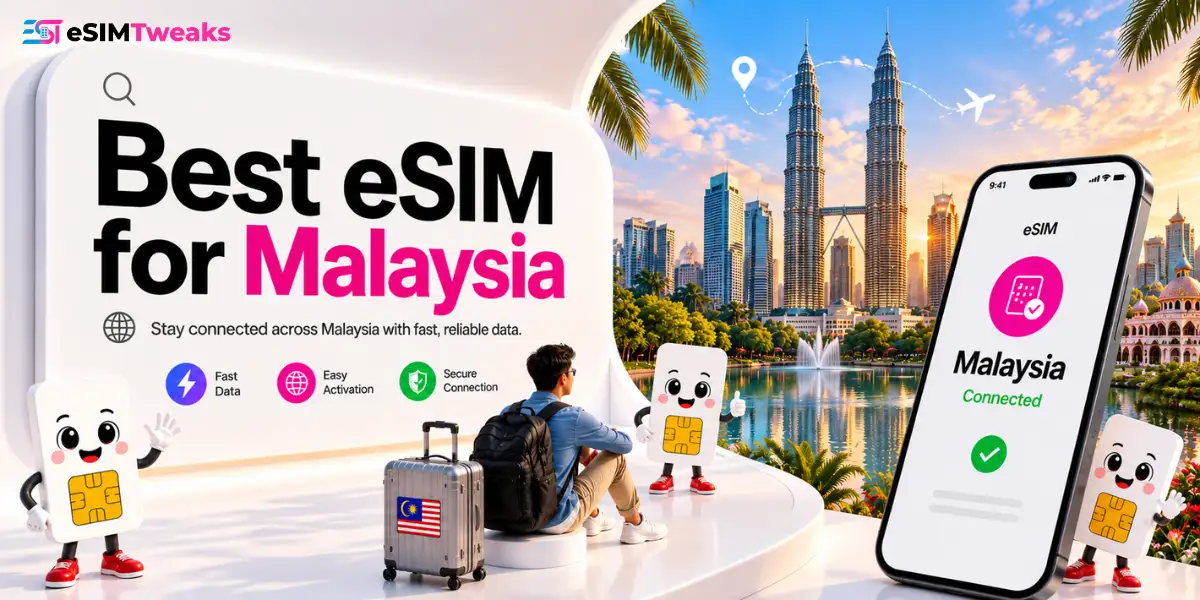
Choosing the right eSIM for Malaysia is easy in Kuala Lumpur, but Borneo is a different story. Malaysia is two countries with one flag, and your eSIM will notice.
On the peninsula, mobile data is fast, cheap and everywhere. Ookla puts the national median download at 141.18 Mbps. Kuala Lumpur, Penang, Melaka and Johor Bahru are as easy as anywhere in Asia.
Then you fly to Borneo. 5G reaches 82.4% of the population nationally, 68.6% in Sabah and 62% in Sarawak, and roughly 475 of 600 towers built in Sarawak are still waiting for equipment. Mulu, Danum Valley and Bario are effectively offline, and the one network people name for the interior is Maxis.
We ranked nine plans to find the best eSIM Malaysia sells, on price per gigabyte, on which network each one rides, and on whether it survives the flight east. Prices are standard rates before any code.

Top 3 eSIMs for Malaysia
Bottom line:

MobiMatter
- 50GB for $17.99 over 30 days
- Just $0.36 per GB at 50GB
- Ideal for KL, Penang and Langkawi
- Multiple affordable data tiers
eSIM4Travel
- Celcom and Digi network access
- 5GB for just $4.07
- 1GB for seven days at $1.20
- Great for city trips and stopovers

Travel Sim Asia
- Maxis and CelcomDigi access
- Hotspot and tethering allowed
- 180-day activation window
- Good fit for Sabah and Sarawak
All three cover the peninsula comfortably. Borneo is the section to read before you book.
Price comparison: all 9 Malaysia eSIMs
| Provider | Entry-level plan | 5GB | 10GB | 20GB | Best cost per GB | Runs on | Code |
|---|---|---|---|---|---|---|---|
| MobiMatter | $5.99 (5GB) | $5.99 / 30d | $7.99 / 30d | $9.99 / 30d | $0.36 (50GB) | Local networks | ESIMDUDE |
| eSIM4Travel | $1.20 / 7d | $4.07 / 30d | $7.54 / 30d | $14.49 / 30d | $0.72 | Celcom and Digi | ESIMADVICE |
| Esimx | $3.80 (3GB) | $4.80 / 30d | $7.80 / 30d | $13.80 / 30d | $0.63 (30GB) | Local networks | ESIMX10 |
| Billion Connect | $0.90 / 3d | $3.20 / 7d | $5.80 / 15d | $10.70 / 30d | $0.44 | Local networks | ESIMADVICE |
| Global YO | $3.89 / 3d | $6.29 / 15d | $8.39 / 30d | $12.59 / 30d | $0.34 (100GB) | Local networks | ESIMDUDE10 |
| Travel Sim Asia | $2.49 / 7d | $7.99 / 30d | $13.99 / 30d | $19.99 / 30d | $0.70 (50GB) | Maxis and CelcomDigi | ESIMADVICE01 |
| RedteaGO | $2.00 / 30d | $7.90 / 30d | $12.00 / 30d | $16.99 / 90d | $0.72 | Local networks | RTGF95CDO |
| Airalo | $4.00 / 3d | $11.00 / 7d | $25.00 (regional) | n/a | $0.98 (50GB) | Maxis | ESIMADVICE15 |
| Maya Mobile | unlimited only | unlimited only | unlimited only | unlimited only | $1.67 per day | Local networks | ESIMTWEAKS10 |
MobiMatter charges $9.99 for the 20GB that Airalo’s regional plan sells at four times the rate.
Malaysia is one of the cheapest data markets in Asia, and the brand premium here is steeper than the coverage difference justifies unless Borneo is on your itinerary.
Malaysia has three networks, a shared 5G network, and a brand that no longer exists
Start with the correction, because half the guides online still get this wrong. Yoodo ceased operations on 29 August 2024.
If a comparison page recommends it, that page has not been updated in two years. Tune Talk still runs, on CelcomDigi.
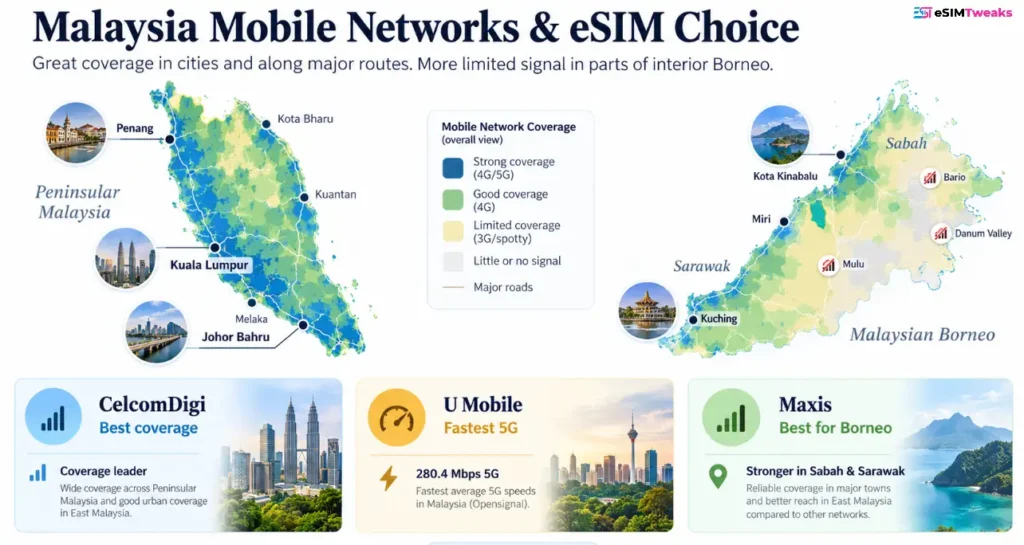
CelcomDigi is the biggest and the widest. It carries 20.4 million subscribers, roughly 30.1% of a market with 43.3 million connections and 121% penetration.
In Opensignal’s July 2026 report it won Coverage Experience at 8.8 out of 10, which is the award that matters if you are leaving the cities.
U Mobile is the fastest and the newest. It carries about 9.8 million subscribers and it swept the speed awards in July 2026: download, upload, 5G download at 280.4 Mbps, 5G availability at 66.6% and consistent quality.
Its ULTRA5G network launched in August 2025 and reached 6,737 sites and more than 85% population coverage by July 2026.
The catch is that it is the newest footprint in the country, which is exactly why it is fast.
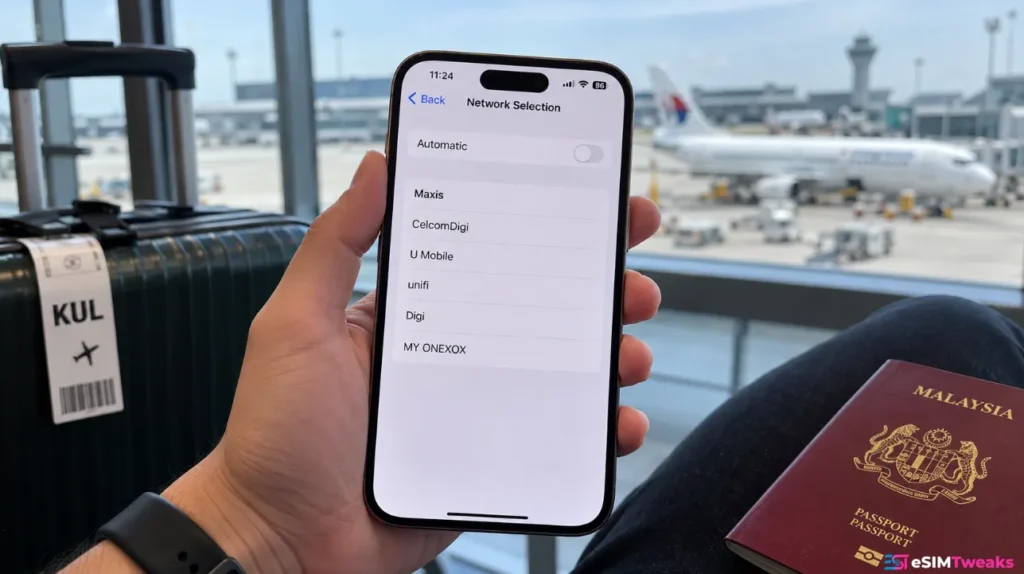
Maxis is worth considering for Borneo, particularly where its coverage is confirmed. Check your eSIM’s supported network before purchasing.
It is the network travellers name for the interior of Sabah and Sarawak, and the Mulu national park guidance names Maxis specifically as the signal near park headquarters. On this page, Airalo and Travel Sim Asia are the plans that ride it.
The 5G situation is unusual and worth two minutes. Malaysia built a single wholesale 5G network through Digital Nasional Berhad, then moved to a dual network model with U Mobile appointed to build the second.
U Mobile completed its exit from DNB’s 5G network effective 30 June 2026. DNB then activated an extra 100 MHz at 3.3 to 3.4 GHz to give a contiguous 200 MHz block serving CelcomDigi, Maxis and Yes, covering around 30 million subscribers, more than 80% of the population and more than 80% of national 5G traffic.
One consequence you can measure: as the DNB network filled up, median 5G speed fell 46%, from 451.79 Mbps to 242.92 Mbps. That is still very fast.
It is also a reminder that a 5G badge tells you less than a coverage award does.
Practical version: U Mobile for speed, CelcomDigi for coverage, Maxis for Borneo. On the peninsula it barely matters.
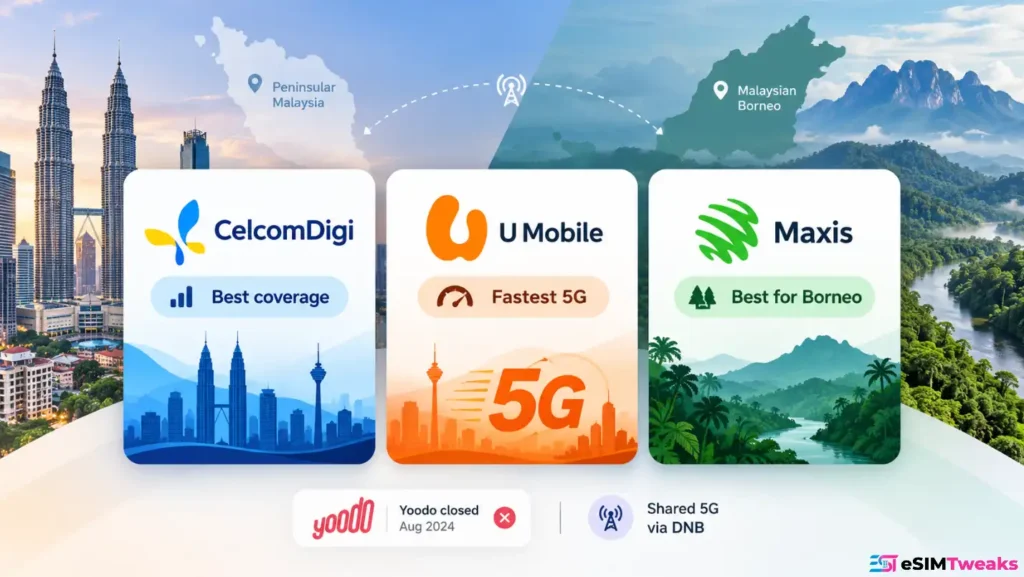
East of the South China Sea it decides your trip.
Travel eSIM, local SIM or your own carrier?
Malaysia is one of the few countries where we tell you the local option is cheaper, because it plainly is.
Your home carrier charges $12 a day. That is both AT&T’s International Day Pass and Verizon’s TravelPass rate. Verizon gives 5GB of high speed data then drops to 3G.
T-Mobile includes 5 to 15GB of roaming data depending on your tier, which makes it the one carrier worth checking first. Run your own numbers through our roaming versus eSIM calculator.
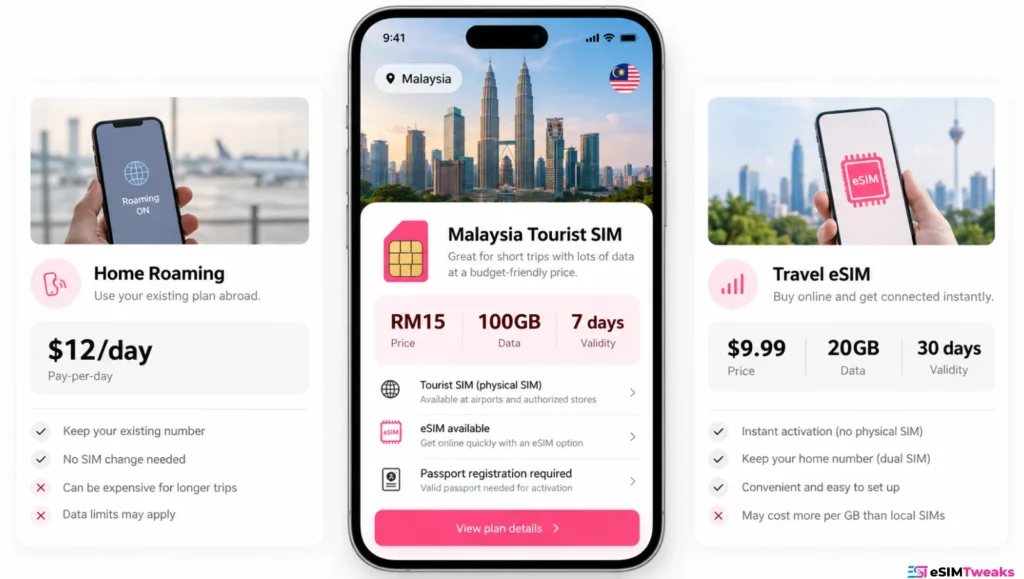
A local SIM is astonishing value and needs your passport. Registration has been mandatory since 2006.
In return: U Mobile sells a tourist SIM at RM15, about $3.71, with 100GB over seven days, available as an eSIM and bundled with a Grab Visit Malaysia 2026 travel pass.
Hotlink’s Travel SIM is RM64, about $15.85, for 400GB over thirty days, also available as an eSIM through the app. CelcomDigi sells unlimited passes from RM25 to RM90, physical SIM only.
Nothing on this page competes with RM15 for 100GB. What a travel eSIM buys you in Malaysia is convenience, not price: it is working before you land, there is no counter and no passport photocopied, and you do not lose thirty minutes of your first morning.
A travel eSIM Malaysia plan installs before you fly and is live the moment you clear immigration at KLIA.
Hot tip: Touch n Go eWallet is no longer the obstacle it used to be. It pays for tolls, parking, LRT and MRT fares and a huge share of small merchants through DuitNow QR, and it was locked to Malaysian numbers for years. Since April 2025 it accepts overseas mobile numbers.
You need an active home country number, a passport with six months validity, and WhatsApp installed, because verification codes come through WhatsApp.
You can register before you arrive. Tourists spent more than a billion ringgit through it in the first half of Visit Malaysia 2026.
The 9 best eSIMs for Malaysia
Ranked on price per gigabyte, the network each one rides, and what happens when the data runs out. Every plan is data only unless we say otherwise.
1
MobiMatter
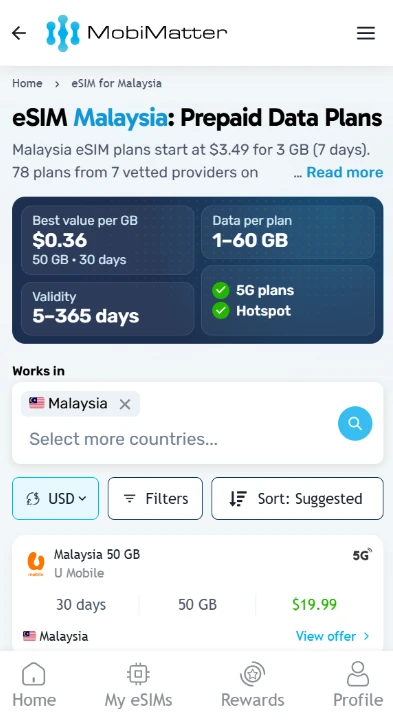
MobiMatter is a marketplace and in Malaysia it produces prices the premium brands cannot approach.
5GB for thirty days at $5.99. 10GB for fifteen days at $5.99. 10GB for thirty days at $7.99. 20GB for thirty days at $9.99. 30GB for thirty days at $11.99. 50GB for thirty days at $17.99.
Read that ladder carefully, because it is unusually generous at the top. Going from 10GB to 20GB costs two dollars. Going from 20GB to 50GB costs eight. The 50GB tier at $0.36 per gigabyte is the cheapest fixed data figure on this page, and it is a third of what Airalo charges for 50GB.
For a two week trip across the peninsula plus a week in Borneo, 20GB at $9.99 is more data than most people will use and costs less than a single day of your home carrier’s roaming pass.
Being a marketplace, listings vary by seller. Read the specific tier you are buying, and support runs through MobiMatter rather than whoever provisioned the profile.
What we like
What we don’t
The platform is covered in our MobiMatter review.
2
eSIM4Travel
Runs on Celcom and Digi.
eSIM4Travel is the cheapest brand here that will tell you which network you are on, and it names Celcom and Digi, the two halves of CelcomDigi, which won Opensignal's Coverage Experience award.
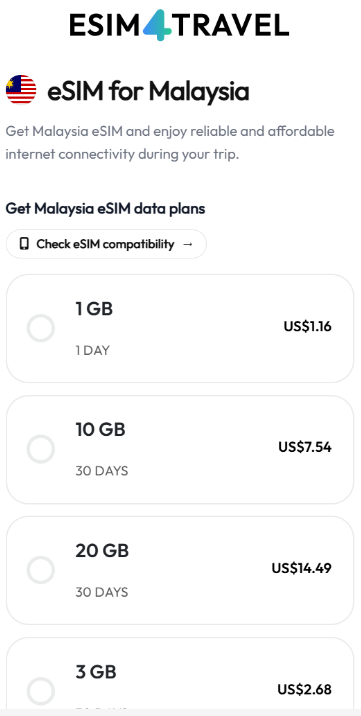
1GB for a day at $1.16. 1GB for seven days at $1.20. 3GB for thirty days at $2.68. 5GB for thirty days at $4.07. 10GB for thirty days at $7.54. 20GB for thirty days at $14.49. 50GB for thirty days at $39.69.
That $1.20 for a full week of 1GB is the cheapest week on this page, and it is exactly right for a Kuala Lumpur stopover between long haul flights.
The mid ladder is where it wins outright. 10GB at $7.54 is the second cheapest here and comes with a named coverage network attached, which is a better combination than most of this table offers.
Unlimited runs 3GB a day at full speed then 1 Mbps, from $15.19 for a week to $63.14 for thirty days.
There is also a South Asia five country plan covering Singapore, Malaysia, Thailand, Indonesia and Vietnam from $1.03 for 1GB over a week, which is the cheapest regional entry we found.
What we like
What we don't
3
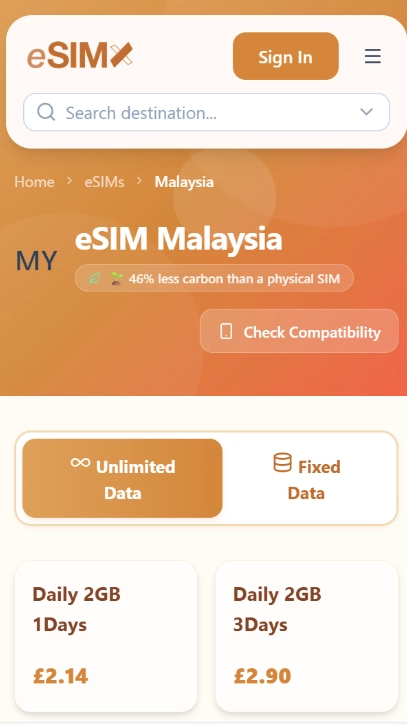
Esimx
Esimx sits within pennies of eSIM4Travel across the whole ladder and beats it at the top.
3GB for seven days at $3.80. 5GB for thirty days at $4.80. 10GB for seven days at $5.80. 10GB for thirty days at $7.80. 20GB for seven days at $10.80. 20GB for thirty days at $13.80. 30GB for thirty days at $18.80.
That 30GB tier works out at $0.63 per gigabyte, third cheapest here, and the seven day versions are useful shapes: 20GB in a week for $10.80 suits somebody working from a Penang cafe for a fortnight of half days.
There is a daily line at 2GB a day: $6.90 for a week, $9.80 for ten days and $28.80 for thirty.
Plans support 5G, which in Malaysia now means either the DNB block or U Mobile's ULTRA5G depending on which network answers.
The trade off is that no host network is named, so for a Borneo leg you are trusting the roaming table rather than choosing.
What we like
What we don't
4
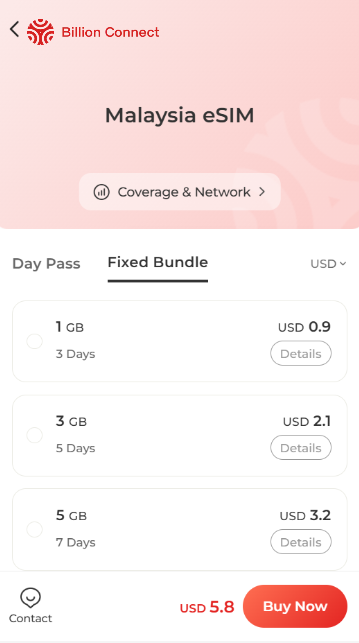
Billion Connect
For a weekend in Kuala Lumpur or a two night Langkawi stop, nothing here is cheaper.
1GB for three days costs $0.90. 3GB for five days costs $2.10. 5GB for seven days costs $3.20. 10GB for fifteen days costs $5.80. 20GB for thirty days costs $10.70. 30GB for thirty days costs $14.60. 50GB for thirty days costs $22.20.
Ninety cents for a three day plan is the lowest single price in this entire guide series, and the 20GB tier at $0.54 per gigabyte is the second best fixed figure on this page.
The catch is the tail. Every plan continues at 128 kbps once the allowance is gone, which delivers a WhatsApp message and nothing else. Buy the size you need rather than counting on the overflow.
There is also a Singapore, Malaysia and Indonesia daily plan at $1.08 for a gigabyte a day, which is the cheapest way to handle the Johor Bahru causeway and a Batam side trip on one profile.
What we like
What we don't
5
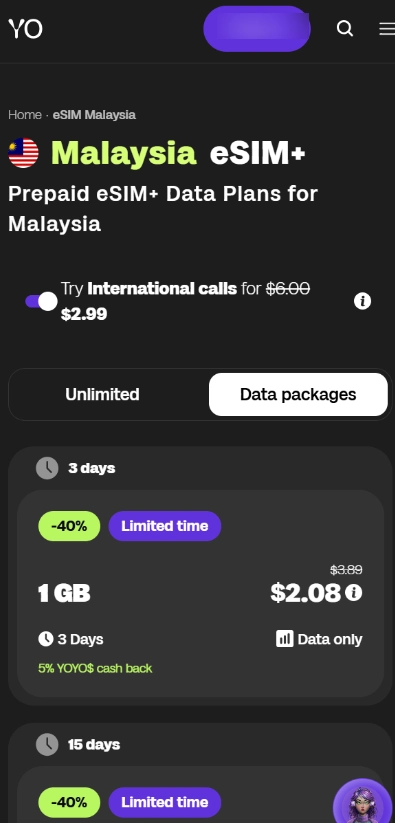
Global YO
If you are working from Malaysia rather than visiting it, Global YO is the cheapest way to feed a laptop.
1GB for three days at $3.89. 3GB for fifteen days at $5.99. 5GB for fifteen days at $6.29. 10GB for thirty days at $8.39. 20GB for thirty days at $12.59. 50GB for forty five days at $23.19. 100GB for sixty days at $34.39.
That 100GB tier is $0.34 per gigabyte, the lowest rate on this page, and the 50GB tier at $0.46 is not far behind. A sixty day window on 100 gigabytes covers a two month stint in Penang or KL with a hotspot running most days.
Its unlimited tier gives 3GB a day then drops to 512 kbps, priced at $12.74 for a week and $29.99 for thirty days. Half a megabit is better than 128 kbps and well short of Maya's 3 Mbps, so treat that tier as a 3GB per day plan.
The entry plans are the weak point. $3.89 for 1GB over three days is four times what Billion Connect charges.
What we like
What we don't
6
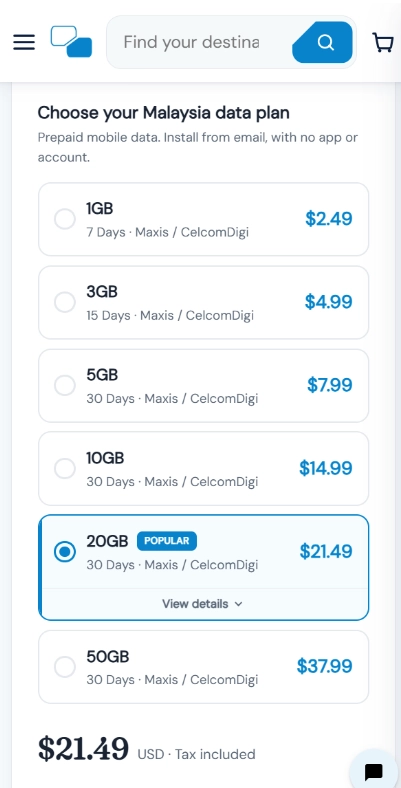
Travel Sim Asia
Runs on Maxis and CelcomDigi.
This is the Borneo plan, and it is the one we would put in a phone before flying to Kota Kinabalu.
It names Maxis and CelcomDigi, which is the pairing you want east of the peninsula: Maxis for the interior and CelcomDigi for the coverage award. Almost nothing else on this page will tell you which network you land on.
Pricing sits above the value tier and below the premium brands. 1GB for seven days at $2.49. 3GB for fifteen days at $4.99. 5GB for thirty days at $7.99. 10GB for thirty days at $13.99. 20GB for thirty days at $19.99. 50GB for thirty days at $34.99.
Two policies are stated plainly and both matter. Hotspot is allowed outright, described as 100% allowed rather than hedged. And the activation window runs 180 days from purchase, so a trip that moves by four months costs you nothing.
Its regional Thailand, Singapore and Malaysia plan uses CelcomDigi and Maxis here, Singtel in Singapore and DTAC and TrueMove H in Thailand, at 5GB for $10.99, 10GB for $22.99 and 20GB for $33.99 over thirty days.
What we like
What we don't
7
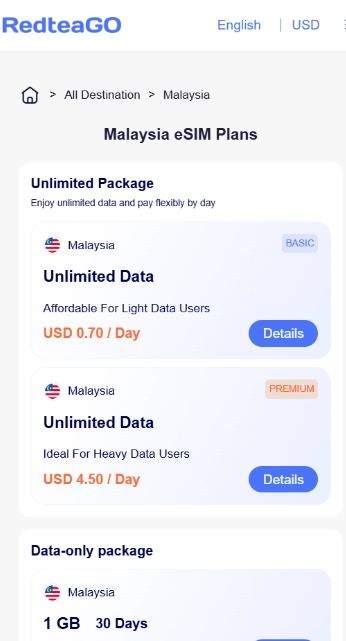
RedteaGO
Malaysia is a hub. People pass through KL three times in a year on the way to Bali, Bangkok or Sydney, and RedteaGO prices for that.
300MB for one day at $0.70. 1GB for thirty days at $2.00. 10GB for one day at $4.50. 3GB for thirty days at $5.00. 5GB for thirty days at $7.90. 10GB for thirty days at $12.00. 20GB for ninety days at $16.99. 50GB for one hundred and eighty days at $35.99.
That 20GB ninety day plan at $16.99 is the one to notice. It costs seven dollars more than MobiMatter's thirty day 20GB and gives you three months, which covers a whole season of KL layovers on one purchase. The 50GB six month tier at $0.72 per gigabyte does the same trick at a larger scale.
The 10GB single day plan at $4.50 is an odd shape that makes sense for one heavy working day, and the 300MB day plan at $0.70 is a sensible emergency profile to keep dormant.
What you give up is app polish and support depth against the premium brands.
What we like
What we don't
8
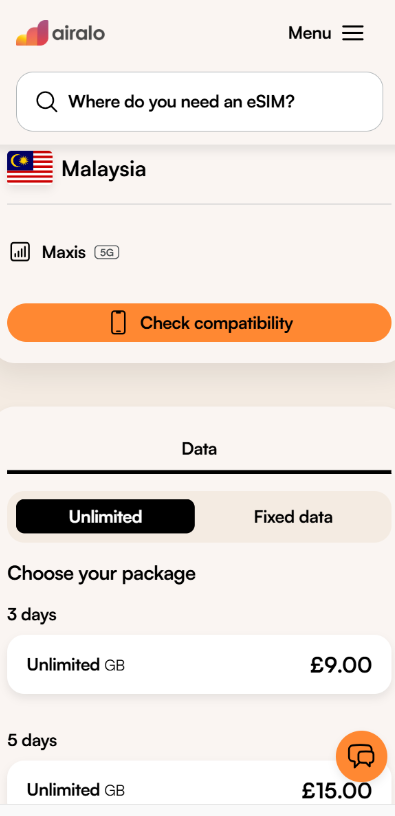
Airalo
Runs on Maxis.
Airalo's Malaysia product is called Sambungkan and it rides Maxis, the network that reaches furthest into Sabah and Sarawak.
Local pricing runs 1GB for three days at $4.00, 3GB for three days at $7.50, 5GB for seven days at $11.00, and 50GB for thirty days at $49.00. That top tier at $0.98 per gigabyte is the only large plan from a premium brand here, and it is the one to buy if you want Maxis under you for a month in Borneo.
The unlimited line gives 3GB a day then 1 Mbps, from $11.50 for three days to $71.00 for thirty.
Where Airalo really wins in this region is Asialink, which covers eighteen countries: 20GB over thirty days for $39.00, 50GB over thirty days for $59.00 and 100GB over 180 days for $89.00, which is $0.89 per gigabyte across the whole of Asia.
If your route runs Malaysia into Bali, Japan or Korea, one profile beats four country plans, and our multi country optimiser will price it for you.
What we like
What we don't
Current stacking sits on our Airalo promo code page, and the full Airalo review covers the app.
9
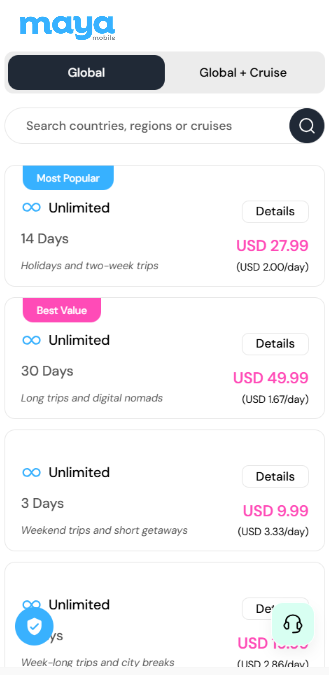
Maya Mobile
Maya sells no fixed data plan for Malaysia. It sells unlimited by duration and it wins the one comparison that decides whether an unlimited plan is real.
After the 5GB daily cap, Maya runs at 3 Mbps. Airalo and eSIM4Travel drop to 1 Mbps. Global YO and CocoRoam drop to 512 kbps.
Billion Connect drops to 128 kbps. aloSIM's Malaysia unlimited tier is listed at 1 kbps, which is not a throttle at all. Three megabits streams, holds a video call and uploads a photo.
Pricing is $9.99 for three days, $19.99 for a week, $27.99 for fourteen days and $49.99 for thirty, covering 165 or more countries on one profile with hotspot included.
The problem in Malaysia specifically is that the local competition is brutal. U Mobile sells 100GB for seven days at RM15, and MobiMatter sells 20GB for a month at $9.99.
Maya makes sense when Malaysia is one leg of a longer Asian route, not when it is the destination.
One setting to get right. Maya plans auto renew while Travel Mode is on. Switch it off when you get home.
What we like
What we don't
The current rate sits on our Maya Mobile coupon page.
Where the signal actually dies in Malaysia
The peninsula is easy. Borneo is where a guide earns its keep.
Kuala Lumpur, Penang, Melaka, Johor Bahru, Ipoh and Langkawi. Strong 4G with 5G across the cities. No plan here will struggle. The North South Expressway and the ETS train line are both well covered.
The Cameron Highlands. Fine in Tanah Rata and Brinchang, patchy on the tea estate roads and the jungle trails. The standing local advice is to run offline trail data rather than trust a live map.
Taman Negara. Effectively offline, including the access road. Kuala Tahan has some signal and the park does not.
The east coast islands. Perhentian, Redang and Tioman all have coverage at the main beaches and lose it in the secluded bays.
More importantly, the northeast monsoon closes them. The Perhentians are essentially shut from November to February, with resorts and ferries stopping and only a daily boat to the Kecil fishing village.
Most Redang resorts close and ferries run on restricted schedules from October to March. If you are travelling in that window, the trip pivots west to Langkawi and Penang or east to Borneo.
Sabah: Kota Kinabalu and the coast. Good coverage. Mount Kinabalu has signal at the park gate and on parts of the trail, thinning toward the summit.
Sandakan, Sepilok and the Kinabatangan. Coverage in the towns and along the main road, then it fades on the river. Lodges run their own wifi of varying quality.

Danum Valley. No mobile coverage. The research lodges run satellite links.
Semporna, Sipadan and Mabul. Signal at Semporna town, patchy on the island resorts, and dive boats are offline.
Sarawak: Kuching, Bako, Mulu and Bario. Kuching is well covered. Mulu is the one to plan around, and Maxis is the network named for the area near park headquarters. Bario in the Kelabit Highlands runs on satellite internet only.

The Johor Bahru causeway. A Malaysia only plan stops at Singaporean immigration.
If you are crossing daily, buy a Singapore and Malaysia plan: Billion Connect sells a three country daily option at $1.08 and Travel Sim Asia sells a three country monthly plan.
The RTS Link rail crossing is targeting an opening on 1 January 2027 and was reported around 90% complete in April 2026, which will make the daily crossing far more common.
Our coverage checker shows which networks each profile can reach before you pay, and for a Borneo leg that is thirty seconds well spent.
How much data do you need in Malaysia?
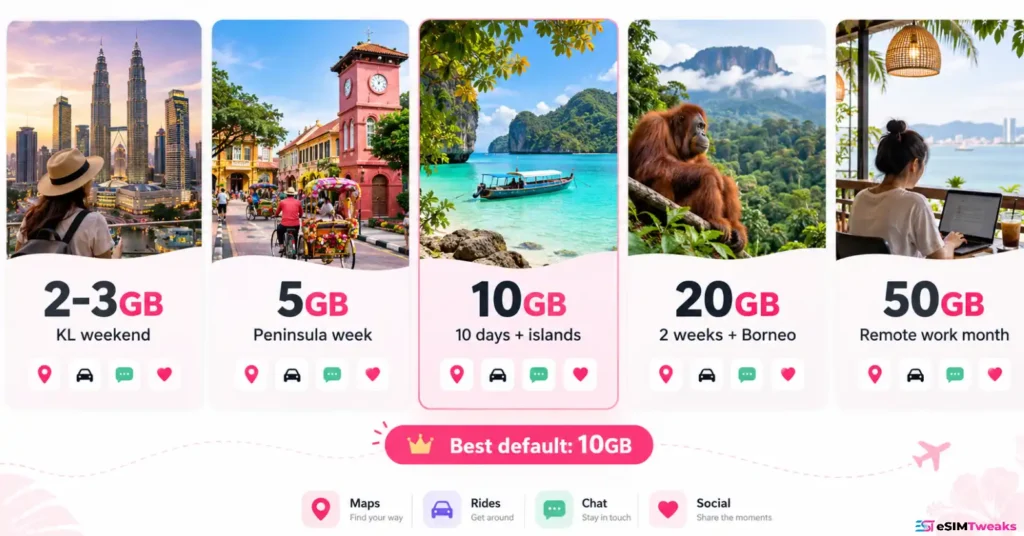
An average tourist day in Malaysia runs 300MB to 1GB across Grab rides, WhatsApp, navigation and casual social.
Grab itself costs 5 to 10 MB a ride, Google Maps runs 10 to 20 MB an hour of active navigation, and Instagram takes 250 to 500 MB per half hour, which is where most allowances actually go.
Hotel, mall and cafe wifi absorb the streaming. Our data planner does the sums exactly.
Setting up before you land
Do this at home on wifi, not in the KLIA arrivals hall.
Five mistakes that cost people money here
It shut down in August 2024. That page is stale and so is everything else on it.
Sarawak's 5G coverage sits at 62% against 82.4% nationally, and Maxis is the name that turns up in the interior.
MobiMatter charges $7.99 and eSIM4Travel charges $7.54 with the network named.
It stops at Singaporean immigration, and an eSIM for Singapore and Malaysia costs almost nothing more: Billion Connect's three country daily plan is $1.08.
The northeast monsoon closes them from November to February, and no data plan helps with a ferry that is not running.
FAQ's
Does Grab work in Malaysia on a foreign phone number?
Yes, and you should set it up before you fly. Grab verifies by SMS at signup and a home country number receives that code fine. After registration, all driver communication runs through the in app chat over data rather than SMS, so a data only eSIM handles the rest of the trip. U Mobile's own Visit Malaysia 2026 travel pass actually requires a Grab account registered to a non Malaysian number, which is direct confirmation that foreign number accounts are the expected case.
Can I use Touch n Go eWallet as a tourist?
Yes, since April 2025. It used to be locked to Malaysian numbers and it is the wallet that pays for tolls, parking, LRT and MRT fares and a large share of small merchants through DuitNow QR, so the change matters. You need an active home country mobile number, a passport valid for at least six months, and WhatsApp installed, because verification codes arrive there. Registration can be completed before you land. Top ups work with home country cards. The physical Enhanced TNG card for transit and tolls is sold separately from RM10.
Which network should I choose for Sabah and Sarawak?
Maxis, and the gap is measurable rather than anecdotal. National 5G reaches 82.4% of the population, Sabah 68.6% and Sarawak 62%, and around 475 of 600 towers built in Sarawak are still waiting for equipment. Maxis is the network travellers name for the interior and the one specified for the area around Mulu park headquarters. On this page, Airalo and Travel Sim Asia are the plans that ride it. U Mobile even sells a separate Borneo plan, which tells you how different the two halves of the country are.
Will one eSIM cover Kuala Lumpur and Singapore?
Only if the plan says so. A Malaysia only profile stops at Singaporean immigration on the causeway, which catches people on Johor Bahru day trips constantly. Billion Connect sells a Singapore, Malaysia and Indonesia daily plan at $1.08 a gigabyte a day, Travel Sim Asia sells a Thailand, Singapore and Malaysia monthly plan from $10.99, and Airalo's Asialink covers eighteen countries. With the RTS Link rail crossing targeting January 2027, the daily crossing is about to become far more common.
Is Malaysian 5G getting slower?
The measured speed is, and the reason is a good one. Median 5G download fell 46%, from 451.79 Mbps to 242.92 Mbps, as the shared DNB network filled with real users after U Mobile exited wholesale on 30 June 2026 and DNB activated an extra 100 MHz to serve CelcomDigi, Maxis and Yes. A near empty network is always fast. What you have now is roughly 240 Mbps on a network carrying about 30 million subscribers and more than 80% of national 5G traffic, which is a better product than the headline number suggests.
Our verdict
Malaysia is cheap to get online in and the only real decision is whether your trip crosses to Borneo.
Buy MobiMatter for the peninsula. 20GB at $9.99 or 50GB at $17.99 with promo code ESIMDUDE (discount subject to checkout eligibility) is the cheapest Malaysia eSIM card on this page and covers KL, Penang, Melaka, Langkawi and Johor with data to spare.
Buy Travel Sim Asia or Airalo if Sabah or Sarawak is on your itinerary. This is the one Malaysia eSIM tourist decision that actually changes your trip.
Travel Sim Asia's 20GB at $19.99 with ESIMADVICE01 for 10% off names Maxis and CelcomDigi and allows hotspot outright, and Airalo's 50GB at $49.00 with ESIMADVICE15 for 15% off puts you on Maxis for a month.
And if you are only in Kuala Lumpur for a few days and price is everything, U Mobile's RM15 tourist SIM with 100GB over a week beats every travel eSIM in existence. It just costs you a passport and a queue.
Those are our best Malaysia eSIM picks. Still deciding? Our eSIM finder picks one for you in under a minute, our provider comparison puts the ladders side by side, and if Malaysia sits alongside Bali, Japan or Australia on your route, the multi country optimiser works out whether one regional bundle beats four country plans.
Why trust eSIMTweaks.
59 providers tested.
388 speed tests run.
20 countries covered.
More like this



About the author

Head of Network Testing
I lead field testing at eSIMTweaks, conducting speed, latency and reliability trials on live networks across Latin America and Southern Europe. In the past year I evaluated more than 60 eSIM profiles under real travel conditions. Every performance figure we publish originates from testing I run or supervise.