eSIM for New Zealand: 9 Best & Cheapest Plans (2026)
A $12 eSIM or a $49 one—which would you trust on a lonely South Island highway? We uncover where cheaper plans shine, where coverage fails, and what’s actually worth your money.
October 16, 2026
New Zealand is the country where the answer to “which network?” matters more than anywhere else we cover, and also less than you think.
Spark, One NZ and 2degrees each claim to reach 99% of New Zealanders. All three are measuring where people live, and the country has 268,000 square kilometres against five million people, most of them in four cities.
The Milford Track has no mobile coverage across the entire four day walk. The Haast tower covers roughly three kilometres of State Highway 6, and then you are on your own.
We compared nine plans to find the best eSIM for New Zealand, weighing data prices, Spark, One NZ and 2degrees coverage, and how well each holds up on remote South Island roads.
Top 3 eSIMs for New Zealand
Bottom line:

Airalo
- Runs on Spark network
- Best pick for South Island road trips
- Only $0.98 per GB

Global YO
- Runs on One NZ network
- Great for Auckland and Queenstown
- Just $0.62 per GB

RedteaGO
- Covers Australia and New Zealand
- One eSIM for both countries
- 90-day validity and hotspot support
All three cover Auckland, Wellington, Christchurch and Queenstown without complaint. The differences show up on State Highway 6, and that is where this guide spends most of its time.
Price comparison: all 9 New Zealand eSIMs
| Provider | Cheapest plan | 10GB | 20GB | Unlimited | Best cost per GB | Runs on | Code |
|---|---|---|---|---|---|---|---|
| Airalo | $4.00 / 1GB / 3d | n/a | n/a | $27.00 / 7d | $0.98 (50GB $49.00) | Spark | ESIMADVICE15 |
| Global YO | $3.64 / 1GB / 3d | $8.14 | $12.34 | none | $0.34 (100GB) | One NZ | ESIMDUDE10 |
| RedteaGO | $2.00 / 1GB / 30d | $16.00 / 60d | $30.00 / 90d | none | $0.89 (100GB) | AU and NZ carriers | RTGF95CDO |
| Esimx | $3.00 / 2GB / 1d | $10.80 | $26.80 (30GB) | daily refresh tiers | $0.86 (100GB) | Local networks | ESIMX10 |
| Saily | $3.99 / 1GB / 7d | $23.99 | $37.99 | $48.99 / 5 to 30d | $1.90 | Local networks | ESIMDUDE |
| aloSIM | $4.50 / 1GB / 7d | n/a | $38.00 | 3GB per day tiers | $1.90 | Local networks | ESIMTWEAKS |
| Sim Local | $4.75 / 1GB / 3d | $26.25 | $48.50 | up to 10GB per day | $1.75 (Orange 20GB) | Oceania networks | ESIMDUDE10 |
| Maya Mobile | $9.99 / 3d | unlimited only | unlimited only | $27.99 / 14d | $0.40 at 5GB a day | Local networks | ESIMTWEAKS10 |
| MobiMatter | $3.49 / 2GB / 15d | n/a | n/a | none | around $0.90 | Local networks | ESIMDUDE |
Global YO charges $8.14 for the 10GB that Saily sells for $23.99 and Sim Local for $26.25. A threefold gap.
What the premium on a New Zealand eSIM card buys is a better app, a support desk and, in Airalo’s case, a network you can name.
New Zealand has three networks and one shared rural backbone
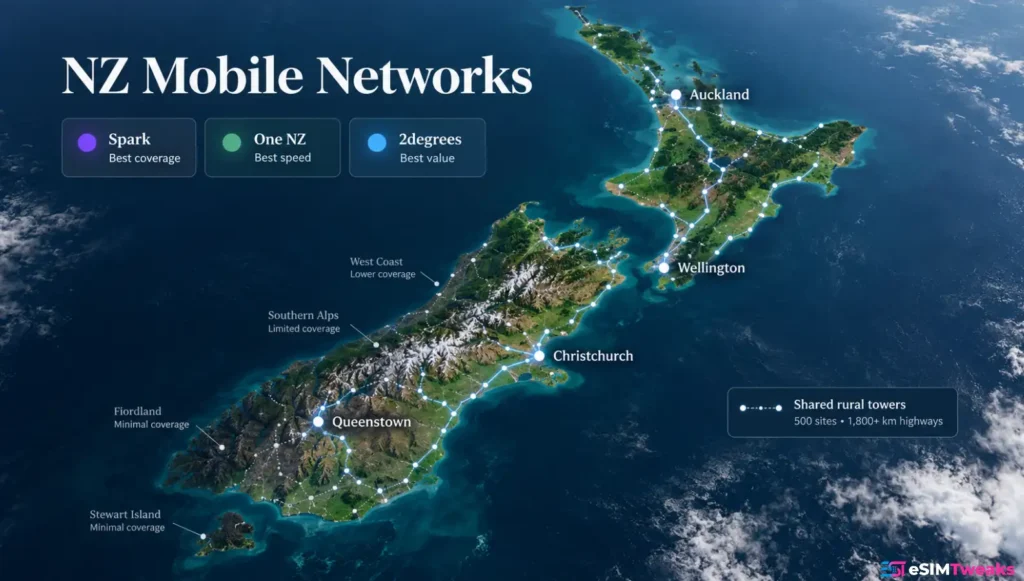
This is the structural fact that changes how you should shop, and almost nobody explains it.
Spark, One NZ and 2degrees jointly own the Rural Connectivity Group. The RCG has built 500 cell sites across rural New Zealand, and every one of them uses a shared radio network.
All three operators run off the same equipment and the same antennae on each tower. New Zealand is the first country in the world where all three mobile operators share their radio access network like this.
Those 500 towers cover more than 1,800 kilometres of state highway and sit at more than 180 tourist locations.
What that means for you: on an RCG tower, your network choice makes no difference whatsoever. Spark, One NZ and 2degrees all come off the same hardware, so if one has signal there, they all do.
The differences only appear on each operator’s own non shared sites. And that is exactly where Spark pulls ahead.
Spark wins Coverage Experience at 9.0 out of 10 in Opensignal’s New Zealand testing, against One NZ at 8.2 and 2degrees at 7.7, and it also wins Reliability at 853 points.
Independent road trip guides land on the same recommendation for the South Island.
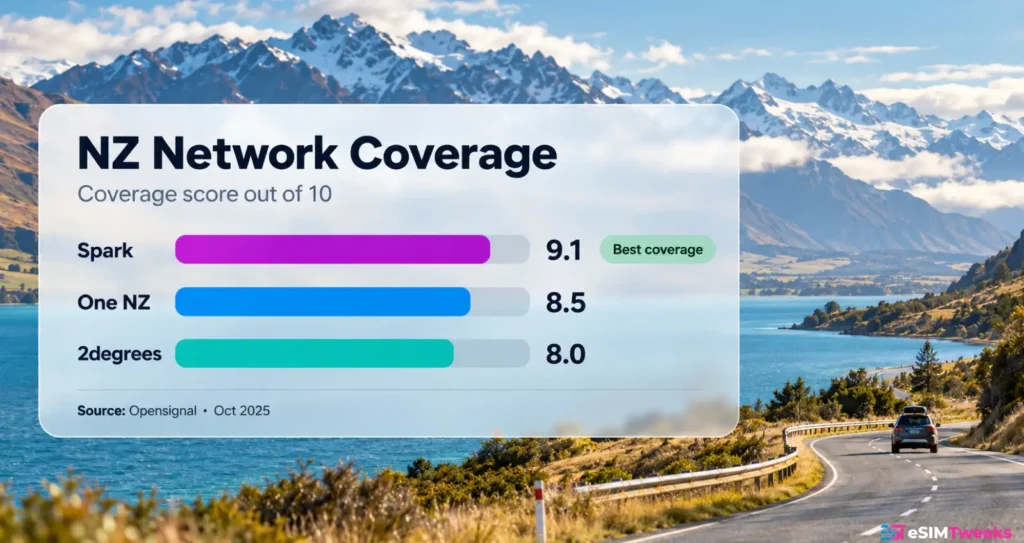
One NZ wins raw speed, taking Download Speed Experience with roughly a 60% year on year improvement against about 30% for the other two, and gaining nearly 100 Mbps on 5G where the others gained 32 Mbps each. It also leads 5G Coverage Experience at 3.8.
2degrees won the most categories overall, ten of fourteen counting joint wins, and it is the cheapest. It is also the most metro focused, with coverage dropping off in smaller towns.
Ookla puts New Zealand’s median mobile download at 131.48 Mbps, a strong number that reflects where the testing happens: in the cities.
One more thing that will catch older phones. New Zealand has switched 3G off, One NZ’s 2G and 3G networks going dark at the end of December 2025. Your handset needs 4G or 5G.
More specifically, a phone without Band 28, the 700 MHz band, loses a large share of rural coverage, because 700 MHz is what travels across valleys. That is a real risk on older handsets and on models bought for another region.
Travel eSIM, local SIM or your own carrier?
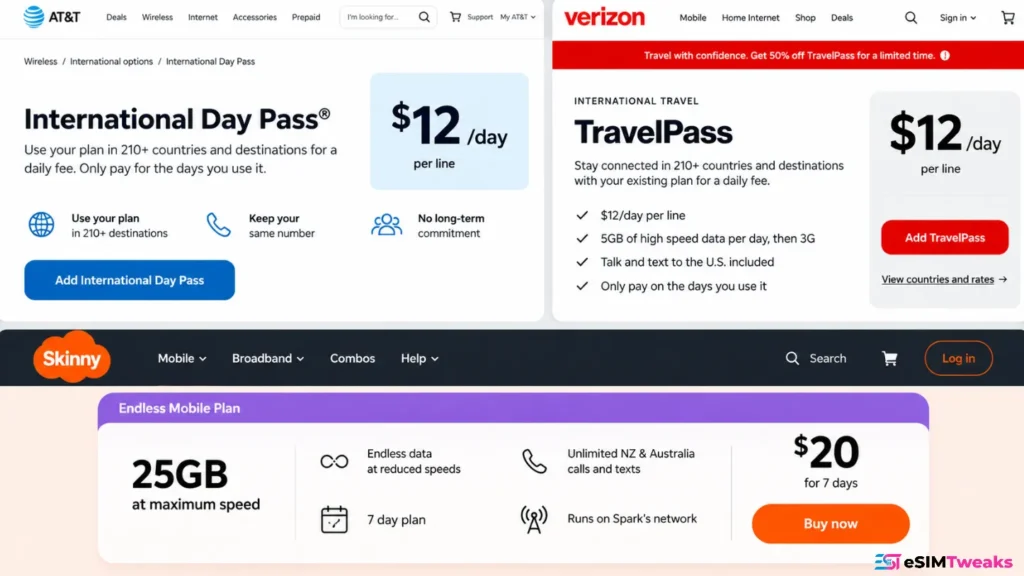
AT&T’s International Day Pass is $10 per line per calendar day. Verizon’s TravelPass is $12 with 5GB of high speed data per session then 3G.
A fourteen day South Island trip is $140 on AT&T or $168 on Verizon.
Its Better Value plan includes 30GB of high speed roaming data here, Experience Beyond and Go5G Next include 15GB, and Experience More and Go5G Plus include 5GB.
If you are on one of the higher tiers, you may not need to buy anything at all.
Check before you spend. Our roaming versus eSIM calculator does the comparison.
Vodafone, Optus and Telstra all charge AUD $5 a day for a pass, roughly $3.30, which is competitive for a short hop across the Tasman.
An eSIM for Australia and New Zealand on one profile usually beats it over a week.
There is no mandatory prepaid registration law here, though retailers may still ask for ID, so carry your passport.
Spark sells a $5 prepaid SIM and free eSIMs, with 90 day travel packs at NZ$29 for 2GB, NZ$49 for 10GB and NZ$79 for 50GB.
The duty free store at Auckland Airport, before immigration, sells the same packs at NZ$25, NZ$42 and NZ$68.
It runs on Spark’s network, and its weekly plan gives 25GB for NZ$20, roughly $12.
Two of those cover a fortnight for about $24 with Spark coverage and a local number. If you are doing a long South Island road trip and you want the best rural network with a phone number attached, that is the answer.
A travel eSIM installs before you fly and works from the moment you land, with no store visit and no airport queue.
Airport SIM shops in Auckland generally close between 11pm and midnight, so a late arrival has no local option at all.
We use travel eSIMs in New Zealand and buy Airalo when the trip goes south of Wanaka.
Hot tip: a data-only travel eSIM carries no voice service, which means it cannot dial 111. If you are tramping, driving remote highways or heading into the backcountry, keep your home SIM active alongside it for emergency calls, and understand that One NZ’s Satellite TXT service, which sends messages via Starlink from outside cell coverage, is tied to a One NZ retail plan and an eligible handset. No travel eSIM gives you access to it.
The 9 best eSIM for New Zealand
Ranked on price per gigabyte, the network each one rides, and what happens when the road runs out. Every plan is data only unless we say otherwise.
1
Airalo
Runs on Spark.
In most countries we would rank Airalo somewhere in the middle on price. In New Zealand it goes first, for one reason: it is the only plan on this page that names Spark as its host network, and Spark wins Opensignal’s Coverage Experience at 9.0 out of 10.
Everything else here either rides One NZ or declines to say. On State Highway 6, on the Milford Road and on the long empty stretches of the West Coast, that is the difference between a working phone and a paperweight. Spark is reported to cover sections of SH94 to Milford that its rivals do not.
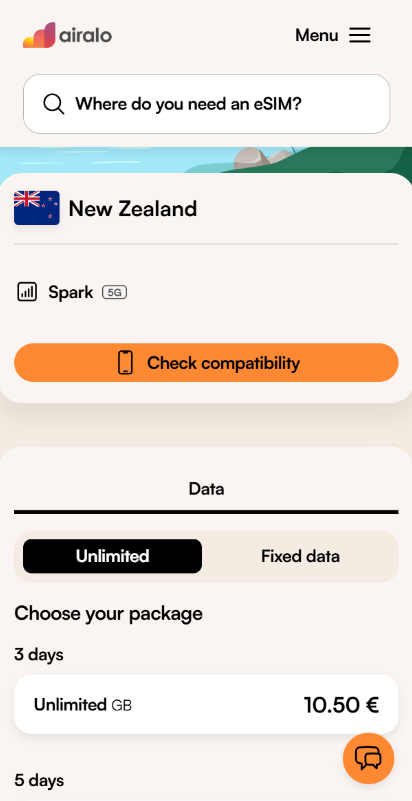
Pricing is fair rather than cheap. The ladder starts at 1GB for three days at $4.00 and runs to 50GB for 30 days at $49.00, which is $0.98 per gigabyte.
Unlimited is priced by duration: $11.50 for three days, $18.50 for five, $27.00 for seven, $34.50 for ten, $48.00 for fifteen and $71.00 for thirty, with 3GB a day at full speed then 1 Mbps.
Here is the trick worth knowing. Airalo’s Oceania regional plan costs between nothing and $2.50 more than the New Zealand only plan at every tier, and the three day and seven day prices are identical.
If Australia is anywhere on your trip, buy the regional plan. The extra coverage is effectively free, which is backwards from how regional pricing usually works. Check it against our Australia guide.
What we like:
What we don’t:
Current stacking sits on our Airalo promo code page, and the full Airalo review covers the app.
2
2. Global YO
Runs on One NZ.
Global YO is the second plan here that names its host network, and it names the opposite one to Airalo.
One NZ is the speed and 5G leader. It won Download Speed Experience, gained nearly 100 Mbps on 5G and leads 5G Coverage Experience.
In Auckland, Wellington, Christchurch and Queenstown it is superb. Away from the highways it trails Spark.
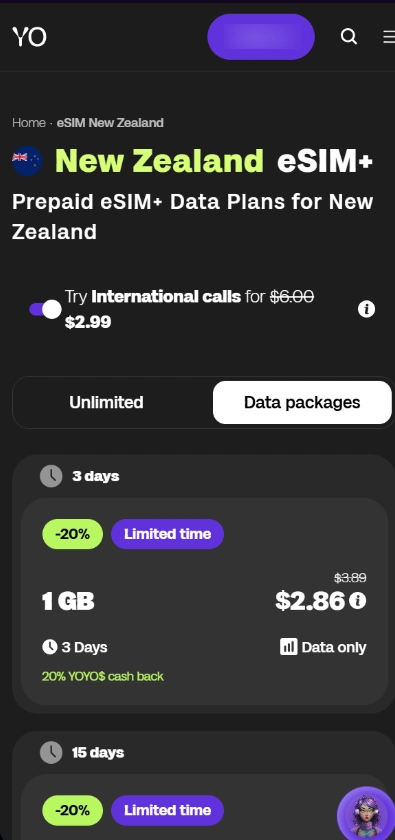
The pricing is remarkable. Discounted rates run 1GB for three days at $3.64, 3GB for 15 days at $5.74, 5GB for 15 days at $6.04, 10GB for 30 days at $8.14, 20GB for 30 days at $12.34, 50GB for 45 days at $22.94 and 100GB for 60 days at $34.14.
That last figure is $0.34 per gigabyte, the cheapest in this guide by a wide margin.
Compare the 20GB row. Global YO charges $12.34. Saily charges $37.99. aloSIM charges $38.00. Sim Local charges $48.50. For the same 20 gigabytes.
Hotspot is included, plans run 4G LTE, and the profile can activate immediately on purchase or later through the app, which is a setting to get right at checkout.
Two caveats. Those are promotional prices, so check the discount is live before you commit. And you are buying One NZ, which makes this the plan for a North Island trip, a city break or a Queenstown week, not for driving to Haast.
What we like:
What we don't:
3
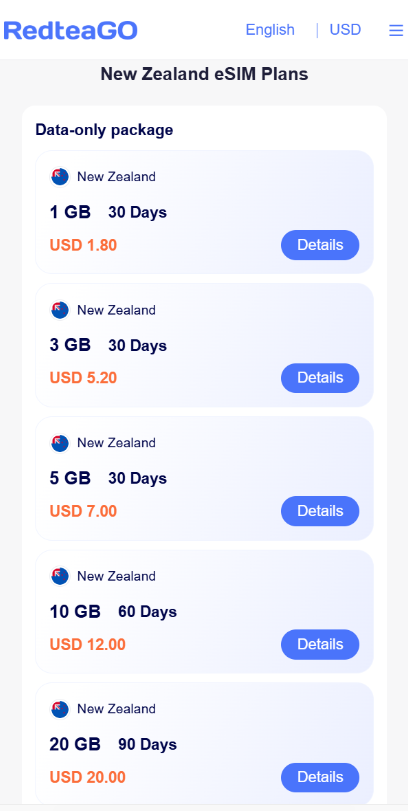
RedteaGO
Most people who fly this far do both countries, and RedteaGO prices a single trans Tasman profile better than anyone else.
1GB for 30 days at $2.00. 3GB for 30 days at $5.40. 5GB for 30 days at $8.60. 10GB for 60 days at $16.00. 20GB for 90 days at $30.00. 50GB for 180 days at $50.80.
100GB for 180 days at $88.80. Every one of those covers both Australia and New Zealand on the same profile.
The 20GB tier at $30.00 across two countries over 90 days is the best value trans Tasman option in this guide.
Buying separate country plans at that size costs more from almost every brand on this page.
Hotspot sharing is explicitly supported, support runs around the clock, and the profile uses multiple local carriers rather than one named operator.
Install it on the day you depart rather than weeks ahead.
The 90 and 180 day windows also make this the pick for a slow loop: three weeks in New Zealand, a month in Australia, and a stop on the way home.
What we like:
What we don't:
4
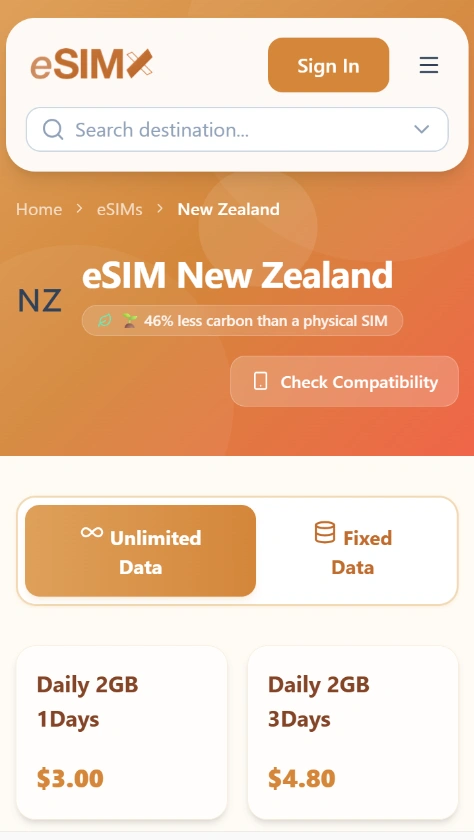
Esimx
Esimx sells sixteen New Zealand specific plans and it is the value pick once you get past ten gigabytes.
10GB for 30 days costs $10.80. 30GB for 30 days costs $26.80. 100GB for 30 days costs $85.80.
Those work out at $1.08, $0.89 and $0.86 per gigabyte respectively, which puts it second only to Global YO among the fixed plans here.
At the small end it sells daily refresh plans where the allowance resets each day rather than draining from a pool.
2GB a day for one day costs $3.00. A clean shape for a heavy working day or an Auckland stopover between long haul flights.
Some premium tiers include calling, which is unusual in this market and worth a look if you need to be reachable on a real number here.
The catch is the usual one at this end of the market: a smaller support operation and a smaller app than the top four.
What we like:
What we don't:
5
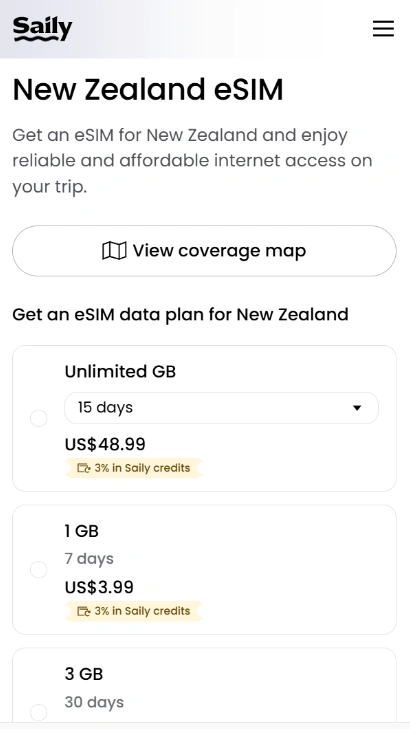
Saily
Saily comes from the NordVPN team and it is the most polished product in this group, which is worth something on a trip where you will be installing a profile in an airport at 11pm.
Pricing sits at the top of the market. 1GB for seven days at $3.99, 3GB for $9.99, 5GB for $13.99, 10GB for $23.99 and 20GB for $37.99, everything above 1GB on 30 days.
Unlimited is $48.99 with a choice of durations from five to thirty days.
What justifies it is the buying experience. The activation window runs 180 days from purchase, and the profile activates automatically when you arrive in New Zealand rather than when you pay.
Hotspot sharing is advertised as limitless. Refunds are supported on unused plans.
For a trip planned six months out, or a flight that might move, that 180 day window removes the single most common eSIM mistake: buying too early and watching the validity drain before you land.
The pricing is the problem. At $23.99 for 10GB you pay three times Global YO and more than double Esimx, and Saily describes its coverage as New Zealand's best networks rather than naming one.
What we like:
What we don't:
The current stack sits on our Saily coupon code page.
6
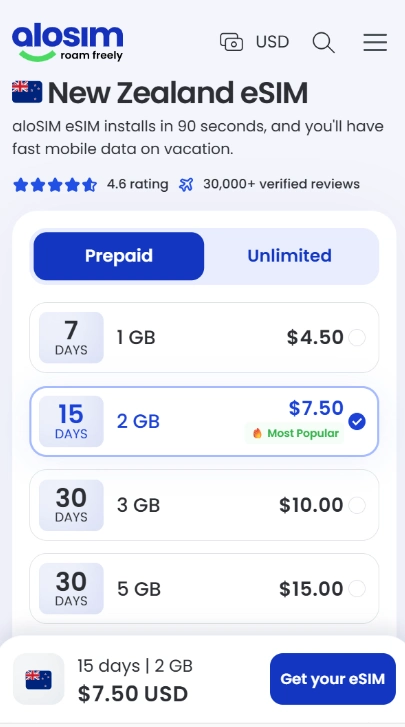
aloSIM
aloSIM comes from AffinityClick in Ottawa and it sells eighteen New Zealand plans across a clean ladder.
1GB for seven days at $4.50 at the entry point, rising to 20GB for 30 days at $38.00, which is $1.90 per gigabyte. Some tiers carry a 3GB per day cap before the speed drops.
That is a dead heat with Saily on price and just behind on features.
Where it earns its place is breadth: plans in almost every country, a working app on both stores, and a support desk that answers, which makes it a reasonable single account if you travel constantly and do not want twelve logins.
For a New Zealand trip specifically, Esimx sells more data for less and Airalo names a better network.
Buy aloSIM if you already have the app and the balance.
What we like:
What we don't:
7
Sim Local
Sim Local's New Zealand offer is an Oceania plan, and the region it covers is the widest here: Australia, New Zealand, Fiji, Papua New Guinea, Tonga, Vanuatu and more, nine countries in total.
Pricing is 1GB for three days at $4.75, 3GB for seven days at $10.75, 5GB for 30 days at $16.00, 10GB for 30 days at $26.25 and 20GB for 30 days at $48.50.
It advertises up to 10GB a day at full speed without throttling on its unlimited tiers, which is the largest daily allowance on this page.
The reason it ranks here rather than lower is a separate product. Sim Local lists an Orange network four country plan at 20GB over 31 days for $35.00 that includes calls and SMS.
Every other plan in this guide is data only, which in New Zealand means no 111 and no phone call from a DOC hut warden or a campervan depot.
A line with real minutes solves that.
Support runs around the clock on chat and WhatsApp.
What we like:
What we don't:
8
Maya Mobile
Maya has the widest catalogue here, 26 New Zealand plans plus 72 multi country options, and it wins one specific comparison outright.
Its 14 day unlimited plan costs $27.99. Airalo's 15 day unlimited costs $48.00. For a fortnight of not thinking about data at all, Maya is $20 cheaper than the nearest premium equivalent.
The rest of the ladder runs $9.99 for three days, $19.99 for seven and $49.99 for thirty, and the same profile covers Oceania plus 165 or more countries.
Hotspot is included, plans run 4G and 5G, and one plan works across multiple devices, which is a feature nobody else here offers and which matters if you are travelling as a couple with a tablet and a laptop in a campervan.
Two things to know. The marketing claim of no caps and no throttling should be read as a fair use policy rather than a technical guarantee.
And plans auto renew while Travel Mode is switched on, so turn it off when you get home.
What we like:
What we don't:
The current rate sits on our Maya Mobile coupon page.
9
MobiMatter
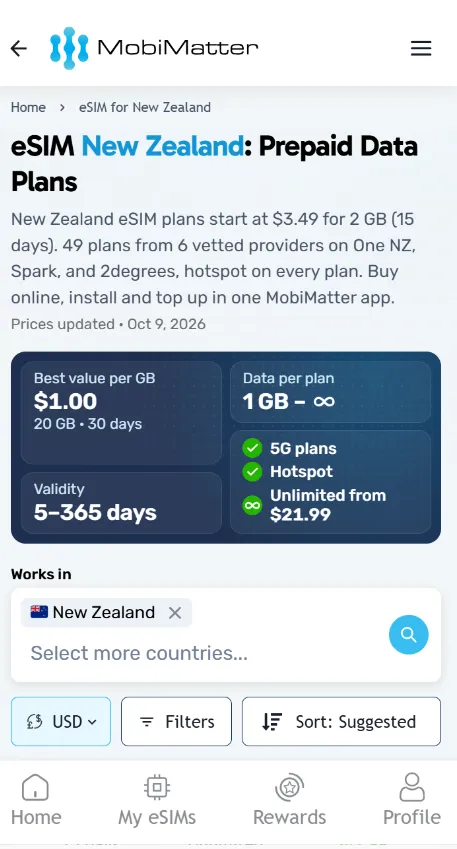
MobiMatter is a marketplace and in New Zealand its catalogue is thinner than elsewhere: five single country plans plus 45 multi country options, none of them unlimited.
Its useful trick is the entry price. An Australia and New Zealand 2GB plan valid 15 days costs $3.49, which is the cheapest way to hold a working trans Tasman profile in your phone.
For a two night Auckland stopover on the way to Sydney, or as a backup line sitting dormant behind your main plan, that is close to free.
Larger plans go up to 100GB with validity as long as 365 days, and its own marketing puts New Zealand data from around $0.90 per gigabyte.
The marketplace caveat applies as always: listings vary by seller, so read the specific tier you are buying rather than assuming a bigger number costs more, and support runs through MobiMatter rather than through whoever provisioned the profile.
What we like:
What we don't:
The platform is covered in our MobiMatter review.
Where the signal actually dies in New Zealand?
This is the section that matters. New Zealand's coverage is delivered as islands, not as continuity, and the government says so itself: the rural network is prioritised to the longest blackspots, the busiest roads and the worst crash sites, and it is signposted for drivers rather than continuous.

Auckland, Wellington and Christchurch. Full 4G and 5G on all three networks, typically 50 to 150 Mbps. No plan on this page will struggle.
Queenstown. Reliable across the town centre, Frankton and Arrowtown at roughly 40 to 70 Mbps. It was one of One NZ's four original 5G launch cities.
State Highway 6 and the West Coast. One of the weakest stretches in the country, with extended dead zones between towns. If your trip runs Nelson to Westport to Greymouth to Franz Josef, plan around long gaps.
Haast and the Haast Pass. Historically one of the longest mobile blackspots in New Zealand.
The tower covers Haast township and about three kilometres of SH6, and further roadside sites are planned between Fox Glacier and Lake Hawea. The Pass itself is not continuously covered.
Milford Sound and the Milford Road, SH94. Virtually no coverage across most of the route.
Spark covers sections that the other two do not, which is the single clearest operator difference in the country and the strongest argument for buying Airalo if this drive is on your itinerary.
The Great Walks. All nine have minimal to zero signal. The Milford Track has no mobile coverage across the entire four day walk.
The Routeburn and the Kepler cross the same Fiordland and Mount Aspiring terrain, so assume the same.
Everywhere else off the highway. National parks, mountain passes and remote coastline are limited or absent whichever network you are on.
On the shared rural towers all three operators come off the same equipment, so switching network changes nothing there.
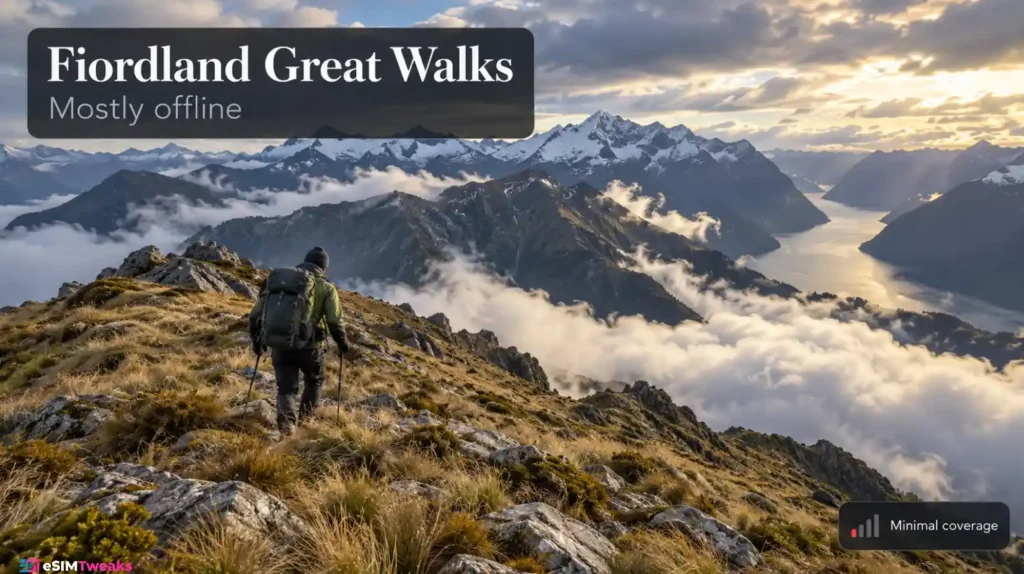
Plan for it rather than around it. Download offline maps of both islands, your DOC hut bookings and your accommodation confirmations before you leave a town.
Cache the whole South Island in Google Maps, it is not a large download, and keep a paper backup for Fiordland.
Our coverage checker shows which networks each profile can reach before you pay.
How much data do you need in New Zealand?
A city break in Auckland or Wellington: 3GB to 5GB. Maps, transport, bookings, messaging. Using an eSIM in New Zealand's cities is easy on data, and Global YO covers 5GB for $6.04.
One week including Queenstown: 10GB. What most visitors should buy. Global YO at $8.14 or Esimx at $10.80.
A two week South Island road trip: 20GB. The standard shape, and the reason is navigation. Google Maps burns 100 to 200 MB an hour and you will drive for hours a day. Global YO at $12.34, or RedteaGO at $30.00 if Australia is on the ticket.
A month, or a campervan tour, or you are working: 50GB or a daily cap plan. Esimx at $26.80 for 30GB, Airalo at $49.00 for 50GB on Spark, or Maya's 14 day unlimited at $27.99.
Great Walks and Fiordland days: nothing. You are offline, and no plan changes that.
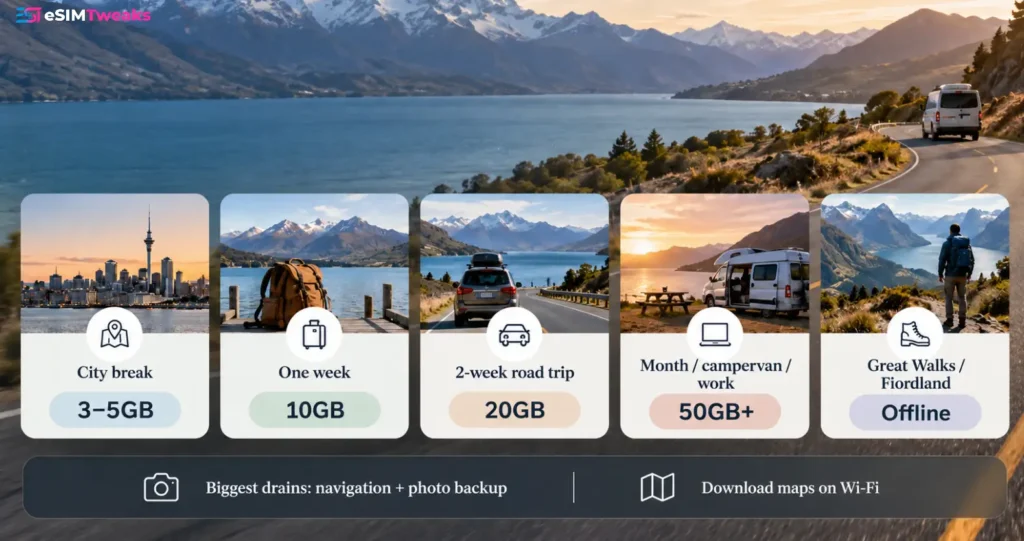
The two biggest drains on a New Zealand trip are turn by turn navigation and photo backup. Cache your maps on hotel wifi and switch cellular photo sync off, and most people halve their usage.
Our data planner does the sums exactly, and the remote work guide covers what a campervan office actually needs.
Setting up before you land
Do this at home on wifi, not in the Auckland arrivals hall at midnight.
Check the phone first. Dial *#06#. An EID under the IMEI means the handset has an eSIM chip, and it must also be carrier unlocked. Check for Band 28 support while you are there, because without 700 MHz you will lose a lot of rural coverage in New Zealand specifically.
Our Android compatibility list covers the models people get wrong.
iPhone: Settings, Mobile Data, Add eSIM, Use QR Code. Android: Settings, Network and Internet, SIMs, Add eSIM.
Landing checklist. Select the travel line. Turn Data Roaming ON. Set it as your default data line. Turn roaming OFF on your home SIM so it cannot bill you on the taxiway.
Keep your home SIM enabled for voice. A data only travel eSIM cannot make a 111 call. On a trip involving remote roads and backcountry, that matters more than the few dollars of standby roaming it might cost.
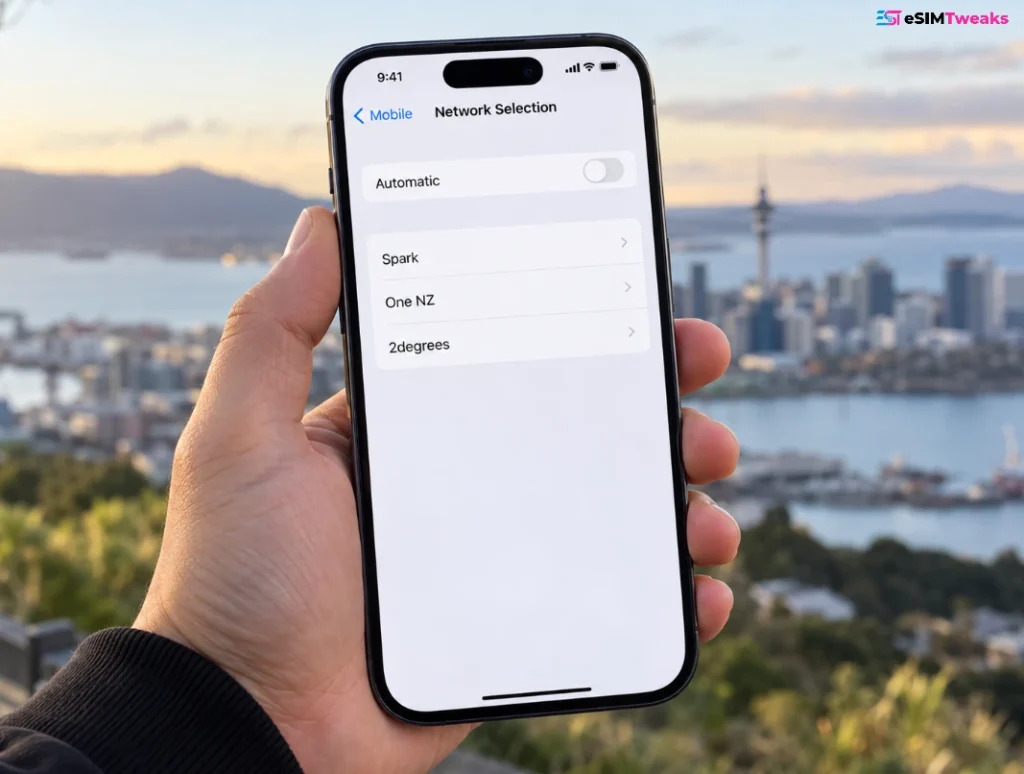
If nothing loads, wait five minutes, then set network selection to Manual and choose Spark, One NZ or 2degrees by name depending on which your plan rides.
On the West Coast, trying all three manually before you assume the plan is broken is worth the sixty seconds.
Five mistakes that cost people money here
FAQ's
Which New Zealand network should I choose for a South Island road trip?
Spark offers the strongest overall rural coverage. Choose Airalo for a travel eSIM or Skinny for 25GB at NZ$20 per week.ek.
Does an eSIM work on the Interislander or Bluebridge ferry between the islands?
Yes, near Wellington Harbour and Marlborough Sounds, but coverage drops in the middle of Cook Strait. Download content before boarding.
Can I get a New Zealand phone number on an eSIM?
Most travel eSIMs are data-only. For a local number, choose a prepaid Spark or Skinny eSIM with calls and texts.
What is One NZ Satellite TXT, and can I use it while tramping?
It lets eligible One NZ customers send satellite messages outside mobile coverage. Travel eSIMs don't support it, and it doesn't replace an emergency beacon.
Why does my eSIM work in Auckland but lose signal on highways?
Rural coverage has gaps, especially between towns. Check whether your phone supports Band 28 (700 MHz), which is important for rural reception.
Is buying data worthwhile for the TranzAlpine or Northern Explorer train?
Yes, for use around stations and towns, but expect frequent signal loss in remote areas, especially Arthur's Pass. Download essentials before boarding.
Our verdict
New Zealand is two buying decisions wearing one coat. If you are staying in the cities, this is a cheap country to get online in. If you are driving south of Wanaka, the network under your plan is the only thing that matters.
Buy Airalo if your trip leaves the main centres. It is the only plan here that names Spark, the network that wins Opensignal's Coverage Experience at 9.0 and covers stretches of the Milford Road that its rivals do not. 50GB at $49.00, or the Oceania regional plan for almost the same money, with ESIMADVICE15 for 15% off as a new customer.
Buy Global YO if you are staying urban and want the cheapest eSIM card New Zealand sells here. 10GB at $8.14 and 20GB at $12.34 with ESIMDUDE10 for 10% off, riding One NZ, costs less for a fortnight than one day of Verizon's roaming pass.
And if Australia is on the same ticket, RedteaGO's 20GB across both countries for $30.00 over 90 days with RTGF95CDO is the cleanest single profile answer.
Those are our best New Zealand eSIM picks. Still deciding? Our eSIM finder picks one for you in under a minute, and if you are crossing the Tasman, the Australia guide and the multi country optimiser work out whether one bundle beats two country plans.
Why trust eSIMTweaks.
59 providers tested.
388 speed tests run.
20 countries covered.
More like this






About the author

Ali has bought the wrong eSIM in enough airports to make it a personal mission that you don't. He handles reviews and price-tracking at eSIMTweaks — catching providers who quietly charge triple for the same gigabyte and pulling coupon codes the second they stop working. He trusts a speed test over a marketing deck and a live price over a five-star badge, every time.