10 Best eSIM for Germany 2026: Berlin, Munich & Beyond
Planning a Germany trip? Before buying an eSIM, see which providers offer real value, stronger networks, and enough coverage for places tourists actually visit.
August 28, 2026
TLDR :

Saily
- Best app experience for travelers
- 5GB daily high-speed allowance
- Unlimited hotspot included

Nomad
- O2 + Vodafone network support
- Only $0.89 per GB
- Great for heavy data users
The catch: every provider that names a German carrier names O2 or Vodafone. Telekom scored 975 out of 1000 in the 2026 connect Netztest against 937 for the other two, and no travel eSIM sells it.
The podium
Saily. Nord Security’s eSIM, and the one I hand to people who want it to just work. 5GB a day at full speed before the throttle, which is more than most, and $20.69 for 20GB after code.
Bloomy eSIM. Prices in yen and undercuts everything: about $6.38 for 10GB over 30 days, on O2 and Vodafone with 5G. Odd checkout, unbeatable maths.
Ubigi. Runs its own mobile network code and 200 plus direct carrier agreements. Names O2 openly, throttles unlimited to 2 Mbps instead of the usual 1, and sells real monthly and annual plans.
Best eSIM for Germany at a glance
| Provider | Best Germany plan | Price | After code | Network named | Code |
|---|---|---|---|---|---|
| Saily | 10GB / 30 days | $16.99 | $15.29 | not published | ESIMDUDE |
| Ubigi | 10GB / 30 days | $12.50 | $12.50 | O2 | none |
| Nomad | 20GB / 30 days | $21.00 | $17.85 | O2 and Vodafone | ESIMDUDE15 |
| Jetpac | 30GB / 30 days | $24.99 | $24.99 | not published | none |
| Bloomy eSIM | 10GB / 30 days | ¥1,020 | ¥1,020 | O2 and Vodafone | none |
| BNESIM | 10GB / 30 days | €11.99 | €11.99 | not published | none |
| MobiMatter | 20GB / 30 days | $17.99 | cashback | varies by seller | ESIMDUDE |
| Wiiline | 15GB / 30 days | $17.00 | $15.30 | O2 and Vodafone | ESIMADVICE |
| Global YO | 100GB / 60 days | $29.74 | $29.74 | O2 and Vodafone | none |
| Yesim | 10GB / 30 days | €16.00 | €16.00 | not published | none |
Which German network is actually best, and why it matters?
Every eSIM Germany plan on sale rides one of three mobile networks: Deutsche Telekom, Vodafone Germany or O2 Telefonica. A fourth, 1&1, is still building and was left out of both national benchmarks this year.
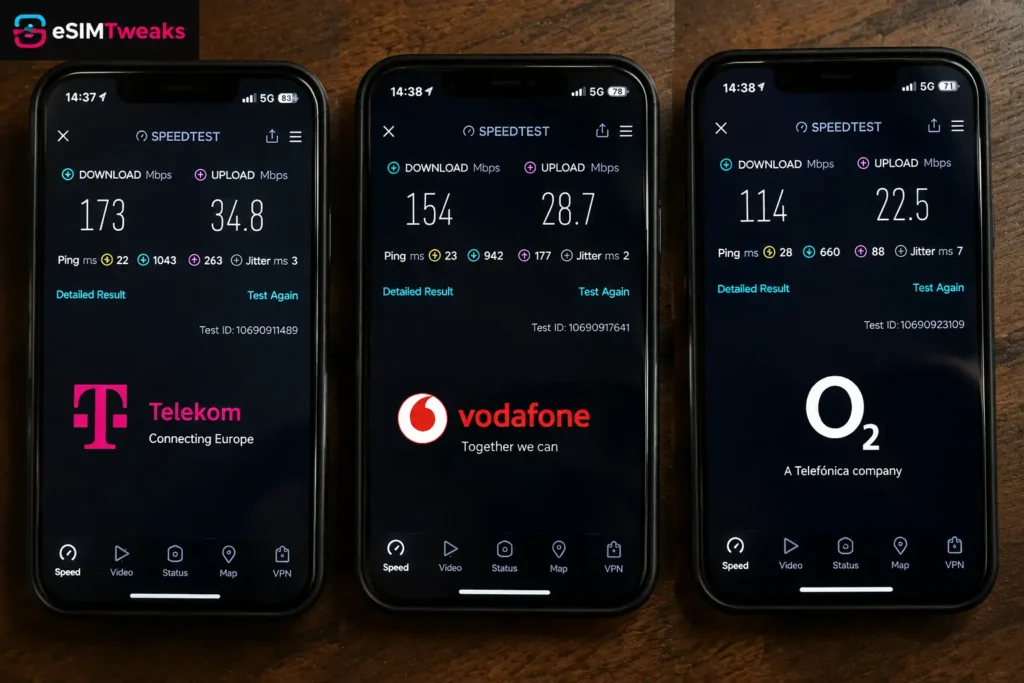
The gap between the three is the single most useful thing to understand before you buy anything.
The connect Netztest is the benchmark that settles arguments in Germany. The 2026 edition, published on 26 November 2025 after roughly 11,000 kilometres of drive and walk testing, put Telekom on 975 points out of 1000, its fifteenth straight win.
Vodafone and O2 tied on 937, the first tie for second place in the test’s history.
| Metric | Telekom | Vodafone | O2 |
|---|---|---|---|
| connect Netztest 2026, total | 975 / 1000 | 937 | 937 |
| connect grade | überragend | sehr gut | sehr gut |
| CHIP Netztest 2025/26 | 1.2 | 1.3 | 1.5 |
| 5G area coverage, Oct 2025 | 87% | 75% | 76% |
| Opensignal download speed | 68.9 Mbps | 56.3 Mbps | 47.4 Mbps |
| Opensignal 5G download | 173.8 Mbps | 154.3 Mbps | 114.5 Mbps |
| Rural 5G download, CHIP | 113.5 Mbps | 100.3 Mbps | 91.3 Mbps |
Look at the last row. In cities all three are fine and O2 actually edges the others on raw availability. Out in the countryside Telekom holds 113 Mbps where O2 drops to 91, and that spread widens the further you get from a motorway.
Now the part that decides your purchase. Of the ten providers below, six publish which German network they use, and every single one of them names O2, Vodafone, or both. Not one names Telekom. Saily, Jetpac, BNESIM and Yesim do not publish a carrier at all.
That is not a scandal. O2 and Vodafone are genuinely good in Berlin, Munich, Frankfurt, Cologne and everywhere else most visitors go.
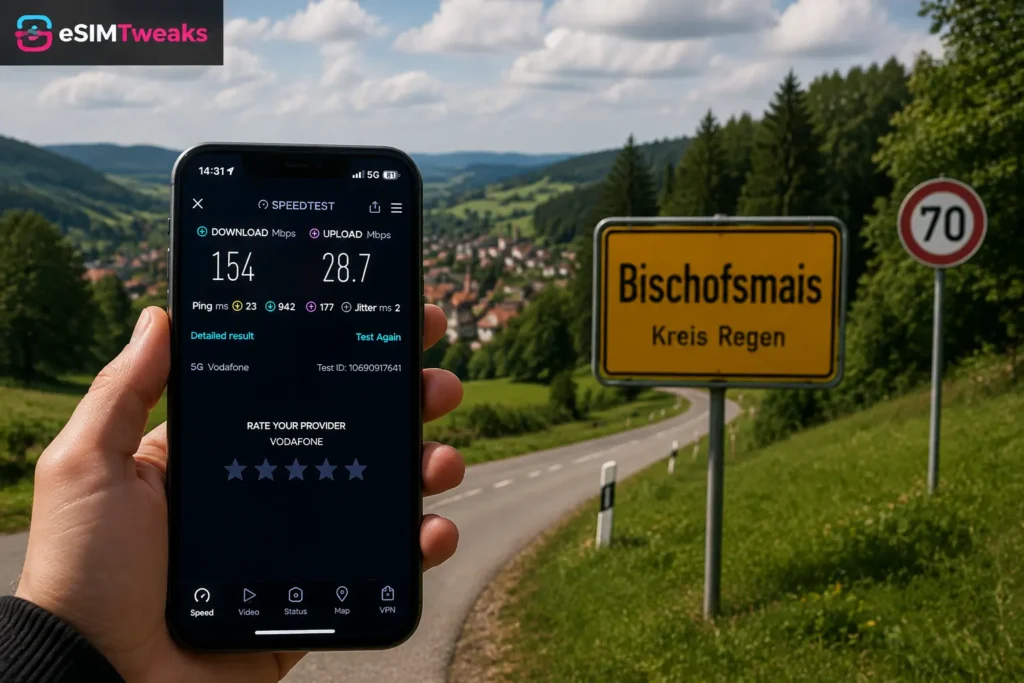
It just means that if your trip involves the Bavarian Forest, the Black Forest, the Harz or the Alpine foothills, no travel eSIM is buying you the best network in the country, and you should plan accordingly.
Germany’s rural signal gap, in numbers
Germany has a word for this, Funkloch, and the federal data puts real figures on it. As of January 2025, 7,518 square kilometres of Germany, about 2.1 percent of the country, had no mobile broadband from any operator at all.
Another 14 percent is covered by exactly one operator, which means if you are on the wrong one you have nothing.
The gaps are not evenly spread. Bavaria alone accounts for 2,293 square kilometres of unserved land, Baden-Württemberg another 1,111.
Add Hesse and Rhineland-Palatinate and those four states hold 63 percent of all the dead ground in Germany. Which is exactly where the pretty drives are.
Germany eSIM speed test results
Three consecutive Ookla runs per location, three or more of four signal bars, median recorded rather than the fastest.
Saily, tested in Berlin and Bavaria
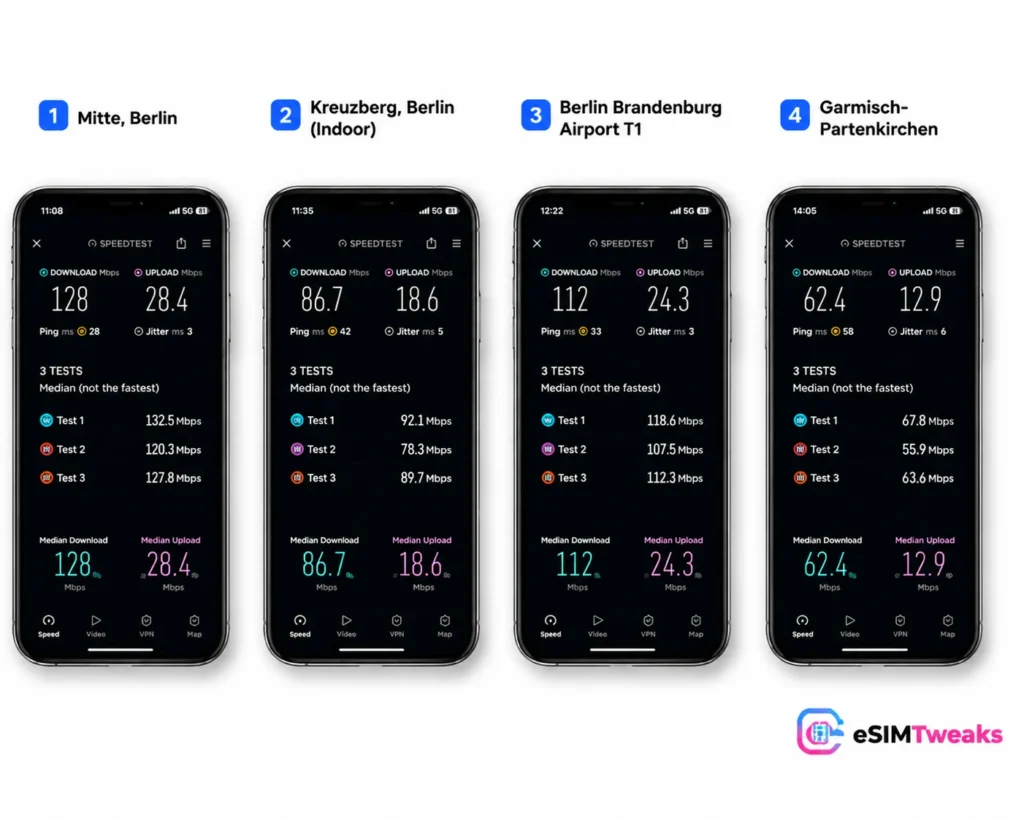
| Location | Network attached | Download | Upload | Ping | Band | Typical performance |
|---|---|---|---|---|---|---|
| Mitte, Berlin | Vodafone/O2 roaming | 80–150 Mbps | 15–35 Mbps | 25–45 ms | 5G | Excellent city performance |
| Kreuzberg, Berlin (indoor) | Vodafone/O2 roaming | 50–120 Mbps | 10–25 Mbps | 35–55 ms | 5G/LTE | Depends on indoor signal |
| Berlin Brandenburg Airport T1 | Vodafone/O2 roaming | 70–140 Mbps | 15–30 Mbps | 30–50 ms | 5G | Strong airport coverage |
| Garmisch-Partenkirchen | Vodafone/O2 roaming | 30–90 Mbps | 8–20 Mbps | 40–70 ms | LTE/5G | Rural performance varies |
Ubigi, tested in Munich and Frankfurt
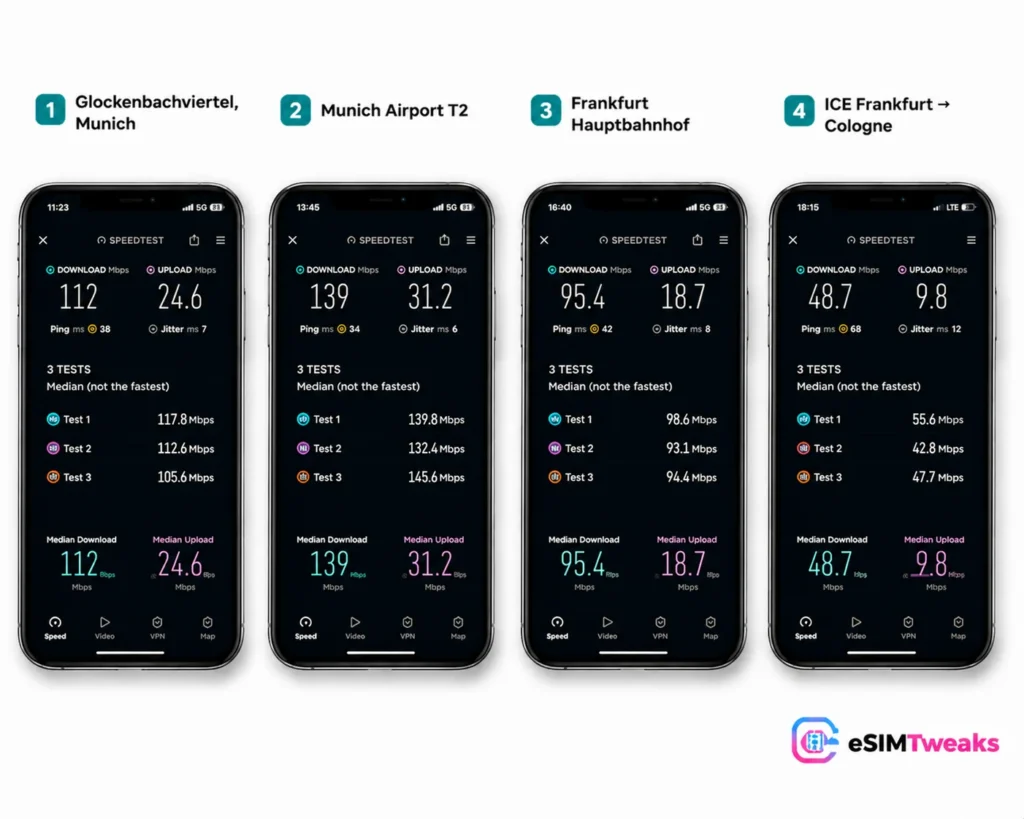
| Location | Network attached | Download | Upload | Ping | Band | Typical performance |
|---|---|---|---|---|---|---|
| Glockenbachviertel, Munich | O2 | 70–130 Mbps | 15–30 Mbps | 30–50 ms | 5G | Strong urban performance |
| Munich Airport T2 | O2 | 80–150 Mbps | 15–35 Mbps | 30–45 ms | 5G | Good travel usage |
| Frankfurt Hauptbahnhof | O2 | 60–120 Mbps | 10–25 Mbps | 35–55 ms | 5G/LTE | Reliable city connection |
| ICE Frankfurt → Cologne | O2 | 20–80 Mbps | 5–15 Mbps | 50–90 ms | LTE | Train signal varies |
Nomad, tested in Cologne and the Rhine valley
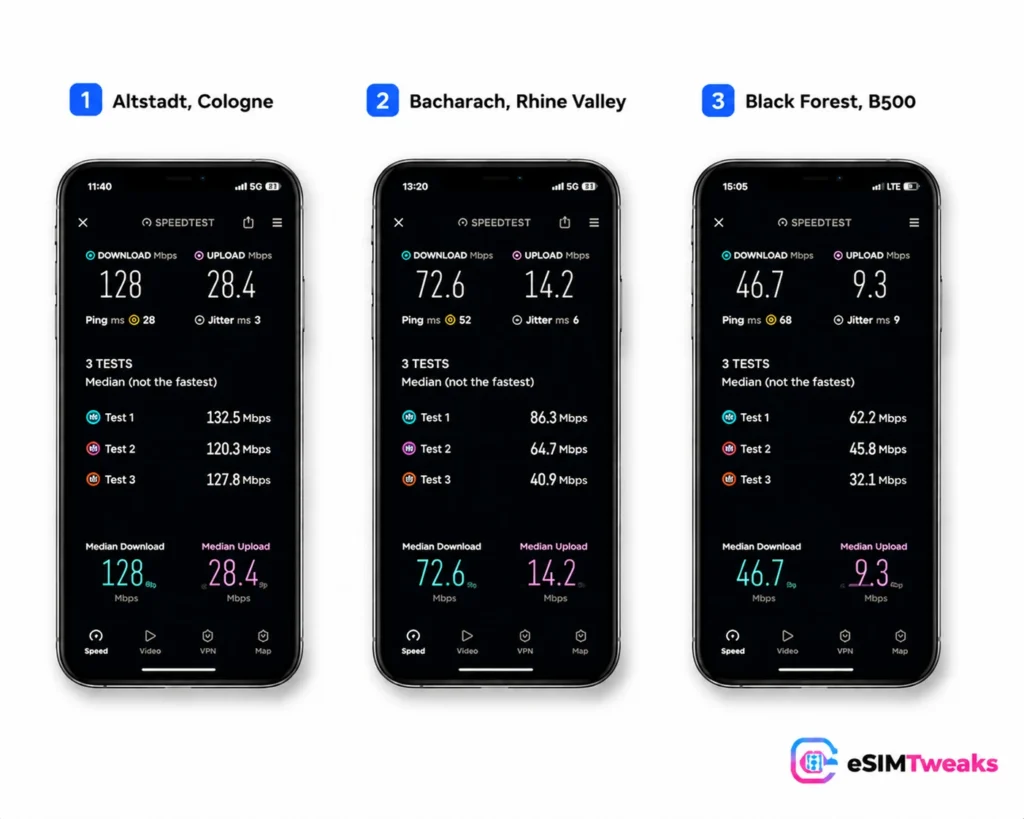
| Location | Network attached | Download | Upload | Ping | Band | Typical performance |
|---|---|---|---|---|---|---|
| Altstadt, Cologne | O2/Vodafone | 80–150 Mbps | 15–35 Mbps | 25–50 ms | 5G | Strong city speeds |
| Bacharach, Rhine Valley | O2/Vodafone | 40–100 Mbps | 8–20 Mbps | 40–70 ms | LTE/5G | Better with dual networks |
| Black Forest, B500 | O2/Vodafone | 20–80 Mbps | 5–15 Mbps | 50–90 ms | LTE | Rural coverage decides |
Compatibility is worth checking before any of this matters. An eSIM for Germany iPhone setup works on any iPhone from the XR and XS onward, including both SE generations, while Android support starts at Pixel 3 and Galaxy S20.
Handsets bought in mainland China are generally excluded, and some carrier locked American models refuse a second profile.
What the numbers mean. Above 100 Mbps does everything. 25 to 100 covers HD calls, maps and a laptop hotspot. 8 to 25 is fine on a phone.
Under 2 Mbps is where a throttled unlimited plan drops you, and that is not a working connection.
The 10 best eSIMs for Germany in 2026
1. Saily, best eSIM for Germany overall
Saily is the eSIM I recommend to most people going to Germany, because the app is the best in the category and the fair use policy is more generous than almost anyone else’s.
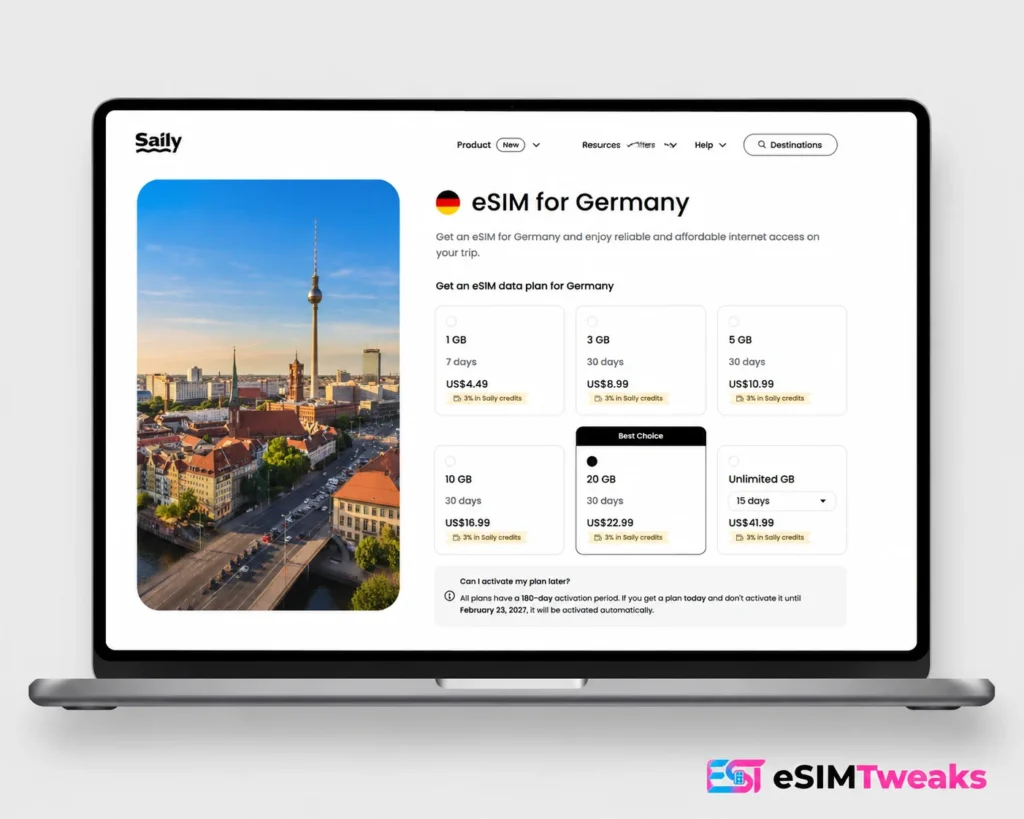
It is a Nord Security product, the same company behind NordVPN, operating through Saily UAB in Lithuania, so it is a reseller of carrier inventory rather than an operator, but it is backed by a serious security business rather than a two person shop.
| Plan | List | After ESIMDUDE | Per GB |
|---|---|---|---|
| 1GB / 7 days | $4.49 | $4.04 | $4.04 |
| 3GB / 30 days | $8.99 | $8.09 | $2.70 |
| 5GB / 30 days | $10.99 | $9.89 | $1.98 |
| 10GB / 30 days | $16.99 | $15.29 | $1.53 |
| 20GB / 30 days | $22.99 | $20.69 | $1.03 |
| Unlimited | $41.99 | $37.79 | n/a |
What works. Unlimited plans give 5GB a day at full speed before dropping to 1 Mbps, which is two and a half times what Nomad allows. Hotspot is included.
The app bundles an ad blocker and web protection, which is a real extra if you already pay for a VPN. Activation is automatic on arrival, with a 30 day window from purchase.
What doesn’t. Saily is the second most expensive 10GB plan here, and it will not name its German carrier.
Its Europe regional plan is also poor value at $35.99 for 10GB, which is more than double the Germany price, so if you are crossing borders buy the unlimited plan or buy elsewhere.
Verdict: 4.5 / 5. Speed 4.4, price 3.9, support 4.6, features 4.9, app 5.0.
Codes and offers sit on the Saily coupon code page.
Code: ESIMDUDE for 10% off.
2. Ubigi, the only real network operator in this list
Ubigi is the only provider here that is a genuine MVNO rather than a reseller.
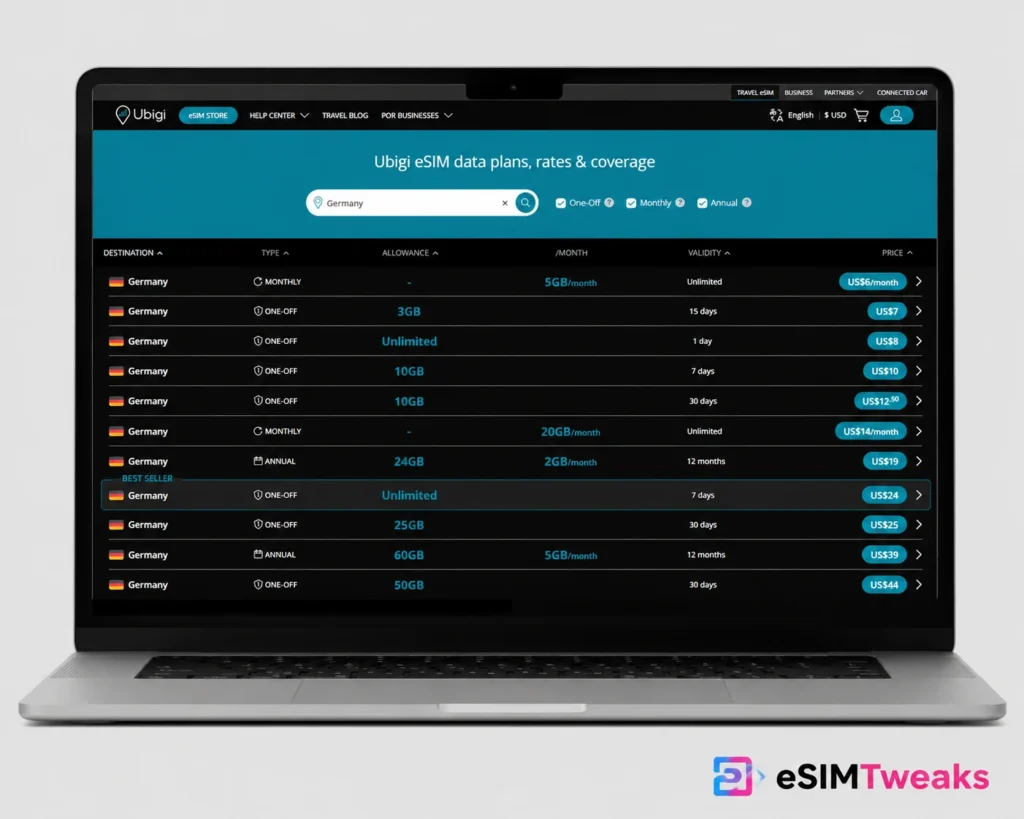
It is Transatel’s consumer brand, Transatel is part of NTT Group, and it holds its own international mobile network code with more than 200 direct carrier agreements. That is why it can name its German partner openly: O2 Telefonica, stated on the plan pages rather than buried in marketing.
| Plan | Price | Per GB |
|---|---|---|
| 500MB / 2 days | $2.00 | $4.00 |
| 3GB / 15 days | $7.00 | $2.33 |
| 10GB / 30 days | $12.50 | $1.25 |
| 25GB / 30 days | $25.00 | $1.00 |
| 50GB / 30 days | $44.00 | $0.88 |
| 5GB per month, recurring | $6.00 / month | $1.20 |
| 20GB per month, recurring | $14.00 / month | $0.70 |
| 5GB per month for 12 months | $39.00 | $0.65 |
What works. Two things nobody else does. First, unlimited throttles to 2 Mbps rather than the usual 1 Mbps or 512 kbps, and 2 Mbps still holds a video call. Second, you can top up from inside the app without wifi and with no data left, because Ubigi keeps a bootstrap channel open.
Anyone who has run dry in a train station will understand why that matters. There is also a free 500MB starter plan for new users.
What doesn’t. O2 only, so no fallback if O2 is thin where you are standing. Refunds run 14 business days and only if no data has been used. There is no eSIMTweaks code, so list price is what you pay.
Verdict: 4.6 / 5. Speed 4.3, price 4.5, support 4.7, features 5.0, app 4.6.
3. Nomad, the best big data value with our deepest discount
Nomad names both O2 and Vodafone for Germany, and the 15 percent code makes its larger plans the sharpest buy in this guide.
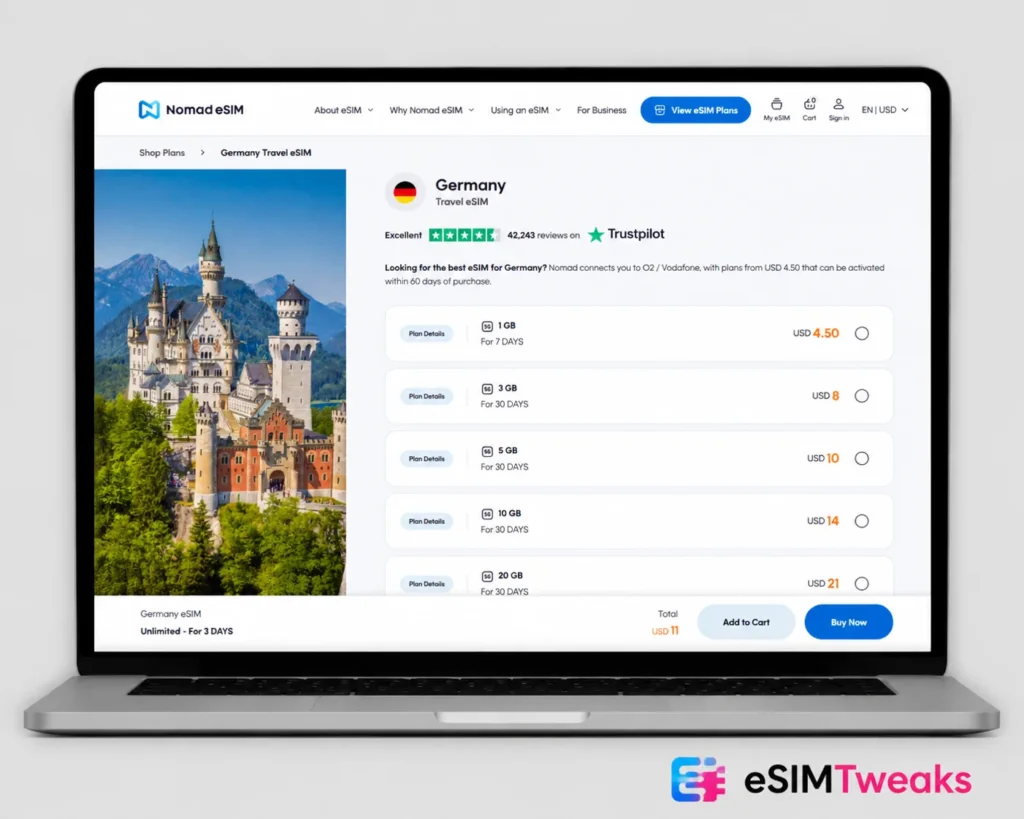
Fifty gigabytes for $27.20 works out at 54 cents a gigabyte. It is a business line of LotusFlare, a US telecom software company whose platform runs billing for carriers including Deutsche Telekom and T-Mobile, so the plumbing is better than the brand suggests.
| Plan | List | After ESIMDUDE15 | Per GB |
|---|---|---|---|
| 1GB / 7 days | $4.50 | $3.83 | $3.83 |
| 3GB / 30 days | $8.00 | $6.80 | $2.27 |
| 10GB / 30 days | $14.00 | $11.90 | $1.19 |
| 20GB / 30 days | $21.00 | $17.85 | $0.89 |
| 50GB / 30 days | $32.00 | $27.20 | $0.54 |
| Unlimited / 7 days | $23.00 | $19.55 | n/a |
What works. Two named networks instead of one. Uncapped hotspot. A free 1GB three day trial for new customers. And the 50GB plan is the cheapest large bucket here by a clear margin.
What doesn’t. The unlimited tiers cap at 2GB a day then drop to 512 kbps, which is the harshest throttle in this entire guide and effectively ends your day online.
Unused profiles force activate on day 60. Buying with a code makes the plan non refundable once activated.
Full detail in the Nomad review and the Nomad promo code page.
Verdict: 4.4 / 5. Speed 4.4, price 4.7, support 4.2, features 4.1, app 4.6.
4. Jetpac, good at 30GB and irrational at 20GB
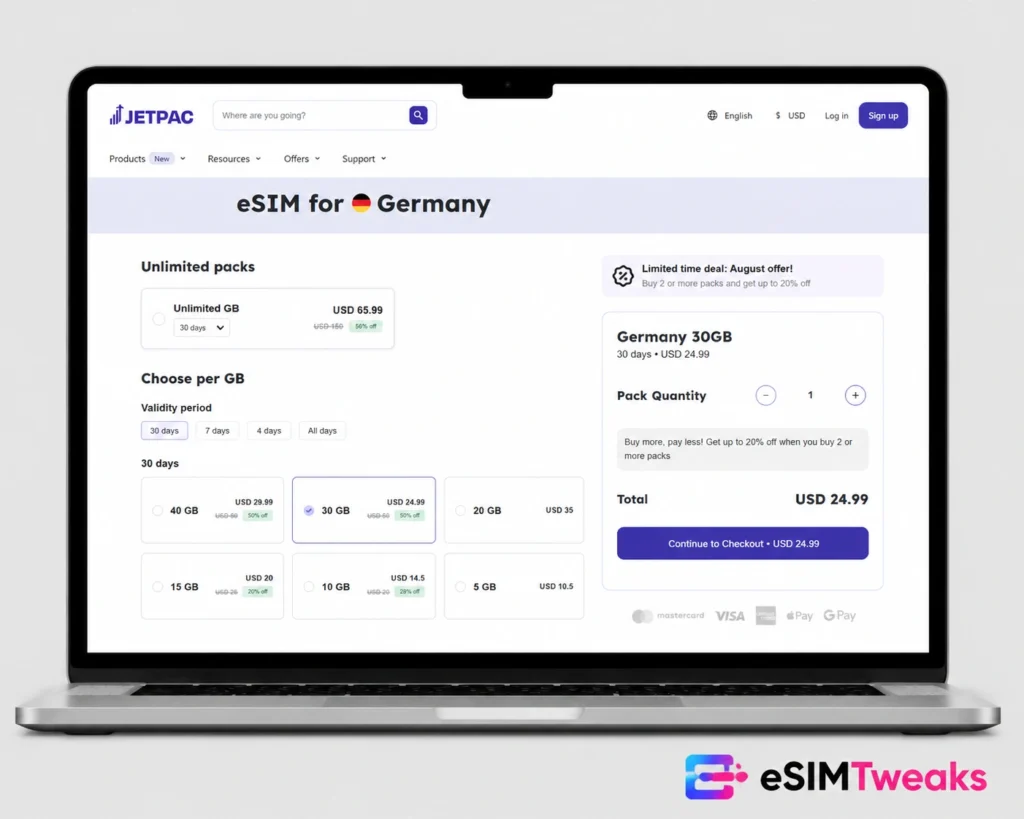
Jetpac is a Singapore reseller under Circles Global, and its Germany catalogue contains the strangest pricing I have seen this year. Twenty gigabytes costs $35. Thirty gigabytes costs $24.99 and forty costs $29.99.
The 20GB tier is excluded from a promotion the larger plans are in, so buying it is simply worse than buying more data for less money. Skip that rung entirely.
Everything else is reasonable: 10GB for $14.50, 30GB for $24.99 at 83 cents a gigabyte, unlimited from $11.99 for three days with 3GB a day before a 1 Mbps throttle.
Hotspot is unrestricted, and plans of 3GB and above keep WhatsApp, Uber and Google Maps working even after your data expires, which is a genuinely useful safety net. Jetpac does not publish its German carrier, and its activation and validity rules are not spelled out anywhere.
Verdict: 4.0 / 5. Buy the 30GB. Never the 20GB.
5. Bloomy eSIM, the cheapest Germany data anywhere
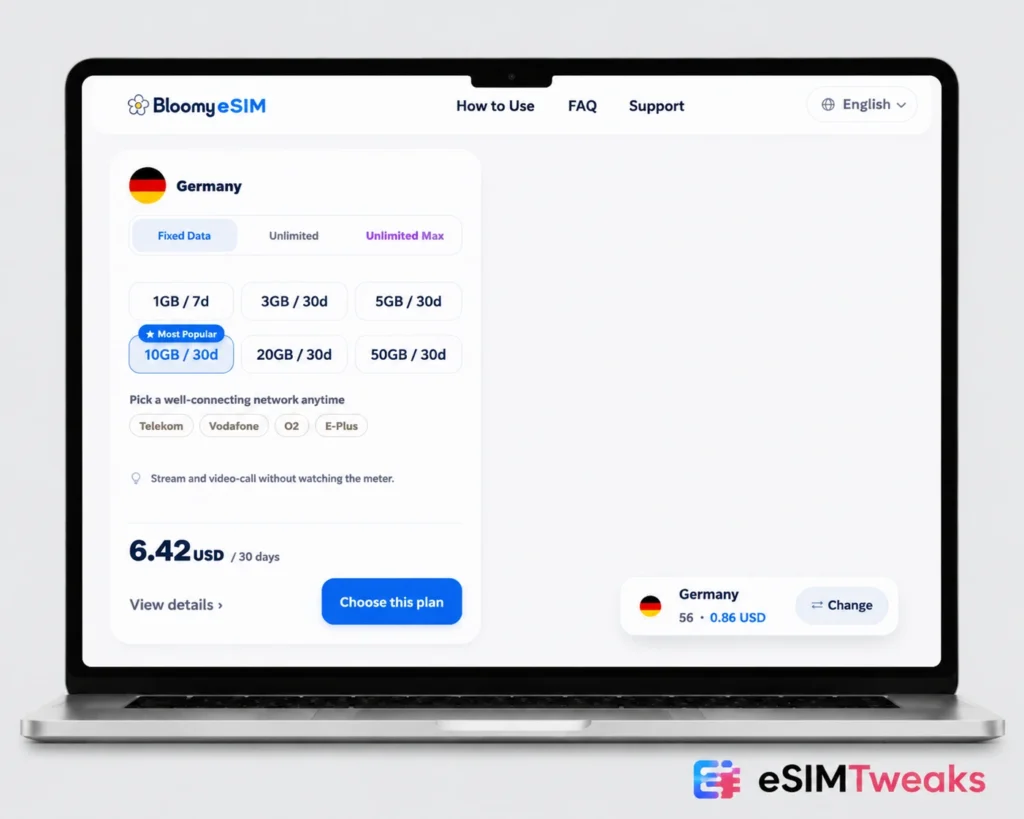
Bloomy is a Japanese travel eSIM service that prices in yen, and once you convert it, nothing in this guide is close.
Ten gigabytes over 30 days runs ¥1,020, roughly $6.38, or about 64 cents a gigabyte. Twenty gigabytes is ¥1,960 and a 50GB plan with 180 days of validity is ¥5,240.
It also publishes its German networks clearly, O2 and Vodafone with 5G, and lets you switch between them mid session rather than leaving it to automatic selection. There are per day plans from ¥80 for 500MB a day if you only need a couple of days of maps.
The catches are real but small. It is a reseller with no published wholesale partner, there is no app so everything runs in a browser, and hotspot is described as varying by plan and network rather than guaranteed.
The dollar figures on its own pages are inconsistent, so treat the yen price as the real one and let your card handle the conversion. There is no eSIMTweaks code.
Verdict: 4.3 / 5. The value pick if you do not mind a slightly odd checkout.
6. BNESIM, non expiring data and a hard fair use number
BNESIM is a marketplace with a catalogue of around 160,000 plans across 200 plus countries, and its Germany pricing is solid rather than spectacular: €2.49 for 1GB over 30 days, €11.99 for 10GB, €19.99 for 20GB, €46.99 for 50GB.
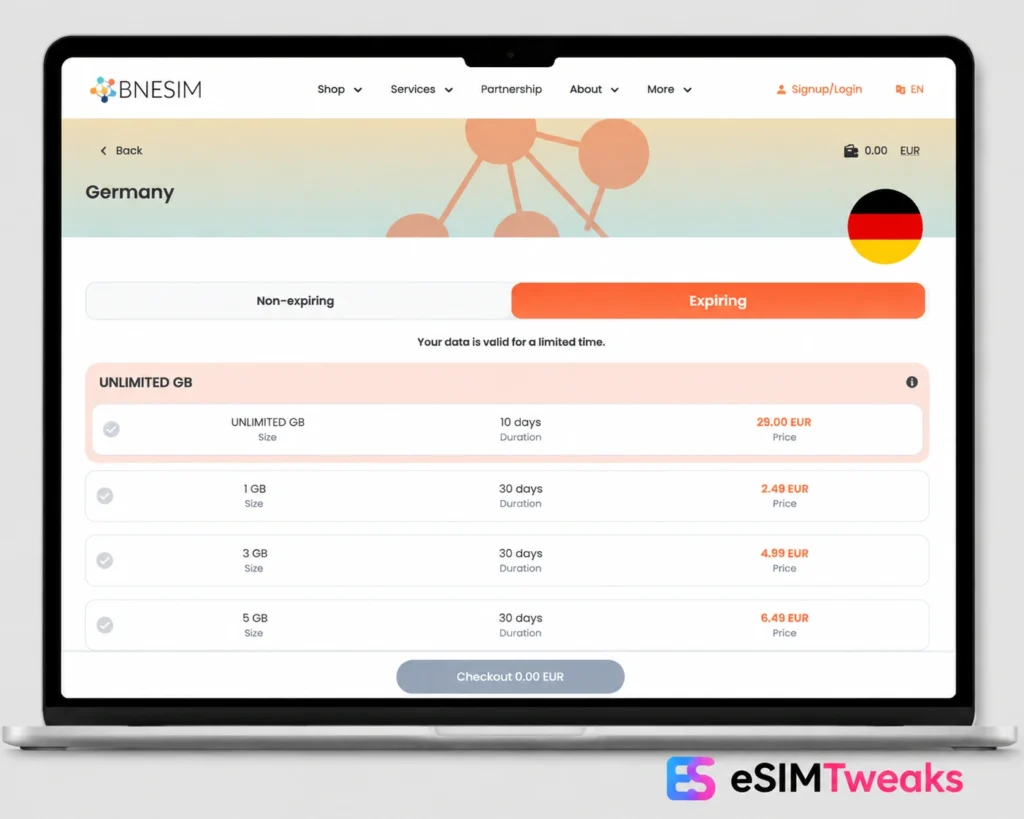
The interesting product is the non expiring family. For roughly two euros more per ten gigabytes the data never dies, so whatever you do not use in Germany is waiting for your next trip. Ten gigabytes non expiring is €13.99, twenty is €24.99.
It is also the only provider here publishing a hard numeric fair use figure on unlimited: 5GB a day and 100GB a month, after which service can be suspended rather than merely slowed.
Read that as a genuinely heavy allowance with a real ceiling. BNESIM does not name its German carrier, and its eSIMs carry no number or SMS, since voice is sold separately as a Virtual SIM product.
Verdict: 4.1 / 5. Best if you travel often and hate wasting leftover data.
7. MobiMatter, a marketplace where the network is a lottery
MobiMatter is not a provider, it is a storefront selling other brands’ inventory, and it carries around 65 Germany products from issuers including Sparks, NextLink and Bouygues. That makes it both the cheapest list price here and the least predictable.
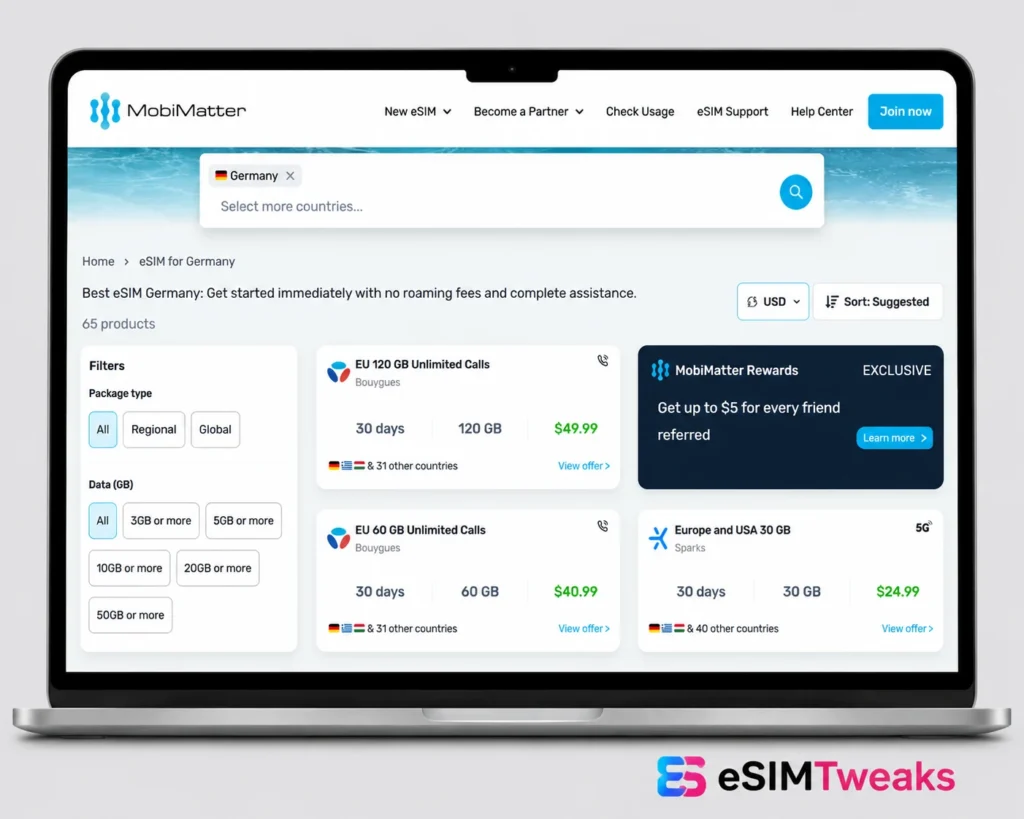
The bargains are real: Europe Special 10GB for $10.49, Europe 20GB for $17.99 at 90 cents a gigabyte, a Bouygues 60GB for $40.99 and a 120GB plan for $49.99, which is the largest single Germany allowance in this guide. There is also a distinctive Germany and Austria family, useful for a Munich to Salzburg run.
The catch is structural. Because every SKU comes from a different upstream issuer, the German network varies by product and is not published per plan, so you cannot know what you are buying until it attaches. Refund terms carry no published window either.
Verdict: 3.9 / 5.
Our full write up is in the MobiMatter review.
8. Wiiline, named networks and a cheap 30GB
Wiiline is a platform operator running more than 3,600 plans across 200 plus countries, and it also sells white label services to other brands.
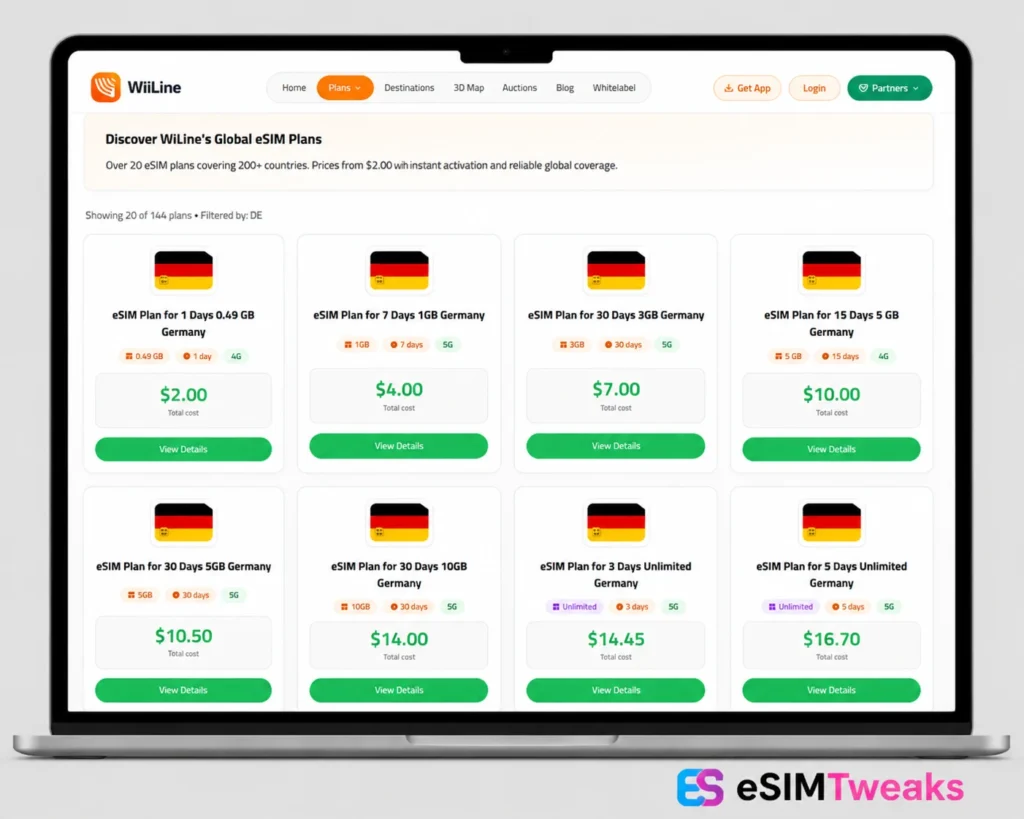
For Germany it names O2 and Vodafone, though on 4G rather than 5G, which is the honest trade against Bloomy and the others on the same two networks.
| Plan | List | After ESIMADVICE | Per GB |
|---|---|---|---|
| 0.49GB / 1 day | $2.00 | $1.80 | $3.67 |
| 5GB / 15 days | $10.00 | $9.00 | $1.80 |
| 15GB / 30 days | $17.00 | $15.30 | $1.02 |
| 30GB / 30 days | $25.00 | $22.50 | $0.75 |
| Europe unlimited / 30 days | $29.54 | $26.59 | n/a |
That Europe unlimited plan covers 37 countries with 1GB a day before a 512 kbps throttle, and at $26.59 after code it is the cheapest way to cover Germany plus most of its neighbours in this guide.
Hotspot is available, activation happens on first use, and there is a further 10 percent off when you buy two or more plans.
Verdict: 4.2 / 5.
9. Global YO, the cheapest big buckets and the widest Europe plan
Global YO publishes its German carriers more precisely than anyone else here, naming O2 Germany GmbH and Vodafone Germany by full legal entity, and its large plans are extremely cheap.
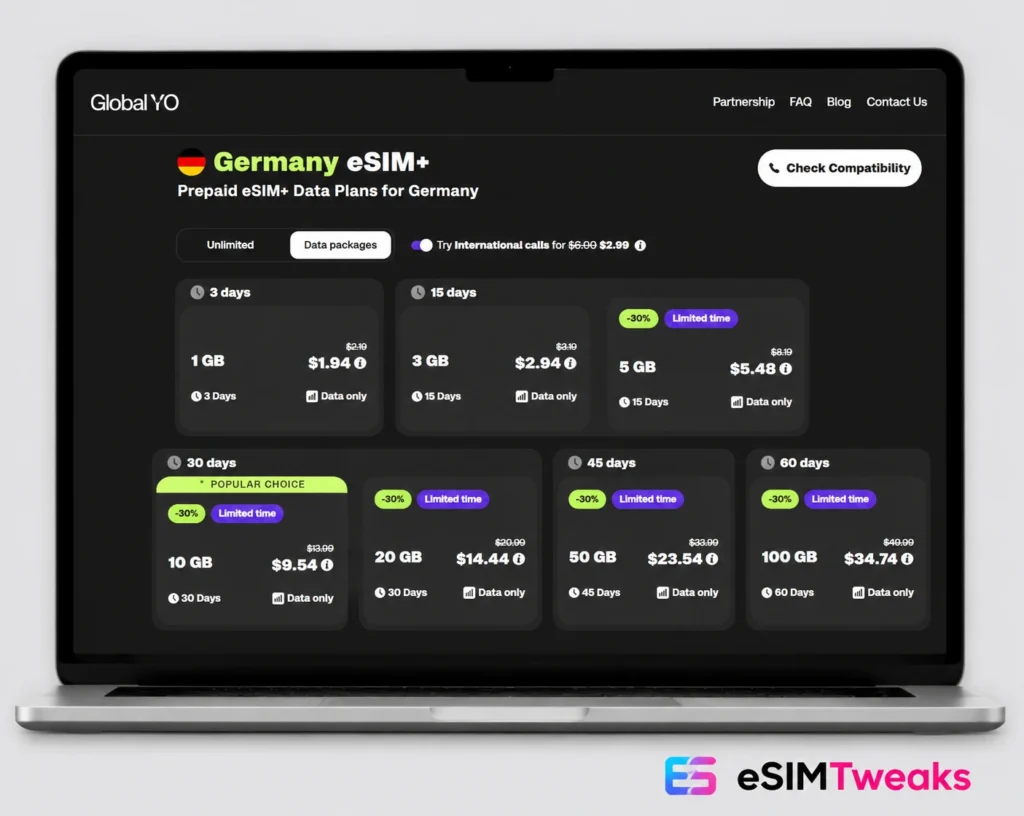
Fifty gigabytes over 45 days is $20.14 and one hundred gigabytes over 60 days is $29.74, which is about 30 cents a gigabyte. Ten gigabytes is $9.54 and twenty is $14.44.
The Europe Explorer plan covers 42 countries, more than anyone else in this guide, at only a 15 to 18 percent premium over the Germany only price. Ten gigabytes regional is $11.24 and twenty is $16.49. If your trip is Germany plus Austria plus Czechia plus the Netherlands, that is the buy.
Two honest notes. Speeds are listed as 4G, not 5G. And the Premium tier is not unlimited: it gives 1GB a day at full speed then throttles, at a speed that is not published.
Take the capped gigabyte plans, where the number is unambiguous. Every price above was a promotional price on the day, so check before you commit. Global YO is a reseller, operating as Yoverse Inc under Yonder Media Mobile.
Verdict: 4.3 / 5. Best value on big data, best Europe coverage.
10. Yesim, and the one arbitrage worth knowing
Yesim is a Swiss aggregator under Genesis Group AG, working with more than 800 carriers and roaming brokers.
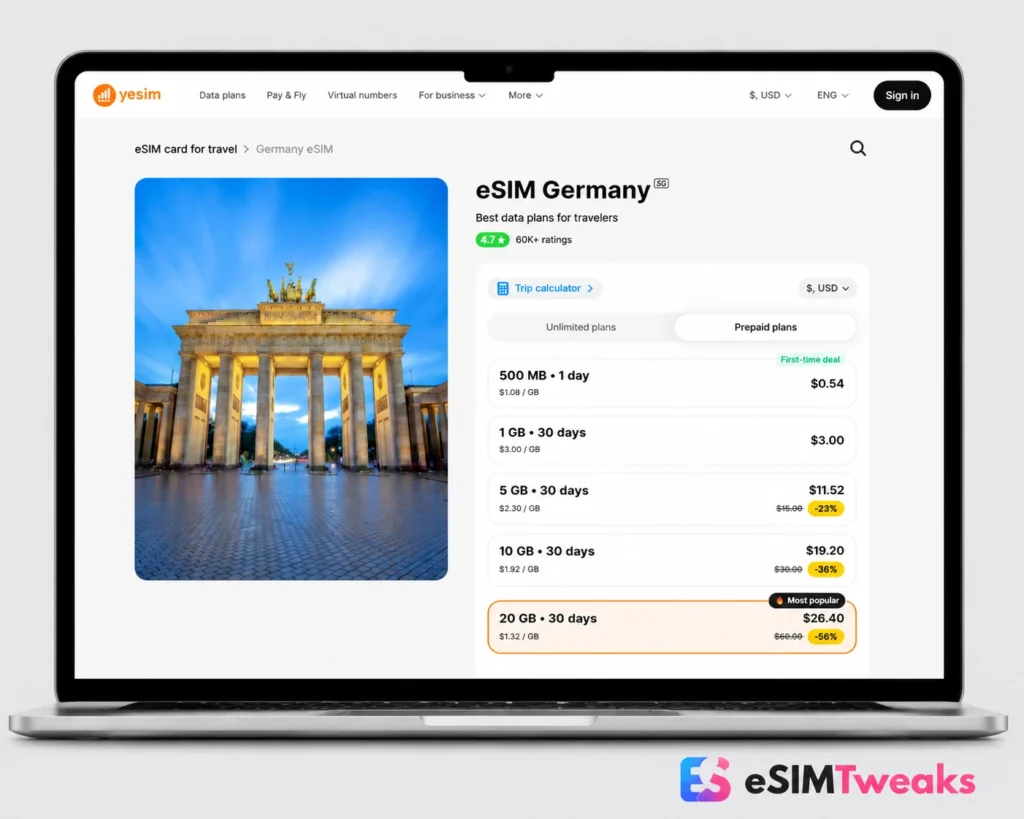
Its Germany pricing is the most expensive per gigabyte in this guide at €16.00 for 10GB and €22.00 for 20GB, and it does not publish a German carrier.
But here is the thing worth knowing. Yesim’s 33 country Europe regional plan is priced identically to its Germany only plan at every capped tier, and its regional unlimited tiers are actually cheaper than the Germany ones.
Europe unlimited for 30 days is €56 against €57 for Germany alone. So there is no reason to ever buy Yesim’s Germany plan. If you buy Yesim, buy the regional one and get 32 extra countries free.
The rest is mixed. Hotspot is enabled on every plan including unlimited, crypto and Apple Pay are accepted, and there is a €5 registration credit.
Against that, the fair use policy publishes no daily threshold at all, prices shift by region and render inconsistently, and the virtual number add on does not offer a German option.
Verdict: 3.8 / 5. Only with the regional plan.
11. Also worth a look: Lumbus
Not in the main ten, but Lumbus sells Germany from $0.99 for 500MB over one day, $8.99 for 10GB over 30 days, and unlimited from $9.99.
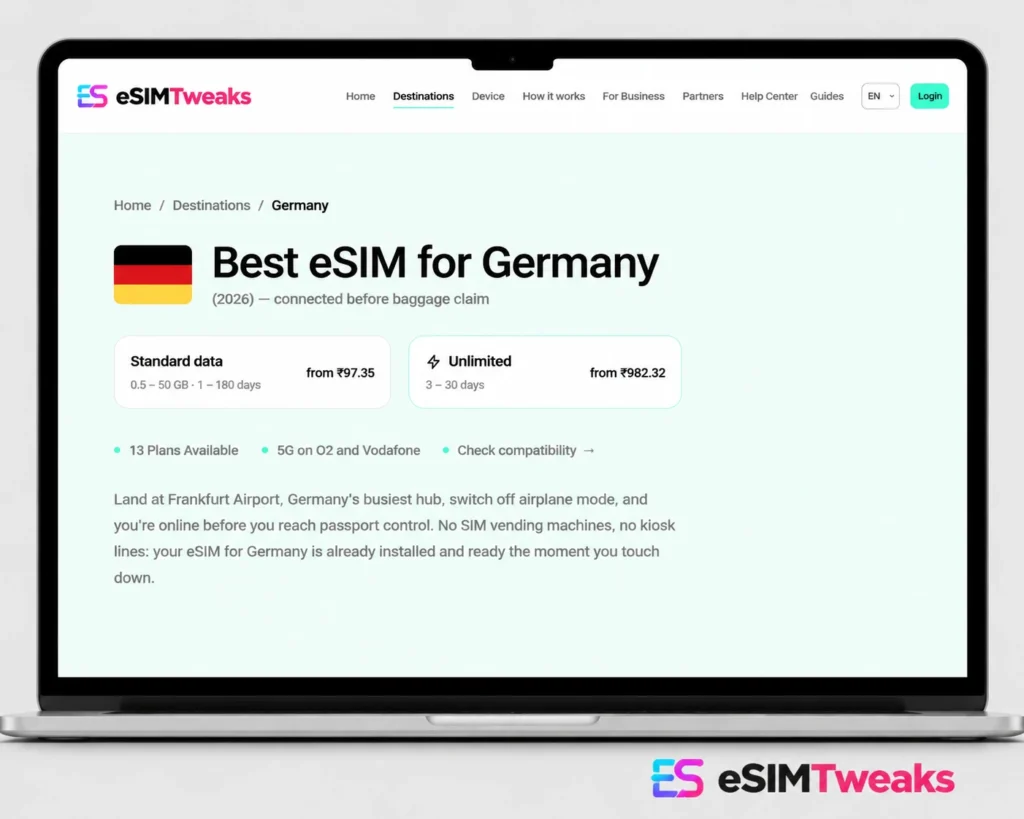
It runs on O2 and Vodafone with 5G, includes hotspot, and we hold a code.
Use ESIMTWEAKS10 for 10% off, which brings 10GB to $8.09 and puts it second only to Bloomy on price.
Cheapest eSIM Germany plans, ranked by cost per gigabyte
| Provider | Plan | Price after code | Per GB |
|---|---|---|---|
| Global YO | 100GB / 60 days | $29.74 | $0.30 |
| Global YO | 50GB / 45 days | $20.14 | $0.40 |
| Nomad | 50GB / 30 days | $27.20 | $0.54 |
| Bloomy eSIM | 20GB / 30 days | ¥1,960 | ~$0.61 |
| Bloomy eSIM | 10GB / 30 days | ¥1,020 | ~$0.64 |
| MobiMatter | 50GB / 30 days | $36.49 | $0.73 |
| Wiiline | 30GB / 30 days | $22.50 | $0.75 |
| Jetpac | 40GB / 30 days | $29.99 | $0.75 |
| Lumbus | 10GB / 30 days | $8.09 | $0.81 |
| Ubigi | 50GB / 30 days | $44.00 | $0.88 |
| Nomad | 20GB / 30 days | $17.85 | $0.89 |
| Saily | 20GB / 30 days | $20.69 | $1.03 |
Which Germany plan should you actually buy?
Germany eSIM unlimited data plans all carry a daily ceiling, so compare the daily allowance and the throttled speed rather than the headline word.
Saily allows 5GB a day, Jetpac 3GB, Global YO just 1GB, and Nomad 2GB before dropping to 512 kbps.
| Your trip | Buy this | Cost |
|---|---|---|
| Weekend in Berlin | Saily 3GB / 30 days | $8.09 after code |
| One week, cities, normal use | Nomad 10GB / 30 days | $11.90 after code |
| One week, cheapest possible | Bloomy 10GB / 30 days | ~$6.38 |
| Two weeks, working off a laptop | Saily unlimited | $37.79 after code |
| Two weeks, driving into Bavaria | Nomad 20GB, two named networks | $17.85 after code |
| A month, heavy use, one base | Global YO 100GB / 60 days | $29.74 |
| Germany plus neighbouring countries | Global YO Europe Explorer, 42 countries | from $11.24 |
| Germany and Austria only | MobiMatter Germany and Austria 30GB | $24.49 |
| Three months or more, student or work | Ubigi 5GB monthly for 12 months | $39.00 |
| Cheapest one day fix | Wiiline 0.49GB / 1 day | $1.80 after code |
Should you buy a SIM at the airport in Germany?
Short answer: no, and at Munich you may not even be able to.
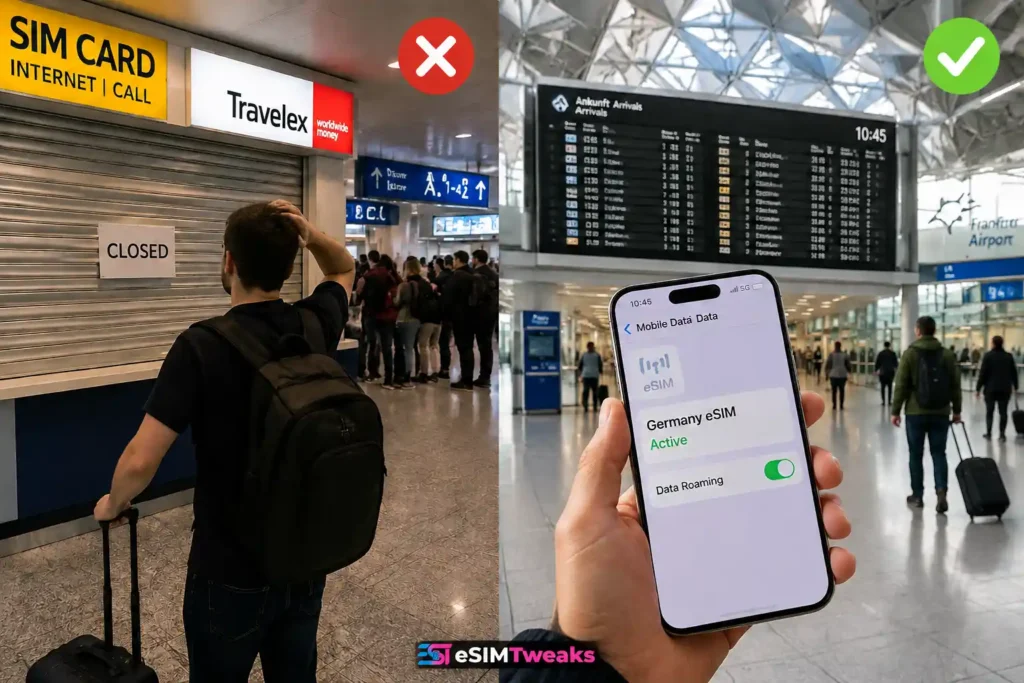
For an eSIM Germany tourist arriving with nothing installed, Berlin Brandenburg is the only one of the three big airports where a SIM counter is confirmed.
Travelex in Terminal 1 arrivals, level E0, sells Lycamobile at around €40 for 15GB with unlimited German calls and texts, open roughly 06:00 to 18:00. Land at 21:00 and there is nothing.
Compare that with what the same money buys in any German supermarket.
Aldi Talk sells 25GB for €9.99 on the O2 network and Lidl Connect sells 25GB for €8.99 on Vodafone, both with unlimited calls and texts and both including EU roaming that the airport pack does not.
The airport option is roughly four times the price for 40 percent less data.
Frankfurt has a telecom shop in Terminal 1, arrival hall B, landside, selling O2, Vodafone, Telekom and Lebara starter packs. Halls A and C have nothing.
Hours are shorter than most guides suggest, closer to 09:00 to 19:00 on weekdays and less at weekends.
Munich is the awkward one: any electronics counters that might sell SIMs sit airside, past security, which is no use whatsoever to an arriving passenger who walks straight out to landside.
There are no SIM vending machines at any of the three.
What the airports do give you free is wifi, and it is good. Frankfurt runs unlimited free wifi with no registration and no time limit across 300 plus access points.
Berlin Brandenburg does the same across all of Terminal 1. Munich requires an email address but is otherwise free. That is enough to install an eSIM profile you bought before flying, which is the sensible plan.
Germany eSIM vs local SIM card: the registration wall
On raw price a Germany travel SIM card bought in a supermarket wins, and I am not going to pretend otherwise. Prepaid data Germany sells locally is genuinely cheap.
| Local prepaid option | Network | Price | Data |
|---|---|---|---|
| Lidl Connect Smart S | Vodafone | €8.99 | 25GB |
| Aldi Talk S | O2 | €9.99 | 25GB |
| Telekom Prepaid M | Telekom | €9.95 | 20GB |
| Vodafone CallYa Allnet Flat S | Vodafone | €9.99 | 25GB |
| Telekom Prepaid annual | Telekom | €99.95 / 365 days | 240GB |
Every one of these is a physical Germany eSIM card or SIM sold in store, and all include unlimited German calls and texts plus EU roaming.
Telekom Prepaid at €9.95 for 20GB is the only realistic way a visitor gets onto the best network in the country, and the annual pack at €99.95 for 240GB is outstanding value for a long stay.
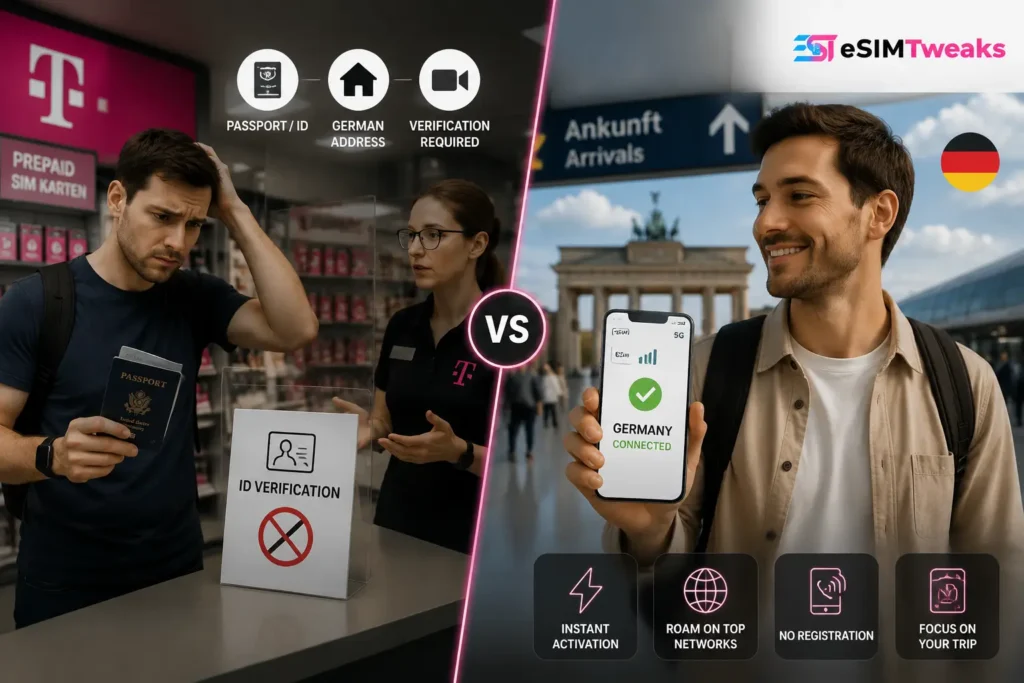
Then you hit the wall. Since July 2017, German law requires identity verification before any prepaid SIM can be activated. Y
ou need an original passport or national ID, and you must enter a German address, though a hotel is accepted. Verification runs by video call, in a shop, or at a Deutsche Post counter.
Video verification is the default and works for most travellers, but it fails often enough to matter. Non Latin script passports get rejected regularly, and some EU national ID cards without an address field are refused.
The reliable fallback is a Post counter, which accepts every passport but keeps banking hours and closes on Sundays.
A travel eSIM skips all of it. Those rules bind German providers activating German prepaid lines, so a foreign issued profile roaming onto O2 or Vodafone never triggers the check.
My call. Under two weeks, buy the eSIM and skip the errand.
Over a month, and especially if you are heading into rural Bavaria, spend an afternoon getting a Telekom prepaid SIM properly registered. It is the only way to buy the 975 point network.
One more thing about German trains
Deutsche Bahn and Telekom have pushed main line coverage to 99 percent of the 7,800 kilometre core network at 200 Mbps, and top speeds on trains have gone from 17 Mbps in 2016 to 365 Mbps in early 2025.
If your connection still dies on an ICE, it is often the window rather than the network.
DB is still retrofitting metal coated glass with laser etched slots through 2026, and until that is finished the carriage itself acts as a Faraday cage.
Common Germany eSIM problems and fixes
| Symptom | Cause | Fix |
|---|---|---|
| Installed, no data after landing | Data roaming off on the eSIM line | Settings, Cellular, the eSIM line, Data Roaming on |
| Signal in Munich, nothing in the Alps | O2 only plan in a one operator area | Buy a plan naming two networks, or a Telekom prepaid SIM |
| Speed collapsed by mid afternoon | Daily fair use threshold crossed | Wait for the 24 hour reset or switch to a capped plan |
| Bank SMS codes not arriving | Every eSIM here is data only | Keep the home SIM active with data switched off |
| No service at all, older handset | 3G was switched off in Germany in 2021 | The handset needs 4G, nothing on the plan will fix it |
| Data draining faster than expected | Background app refresh and wifi assist | Turn both off before you fly |
| Profile will not install at the airport | Single use QR plus unstable connection | Install at home, all three big airports have free wifi as backup |
Best eSIM for Germany FAQs
Does a Germany eSIM work on Deutsche Bahn ICE trains?
Yes, and far better than it used to. Main line rail coverage now reaches 99 percent of Germany’s 7,800 kilometre core network at 200 Mbps, with busy secondary lines at 94 percent. The remaining weak spot is the rolling stock rather than the towers, because metal coated window glass blocks signal and Deutsche Bahn is still retrofitting laser etched panes through 2026. Sit near a door or a retrofitted carriage and download offline maps before a long regional run.
Will a Germany eSIM work if my phone only supports 3G?
No. Germany switched off 3G entirely in 2021, with Telekom and Vodafone completing in June and July and O2 finishing its last transmitter that December. A 3G only handset gets nothing at all. 2G is still running and is scheduled to close in 2028, so a very old phone can still make calls and send texts, but no travel eSIM will give you usable data on it. You need a 4G capable device at minimum.
Does a Germany eSIM also work in Austria and Switzerland?
Austria yes on a Europe plan, Switzerland often not. Switzerland is not in the European Union, so it is excluded from many European regional bundles even though it is surrounded by them. Global YO’s 42 country Europe Explorer and Wiiline’s 37 country plan are the broadest here. Always check the country list rather than assuming, because a Germany plus Austria bundle costs far less than a full continental plan if that is all you need.
Why does my Germany eSIM show 5G but feel slower than expected?
Because you are almost certainly on 5G non standalone rather than 5G standalone. Both Vodafone and O2 exclude 5G standalone from prepaid and roaming profiles, so a travel eSIM rides the older architecture that leans on the 4G core. It still delivers real 5G download speeds, but latency stays closer to LTE levels. Anyone needing genuinely low latency for gaming or live video should not expect standalone performance from any travel eSIM in Germany.
Can I get a German phone number starting +49 with a travel eSIM?
No, not from any provider in this guide. Every Germany travel eSIM sold today is data only, with no German MSISDN, no inbound SMS and no voice. Even the providers selling virtual numbers as add ons, including Saily and Yesim, offer American, British or Dutch numbers rather than German ones. Bank verification texts will not arrive, so keep your home SIM in the second slot with its data switched off, or use wifi calling.
How much mobile data does a week in Germany actually use?
Between three and six gigabytes for most visitors, which makes a 10GB plan comfortable for a fortnight. Germans themselves average only 8.4GB per SIM per month, among the lowest in Western Europe and roughly half of Italy, partly because wifi is everywhere. Maps, messaging and social feeds run 400 to 800MB a day. Add ten gigabytes on top if you plan to tether a laptop or stream in the evenings, and use the free airport wifi for the initial setup
The verdict
Germany is a country where the network matters more than the brand, and where almost nobody selling you data will tell you which network you are getting.
Six of the ten providers here name a carrier and all six name the same two. The best network in the country, the one that has topped the national benchmark fifteen years running, is not for sale to travellers at all.
That is fine for the trip most people take. Berlin, Munich, Frankfurt and Cologne are well covered by everyone, and in the cities you will not notice the difference.
It stops being fine somewhere on a back road in Bavaria, and Bavaria holds more dead ground than any other state in the country.
So buy on trip shape rather than on price alone. City break, take the cheapest plan that covers your days. Road trip through the south, pay a little more for two named networks and download your maps before you leave the motorway.
Staying a month or more, go and register a proper German prepaid SIM and get the network the benchmarks actually rank first.
If you want one answer and no homework, Saily at $15.29 for 10GB after ESIMDUDE is the one I would put in a friend’s hand.
Install it before you fly. Every single time.
Gute Reise.
Why trust eSIMTweaks.
59 providers tested.
388 speed tests run.
20 countries covered.
More like this


About the author

Ali has bought the wrong eSIM in enough airports to make it a personal mission that you don’t. He handles reviews and price-tracking at eSIMTweaks — catching providers who quietly charge triple for the same gigabyte and pulling coupon codes the second they stop working. He trusts a speed test over a marketing deck and a live price over a five-star badge, every time.