Best eSIM for Peru 2026: 10 Ranked, Priced and Pressure Tested
Peru makes choosing a travel eSIM harder than it should be. A plan that handles video calls in Lima might struggle on the way to Machu Picchu, and paying extra doesn’t always buy better service. We ranked 10 providers by network access, data allowances, validity, refund rules and actual cost per GB to help you spend less without gambling on connectivity.
October 8, 2026


Nomad
- Runs on Movistar in Peru
- Strong pick for wider Peru coverage
- Host network disclosed before purchase

Sim Local
- Lowest serious 20GB Peru price
- Only about $1.51 per GB
- Great value for the main tourist circuit
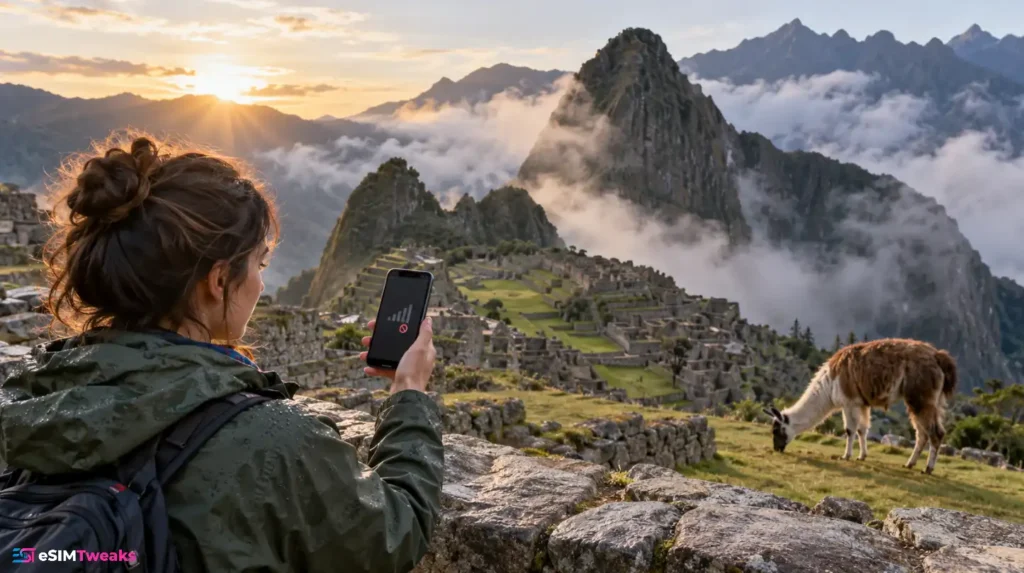
Peru has four mobile networks. Your travel eSIM only rides on one of them. Pick the wrong one and you are the person holding a phone in the air at Ollantaytambo station like you are trying to summon rain.
Best overall eSIM for Peru: Nomad. It is the only big brand that tells you which Peruvian carrier you are actually buying, and 10GB for $25.00 is fair. Use ESIMDUDE15 for 15% off.
Best value: Sim Local. 20GB for $30.25 is the cheapest serious plan in Peru right now, at $1.51 per GB. Use ESIMDUDE10 for 10% off.
Best for a two week Andes trip: Airalo. Its Peru pack throttles to a usable 1 Mbps instead of falling off a cliff. Use ESIMADVICE10 for 10% off.
That is the podium. Below is the full best eSIM Peru list, all ten, ranked, priced and pressure tested against the places you are actually going.
All 10 Peru eSIMs compared
| Provider | 10GB Peru price | Cost per GB | Host network | Throttle after cap | Code |
|---|---|---|---|---|---|
| Nomad | $25.00 / 30d | $2.50 | Movistar (named) | 2 GB/day, then reduced | ESIMDUDE15 |
| Sim Local | $23.50 / 30d | $2.35 | Not published | 5 or 10 GB/day | ESIMDUDE10 |
| Jetpac | $27.99 / 30d | $2.80 | Claro (reported) | 3 GB/day, then 1 Mbps | none held |
| Saily | $29.99 / 30d | $3.00 | Not published | 5 GB/day, then 1 Mbps | ESIMDUDE |
| Airalo | $26.00 / 30d | $2.60 | Movistar (named) | 3 GB/day, then 1 Mbps | ESIMADVICE10 |
| Latam Travellers | £17.61 / 30d | £1.76 | Claro, Movistar, Entel, Bitel claimed | no throttled tier | ESIMADVICE10 |
| GigSky | $24.79 / 30d | $2.48 | Not published | 3.5 GB/day | ESIMADVICE15 |
| Billion Connect | $29.60 / 15d | $2.96 | Not published | 128 kbps | none held |
| Ubigi | $24.00 / 30d | $2.40 | Movistar (named) | 2 Mbps floor | ESIMADVICE |
| aloSIM | $29.00 / 30d | $2.90 | Movistar (named) | not published | ESIMTWEAKS |
Peru has four networks. You are buying one of them.
This is the whole game and almost nobody explains it.
Peru runs on Claro, Bitel, Entel and Movistar. Market share splits roughly 33%, 24%, 23% and 20%. Four real networks, four different maps, four different ideas about whether the Sacred Valley deserves towers.
Your travel eSIM does not roam across all four. It signs one wholesale deal and you live inside it.
So which one do you want? Depends who you ask, and the two best answers disagree.
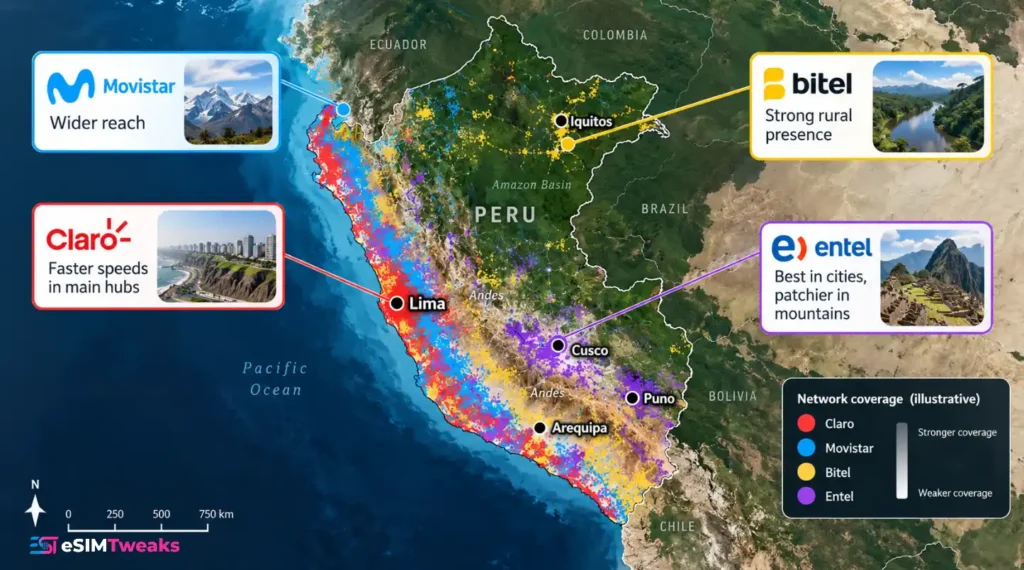
Here is the translation into something useful. Movistar gives you a signal in more places. Claro gives you a faster signal in the places that already have one. If your trip is Lima, Cusco, Arequipa and a train, take Claro. If your trip involves buses, small towns and things ending in “bamba”, take Movistar.
Entel? Great in cities, described as patchy on the tourist mountain routes. Its 3.40% guaranteed figure is a paperwork quirk rather than a real coverage collapse, but the field reports are consistent enough that we would not build a trek around it.
Do you even need a travel eSIM in Peru? (Yes, and the reason changed recently)
You used to have a real choice. Walk into a Claro shop in Miraflores, hand over a passport, walk out with a chip for about 25 soles.
Roughly six dollars for 4GB. Hard to beat. Then November 2025 happened.
OSIPTEL Resolución 000116-2025-CD changed how foreigners buy a Peruvian line. Contracts now have to be signed in person, with biometric verification checked against the Migraciones database, and you are limited to one line per 30 days.
Reporting since then has been messy on exactly which documents work, which is a polite way of saying nobody at the counter agrees either.
A travel eSIM sits completely outside that. It is international roaming on a foreign operator’s profile, not a Peruvian contract. No biometrics. No queue. No shop in Lima. You install it on your sofa at home and it wakes up when you land.
That is the strongest argument for a Peru eSIM in 2026 and it did not exist two years ago.
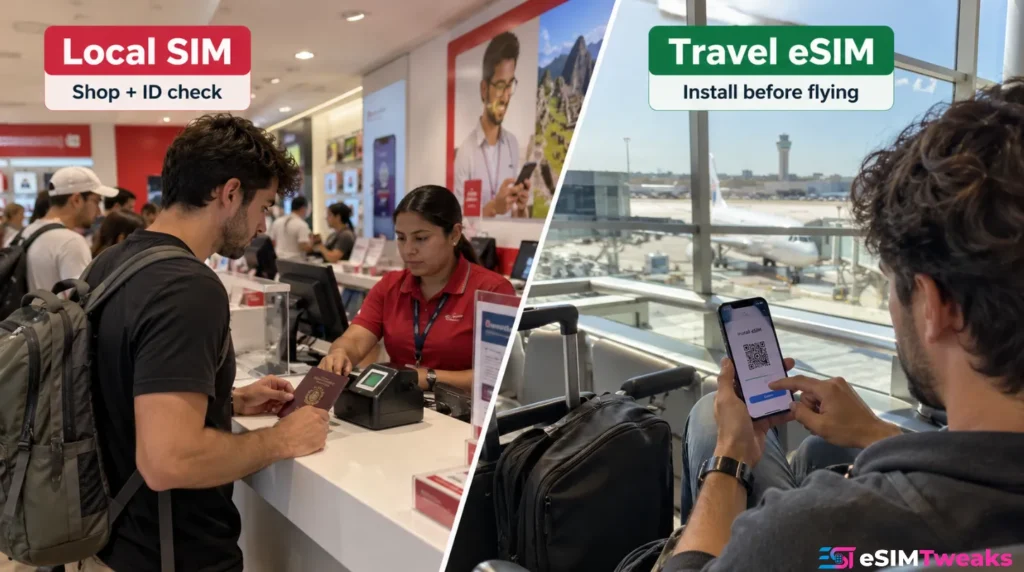
Now the money. Lima airport is a masterclass in geographic pricing.
The Claro store in Arrivals has been selling 14GB for a week at $59. The Claro store in Departures, same building, different floor, sells 4GB for ten days at about $9. Six times cheaper for the crime of walking upstairs.
In the city you are looking at roughly $6 to $11 for 4GB over 10 to 30 days, plus 5 soles for the bare chip.
And your home carrier? AT&T and Verizon charge about $12 a day for a day pass. Pay as you go without it runs $2.05 per megabyte, which is around two thousand dollars per gigabyte. That is not a typo. That is a phone bill that ends a marriage.
T-Mobile’s higher plans do include Peru data, so check yours before you buy anything.
Fourteen days on a day pass is $168. A 10GB Peru eSIM is $25. Run your own numbers on the roaming savings calculator if you enjoy watching a graph make your carrier look silly.
How we ranked these ten?
Cost per GB, because a headline price with a three day validity is a coupon for disappointment.
Whether the brand names its Peruvian host network, because that is the single fact that decides whether your phone works in Pisac.
What actually happens after the daily cap. “Unlimited” in this category means “unlimited at a speed we will not tell you about”.
Refund cut off, validity start, hotspot rules, and whether topping up is even possible.
Then we weighted everything toward the actual Peru tourist trail, because a plan that is brilliant in Lima and useless in Ollantaytambo is not a Peru plan. It is a Lima plan.
The 10 best eSIMs for Peru
Ranked on cost per GB, carrier transparency and what happens when the data runs out. Prices are the standard rate before any code. Every eSIM Peru plan below is data only unless we say otherwise.
1
Nomad
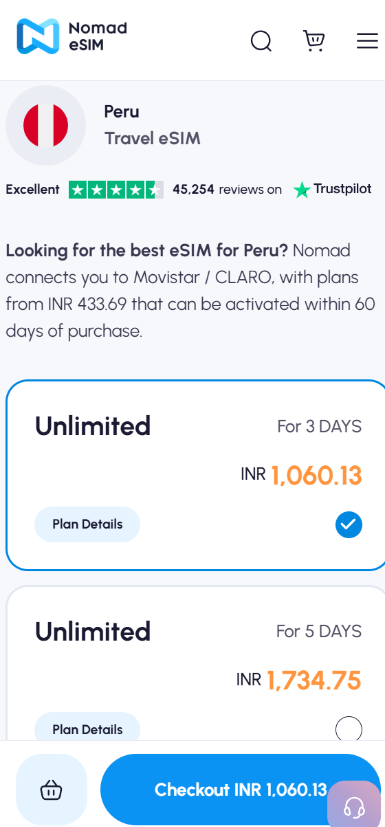
Nomad wins Peru on a technicality that turns out to be the whole point: it prints the host network on the product page. Movistar, with Claro referenced too.
Not one other big brand in this list does that for Peru, and Movistar is the network with the widest guaranteed coverage in the country.
So when you buy Nomad you are buying a known quantity in a country where the coverage map is the entire difference between a good day and a very quiet one.
Nomad eSIM Peru pricing is honest rather than exciting: 1GB for $4.50, 5GB for $17.00, 10GB for $25.00, 20GB for $35.00 at $1.75 per GB.
The app is good, 42,000 plus Trustpilot reviews back it, and the 4.8 App Store rating is the highest here.
The unlimited tiers are where it gets annoying. Nomad gives you 2 GB a day, the smallest full speed allowance of any provider on this list.
Worse, the throttled speed appears as 512 kbps in one place, 1 Mbps in another and 2 Mbps in a third. Three numbers, one product. Pick fixed data and the problem disappears.
One trap to avoid. Nomad’s Latin America bundle covers 17 countries but costs 56% more per GB than buying Peru alone.
Unless you are genuinely crossing into Bolivia or Chile, the regional plan is a tax on optimism.
Also worth knowing: buy with a promo code, install it, then change your mind, and the refund is gone. Not reduced. Gone. Decide before you scan.
Full breakdown in our Nomad review and the code lives on the Nomad promo code page.
2
Sim Local
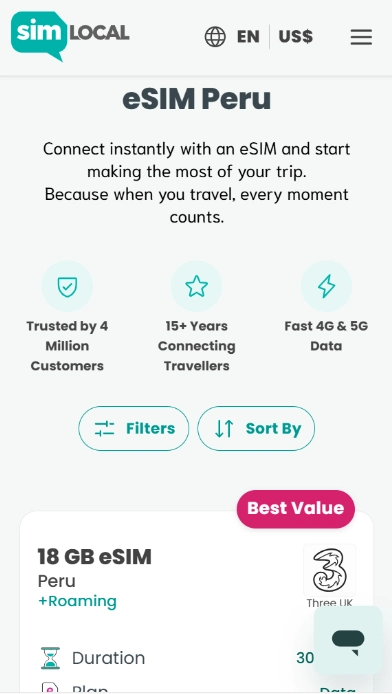
This is the cheapest eSIM Peru option worth buying, and it is not close. 5GB for $11.75. 10GB for $23.50. 20GB for $30.25, which works out at $1.51 per GB and is the lowest serious number in Peru right now.
For a two week trip with maps, WhatsApp, a few uploads and the odd panicked hunt for a bus timetable, 20GB at thirty dollars is a genuinely good deal and everyone else looks slow by comparison.
The daily cap plans go further still, with a 10 GB per day tier that lands near $0.48 per GB if you could ever burn it, which you cannot, but the maths is fun.
Two things to swallow. Sim Local does not name its Peruvian carrier anywhere, so you are buying blind in the one country where that matters most. And every Peru plan is 4G only. No 5G, even in Cusco where Claro now has it.
The refund window is also the tightest here: 14 days, unactivated only. Miss that and you own it.
Buy Sim Local if you are price led and staying on the main circuit. Buy Nomad if you want to know what you are standing on.
3
Jetpac
Code: none held. The price is the price.
Jetpac is a Circles.Life company out of Singapore and it does two things properly for Peru. It publishes a 3 GB daily allowance with an honest 1 Mbps floor afterwards, which is a speed you can actually navigate on.
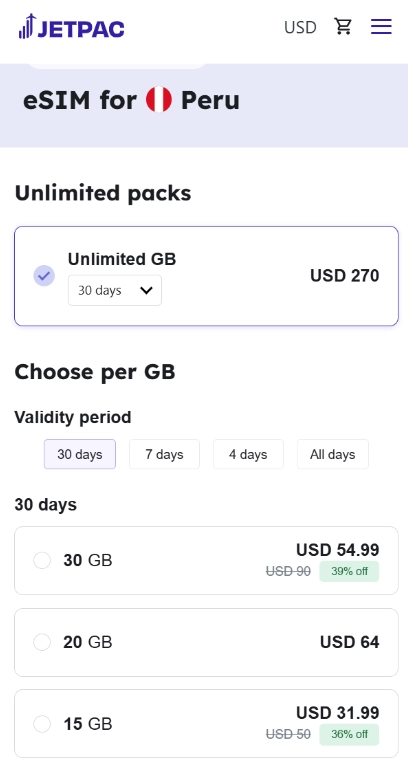
And its long plans are strong: 30GB for $54.99 is $1.83 per GB, comfortably better than Airalo or Saily at similar sizes.
Third parties place it on Claro, the fastest network in the country and the one with 5G in Cusco, though Jetpac itself does not confirm it. Add the airport lounge and transfer perks that Circles.Life bundles in and it is a more interesting product than the ranking suggests.
Now the weird bit. Jetpac's 20GB Peru plan costs $64.00. Its 30GB plan costs $54.99. More data, less money. That is not a typo on our side, it shows up on both Jetpac and the aggregators. Never buy the 20GB.
Its regional Latin America 20GB at $59.99 is also cheaper than the Peru only 20GB, which is the only case in this entire article where the regional bundle wins.
The app scores are the soft spot: 3.6 on Google Play and 4.0 on the App Store, well below everyone else here. Buy it on the website, use it for data, keep expectations of the app modest.
4
Saily
Saily comes from the Nord team and it shows in the polish. Best in class app ratings, 4.7 on Trustpilot from over 30,000 reviews, 5 million plus Android installs, and a genuinely clean install flow with built in ad blocking and a web protection layer that most travel eSIMs do not bother with.
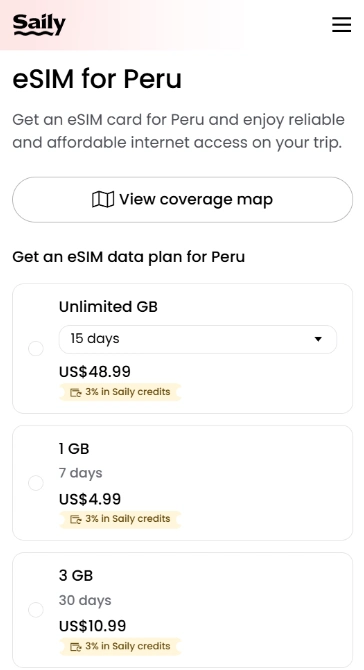
Saily eSIM Peru pricing runs 1GB $4.99, 5GB $17.99, 10GB $29.99, 20GB $40.99, and the unlimited tier gives you the most generous daily allowance in this list at 5 GB a day before it drops to around 1 Mbps.
If you burn data hard and hate thinking about it, that 5 GB ceiling is the best on offer.
The catch is simple arithmetic. At 10GB Saily is $29.99 against Sim Local's $23.50. You are paying 28% more for a nicer app and a security layer, on a network Saily does not name.
Its refund rule is also unusually strict once you activate: you need more than 99% of the data still sitting there. Stream one video, own the plan.
Worth it if you already trust the brand.
Our Airalo vs Saily comparison covers the wider fight, and the code is on the Saily coupon page.
5
Airalo
The Airalo eSIM Peru pack is sold under a local brand called Habla Telefon, running on Movistar, and the reason it earns a top five slot is not price.
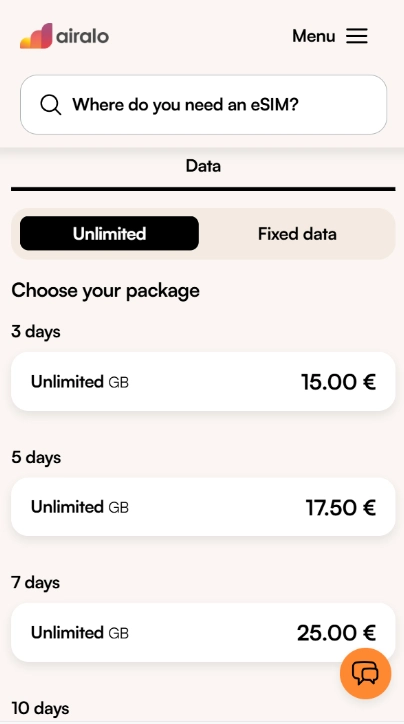
It is behaviour under pressure. Airalo's unlimited tiers give you 3 GB a day and then a published, usable 1 Mbps.
That is a floor you can navigate on, message on and hail a taxi on. Several brands here either publish nothing or publish something far worse.
Add 10 million plus Android installs, 41,000 Trustpilot reviews and eleven fixed tiers from $4.50 for 1GB to $41.00 for 20GB, and it is the option that fails most gracefully.
For a two week Andes trip the $42.50 15 day unlimited is the sweet spot at an effective $0.94 per GB, and it is the plan we would hand a nervous first timer.
The negatives are real though. Peru packs are 4G only, with 5G reserved for the pricier regional and global brands. And the refund cut off is the harshest phrasing in this article: 14 days or activation, whichever comes first.
Details in our Airalo review, code on the Airalo promo code page.
6
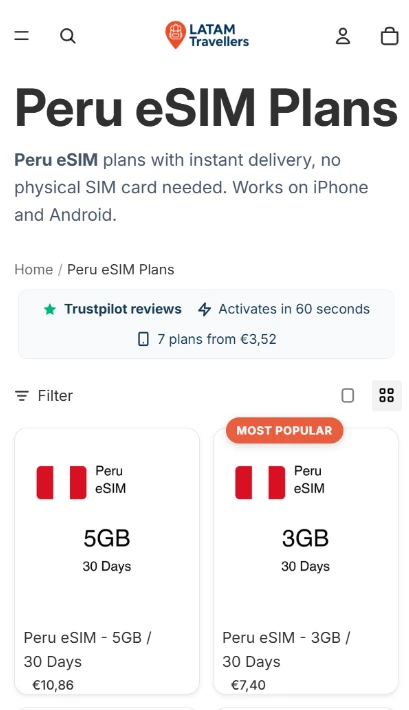
Latam Travellers
Every other brand in this list treats Peru as row 87 of a global spreadsheet. Latam Travellers only sells Latin America, and the product shape shows it.
You get a 100MB tier for a two day layover and a 50GB tier for a long stay, and neither Airalo nor Nomad offers either for Peru.
Pricing is in pounds: £2.58 for 1GB, £10.85 for 5GB, £17.61 for 10GB, £29.36 for 20GB at £1.47 per GB, which is competitive against the global brands once converted.
It also makes the only all four carrier claim in Peru, naming Claro, Movistar, Entel and Bitel.
Treat that claim with some care, because its own blog describes Movistar and Claro only, and its country count appears as 17, 19, 21 and 22 in different places. A specialist should be tidier than that.
There is no app, everything runs through the browser, so save your QR code to your photos before you fly.
Buy it if your trip is Peru plus Bolivia plus Chile and you want country by country plans rather than one bloated regional bundle. Skip it if you want an app and a support chat at 2am.
7
GigSky
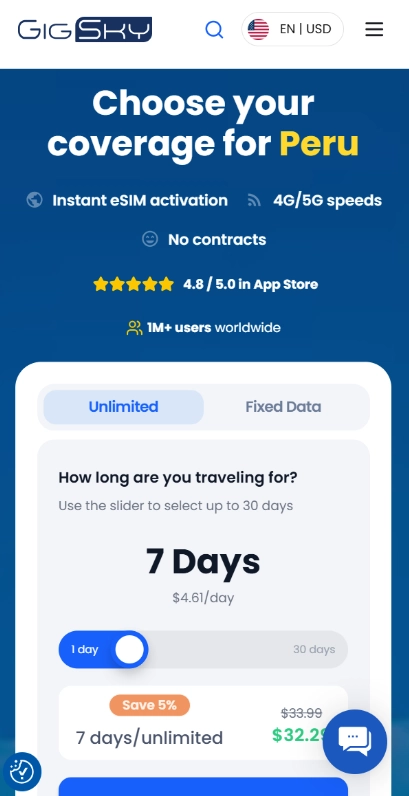
GigSky does something nobody else here does: it gives you 100MB free for 7 days in Peru with no card required. That is a real test drive. Install it at home, land in Lima, see if it attaches before you spend anything.
For a country where the carrier lottery decides your trip, a free trial is worth more than a small discount.
Paid plans are decent too, with 1GB at $3.49, 10GB at $24.79 and a 3.5 GB daily allowance on the unlimited tiers that reaches $0.82 per GB on the 21 day plan. Hotspot is unlimited. Our GigSky review has the wider picture and the code sits on the GigSky promo code page.
Then you read the refund terms and your eyebrows go up. Unused data is not refunded, full stop, at GigSky's sole discretion. That is the strictest position in this article by a distance.
No Peru carrier is published and no Peru plan carries 5G.
One last thing, since GigSky is the cruise brand. Peru does appear in its Cruise and Land Americas coverage, but that runs on the ship's own onboard cellular system, roughly an hour after departure, at $15 to $39 per GB.
It is not satellite and there is nothing confirming it works on small Amazon riverboats.
Our cruise eSIM guide has the full picture.
8
Billion Connect
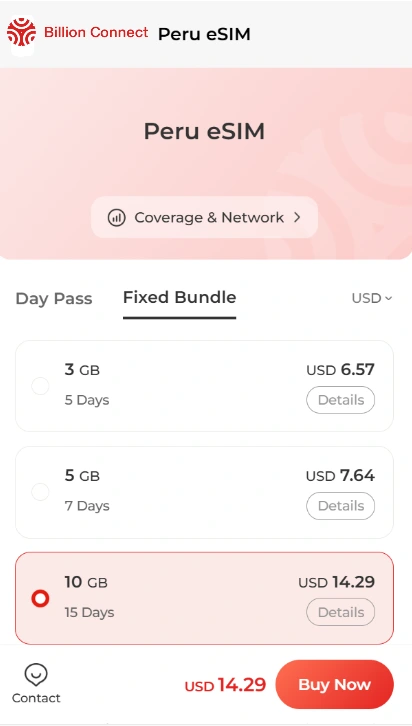
On a spreadsheet Billion Connect wins. $1.00 per GB on a 3GB single day plan, and around $0.89 per GB on the long daily cap tiers, which is the lowest number anywhere in this article.
It also sells Peru at single day granularity across roughly ninety different plan shapes, so if you want exactly four days of exactly two gigabytes a day, it is the only brand that will sell you that without rounding you up to a month.
For a short, precise, budget trip that flexibility is genuinely useful.
Then you find the throttle. 128 kbps. Not 1 Mbps. Not 512 kbps. One hundred and twenty eight kilobits, which is dial up with better marketing.
When Billion Connect's daily cap lands, your internet is over. It also has no top ups at all. Run out and you buy a whole new plan.
No published Peru carrier, no published refund policy, and a small review base. It is the right pick for a confident traveller doing four days in Lima on a budget, and the wrong pick for almost everyone else.
9
Ubigi
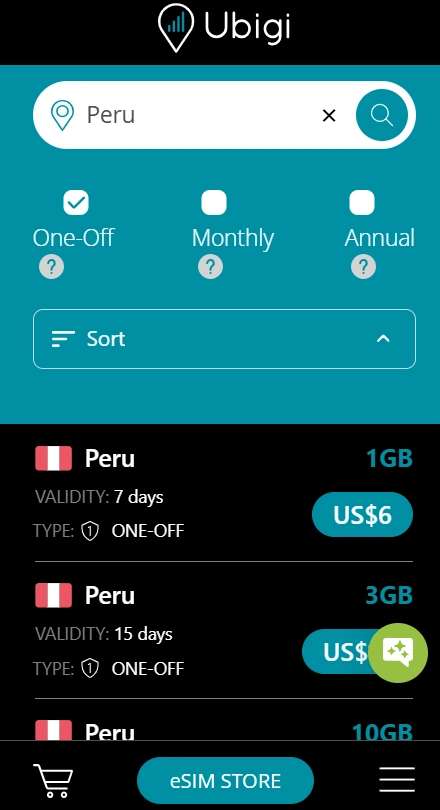
Ubigi is not a reseller in the normal sense. It is Transatel, an NTT company, running its own core network, its own IMSI range and its own eSIM profiles, buying Peruvian radio wholesale from Movistar, which it names openly.
What that buys you is the single best throttle in this article. When Ubigi's high speed bucket runs out, you drop to 2 Mbps, which is double Airalo's floor and roughly sixteen times Billion Connect's.
Plans run 500MB at $5.00 up to 25GB for $42.00 ($1.68 per GB), with a 60GB plus unlimited at 2 Mbps for $79.00 over 30 days.
Two warnings. Ubigi states plainly that its Peru service is not 5G, so you are on LTE everywhere.
And its refund rule is unforgiving: zero data used, refunded within 14 business days. Touch it and it is yours.
The one that catches people out: Ubigi's Latin America regional plan does not include Peru.
Buy the regional bundle for a Peru and Chile trip and you land in Lima with nothing. Buy the Peru plan.
10
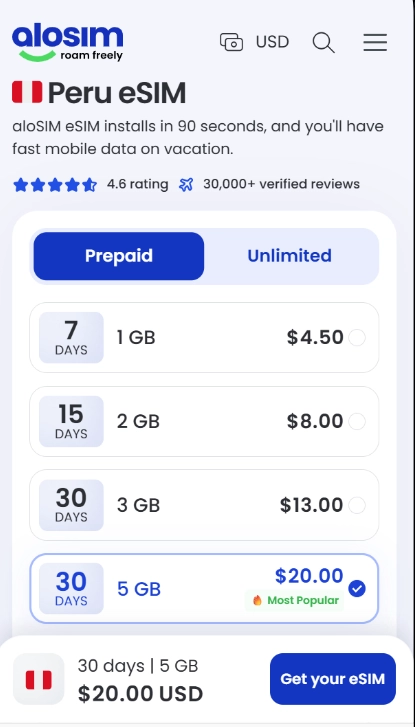
aloSIM
aloSIM runs on Movistar in Peru and names it, which puts it ahead of half this list on transparency.
Pricing is mid pack at 1GB $4.50, 10GB $29.00, 20GB $43.00, and its named tiers are easy to read: Weekender at $20 for 3 days, Month Abroad at $68 for 30.
It throws in a free phone number with most plans, the eSIM profile never expires so future trips are a top up rather than a reinstall, and hotspot is free on everything.
Arequipa is named among its strongest Peru coverage cities.
Then the gap. aloSIM does not publish its Peru daily cap or its throttled speed. Not on the product page, not in the fair use explainer.
Every rival at this end of the list tells you. That silence is why it sits tenth rather than fifth.
Be clear eyed about the free number too. It is a US or Canada VoIP number from the Hushed app, with three dollars of credit.
It is not a Peruvian line, it will not receive your bank's verification code, and it is a separate app with a separate login.
Buy aloSIM for a repeat traveller profile you keep forever. Do not buy its unlimited tier until it publishes the floor.
Where your signal actually dies in Peru?
Prices are easy. This is the section that saves your trip.
Lima. eSIM Lima Peru coverage is the best in the country. Miraflores, San Isidro and Barranco are solid, with measured travel eSIM speeds of 25 to 45 Mbps. The airport gives you 30 minutes of free wifi per device, which is exactly enough time to realise you should have installed your eSIM at home.
Cusco. Stable 4G and now on Claro's 5G district list. Wifi is everywhere in hotels and cafés. Cusco airport has none, so land with data already working.
The Sacred Valley. Pisac, Ollantaytambo, Urubamba. Drops to 5 to 15 Mbps and gets patchy between towns. Claro and Movistar carry the widest coverage here.
Aguas Calientes. Fine. 5 to 15 Mbps plus hotel wifi. This is your last charging and downloading station, so treat it like one.
Machu Picchu itself. This is where it dies. Signal near the entrance, weak to nonexistent deeper into the site, and no wifi anywhere on the archaeological site.
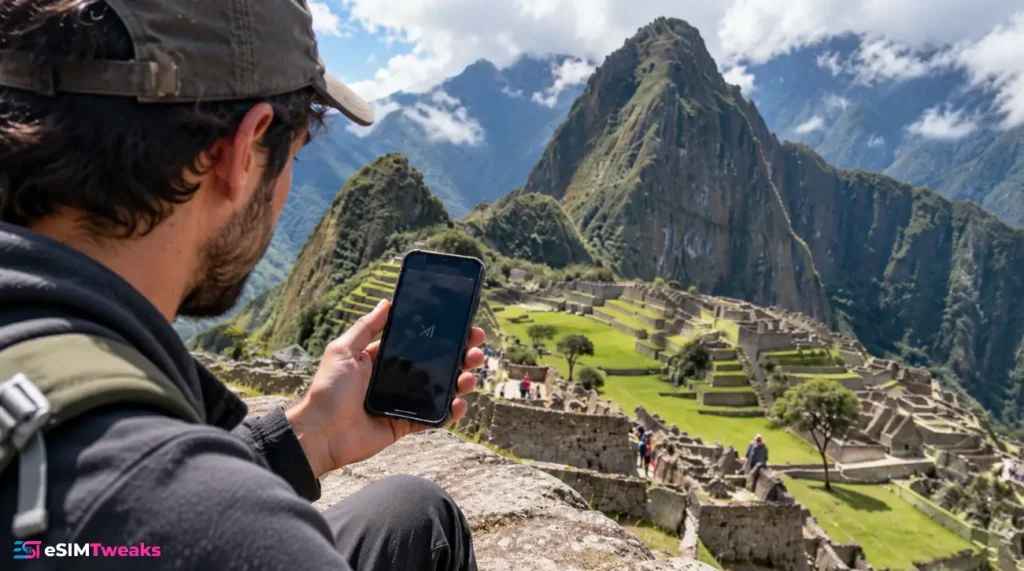
Download your entry ticket QR, your train ticket and your offline map before you leave Aguas Calientes. Nobody has ever regretted doing that.
The four day Inca Trail. The single biggest dead zone on the tourist circuit. Signal on day one until roughly lunchtime, then it goes. Day two, over Dead Woman's Pass at 4,215 metres, is practically nothing including at camp.
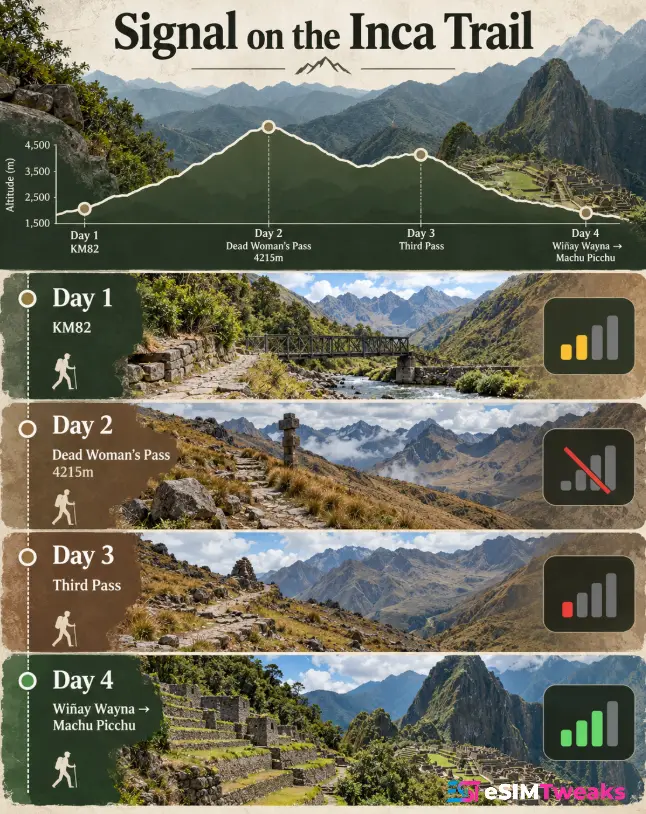
Day three is mostly absent with a possible flicker near the Third Pass. Day four it returns near Wiñay Wayna. Movistar is the most commonly cited survivor.
Serious operators carry satellite phones for a reason, and no campsite has mains power, so bring a power bank you would be embarrassed to describe to a friend.
Rainbow Mountain, Vinicunca. Above 5,000 metres. Plan for nothing. The high passes on the Inka Jungle route are already dead at 4,300 metres, and this is higher.
Lake Titicaca and the Uros islands. Puno city is stable and on Claro's 5G list. The floating islands catch mainland signal in patches. Do not build a work call around it.
Arequipa. Strong. One of the better connected cities in Peru and on the 5G list.
Colca, Nazca, Huacachina, Iquitos, Puerto Maldonado. Towns fine, everything between them variable, Amazon lodges usually nothing but satellite wifi they will charge you for.
Can you just get a Claro eSIM in Peru instead?
Fair question, and the answer changed in November 2025.
All four operators sell eSIM profiles domestically. A Claro eSIM Peru line, a Movistar eSIM Peru line, an Entel Peru eSIM or a Bitel eSIM Peru plan are all real products.
Locals use them constantly. The problem is you are not a local.
Since the OSIPTEL rules landed, a foreigner contracting any Peruvian mobile line has to do it in person, with biometric verification checked against the immigration database, capped at one line per 30 days. That applies whether the line lands on a plastic chip or an eSIM profile. Same contract, same counter, same queue.
So the practical position is this. A local carrier plan is cheaper per gigabyte and gives you a Peruvian number.
It also costs you a morning, a shop visit, a fingerprint scan and a conversation in Spanish about documents, and reports on which papers are accepted keep contradicting each other.
A travel eSIM costs a few dollars more and takes ninety seconds on your sofa.
If you are staying three months and want a local number for banking and deliveries, go and get the local line. If you are here for two weeks of ruins and ceviche, buy eSIM Peru coverage from a travel brand before you fly and spend the morning on a walking tour instead.
An eSIM card for Peru bought from a travel brand is roaming, not a contract, and that is the entire difference.
How much data do you actually need in Peru?
Most people massively overbuy, then feel clever about it.
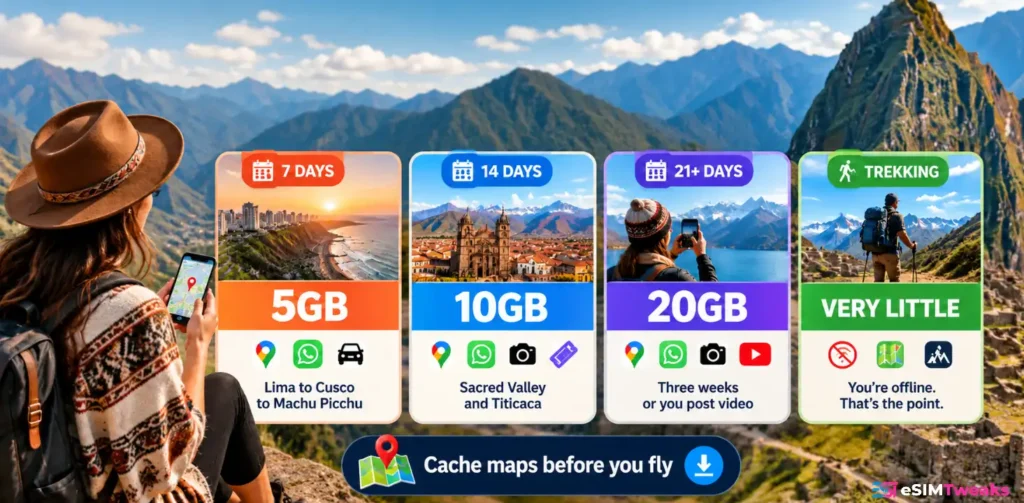
The reason people burn data in Peru is not streaming. It is re downloading maps because they did not cache them, and re uploading photos because the hotel wifi timed out. Cache Cusco, the Sacred Valley and Aguas Calientes offline before you fly and you will genuinely halve your usage.
Our data planner does the sums if you want them.
Setting it up without crying at Lima airport
Do all of this at home, on wifi, before you fly. Every one star review in this category starts with somebody doing it in an arrivals hall.
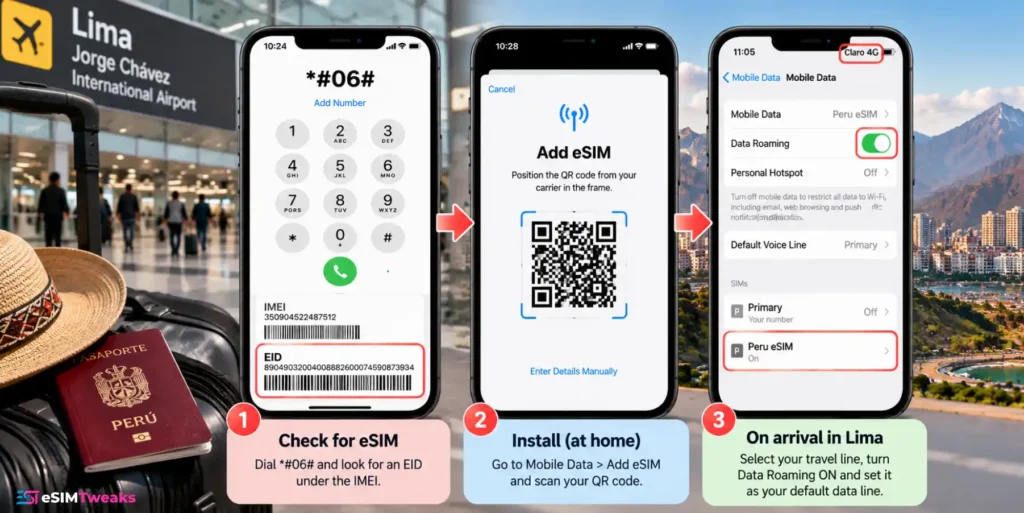
Check the phone first. Dial *#06#. If you see an EID under the IMEI, you have an eSIM chip. The phone also has to be carrier unlocked. Our Android compatibility list covers the awkward models.
Install, do not activate. Install the profile at home and let it sit. Most Peru plans start their clock on first connection in country, not at purchase, but that varies by brand, so buy close to departure.
iPhone: Settings, Mobile Data, Add eSIM, Use QR Code. Android: Settings, Network and Internet, SIMs, Add eSIM.
When you land in Lima, select the travel line, turn Data Roaming ON, set it as your default data line, and turn roaming OFF on your home SIM so it cannot bill you the moment the plane doors open.
If nothing loads, wait five minutes for the network to attach, then set network selection to Manual and pick the host carrier by name. This is exactly why buying a brand that names its carrier is worth a dollar more.
Five Peru eSIM mistakes that cost real money
Nomad's Latin America plan costs 56% more per GB than its Peru plan. Saily's is 50% more. Only Jetpac's 20GB breaks the pattern.
If you are not crossing a border, do not buy the border product.
It does not include Peru. That is not a nuance, that is a plane landing and a phone doing nothing.
$59 for 14GB upstairs, about $9 for 4GB downstairs. Same brand, same building.
Every Peru eSIM unlimited data plan here is a daily cap in a costume.
The gap between Ubigi's 2 Mbps floor and Billion Connect's 128 kbps is the gap between "slow" and "off".
Airalo's refund ends at activation or 14 days. Ubigi wants zero data used.
Sim Local gives you 14 days unactivated. Nomad voids promo code purchases entirely once installed. Buy late, install late.
FAQ's
Will my eSIM work on the PeruRail or IncaRail train to Machu Picchu?
Patchily. The Ollantaytambo to Aguas Calientes line runs through the Urubamba gorge, and signal comes and goes with the canyon walls. Download your ticket QR before boarding. Neither train guarantees onboard connectivity and the staff will not be able to help you retrieve a ticket from an email you cannot open.
Can I keep using my Peru eSIM if I cross into Bolivia at Copacabana?
No. A Peru only plan stops at the border, and Peru's membership of the Andean roaming pact applies to Peruvian line holders, not to your travel eSIM. Either buy a South America regional plan before you go, or install a second Bolivia plan and switch lines at the crossing. Doing it at Kasani in the rain is not fun.
Does the altitude in Cusco actually affect my phone?
Not the signal, but very much the battery. Cold at 3,400 metres, and colder on early Rainbow Mountain and Humantay starts, drains lithium batteries fast and phones sometimes shut down at what they claim is 30%. Keep the phone in an inside pocket rather than an outside one, and carry a power bank. Warming a "dead" phone against your body often brings it straight back.
Can I hotspot my guide or my group on a trek?
Where there is signal, yes. Every provider in this list allows hotspot on Peru plans, and GigSky and aloSIM state it explicitly with no surcharge. The real limit is not policy, it is that four people tethered to one phone at 4,000 metres will flatten it before lunch. Agree who is the hotspot and let everyone else stay in airplane mode.
My flight out of Lima got cancelled and my plan expires tomorrow. Now what?
Top up rather than rebuy, if your provider allows it. aloSIM keeps the eSIM profile alive permanently so you add days to the existing line. Nomad, Airalo and Saily all support top ups too. Billion Connect does not support top ups at all, so an extension there means buying a whole new plan and installing a whole new profile.
Do I need a Peruvian phone number for Uber, Cabify or InDrive in Lima?
No. Those apps work fine on your existing account with data only, and drivers contact you through the in app chat. What you do lose is SMS verification if an app decides to re verify you mid trip, so log in and confirm everything works while you still have your home network, before you fly.
The verdict
Peru is a country where the network you land on matters more than the logo on the app.
Buy Nomad. It is the only brand in this list that puts the Peruvian carrier on the page before you pay, and that carrier is Movistar, the one with the widest guaranteed coverage in the country.
10GB for $25.00 is fair, the app is good, and when something goes wrong on a Tuesday night in Ollantaytambo there is a real support operation behind it. Use ESIMDUDE15 for 15% off.
If you are counting every dollar, Sim Local does 20GB for $30.25 and nothing else comes close on price. You are trading away knowing your carrier, and on the main tourist circuit that trade is usually fine. Use ESIMDUDE10 for 10% off.
That is the decision. Two options, both good, and you can stop reading comparison articles now and go book the train. Still torn? Our eSIM finder will pick one for you in about forty seconds.
Why trust eSIMTweaks.
59 providers tested.
388 speed tests run.
20 countries covered.
More like this




About the author

Editor-in-Chief
As Editor-in-Chief, I am responsible for our editorial standards, review methodology and the final approval of every provider ranking published on eSIMTweaks. I have spent fifteen years in travel and consumer technology publishing. Our team purchases the plans it evaluates, and commercial partnerships have no influence on placement.