eSIM for Cruises 2026: 9 Best Plans for Sea + Port
Compare 9 eSIM for Cruises options for sea days and ports, including which plans actually connect offshore and which only work near land. See at-sea coverage, pricing, hotspot support, cruise-line compatibility, and the best picks for different sailing styles.
September 6, 2026
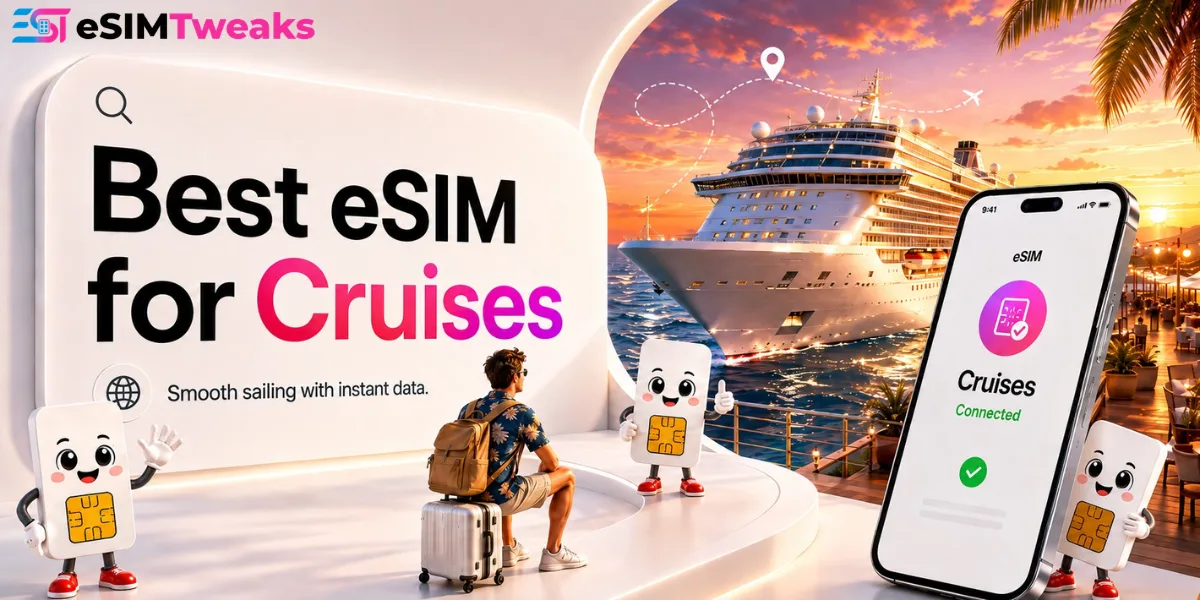
About an hour out of Galveston the bars came back. Not the ship’s wifi, which I had not paid for. My phone had found a cell tower, except there is no tower in the Gulf of Mexico.
There is a picocell bolted into the ship, backhauled to a satellite, and it had quietly started charging somebody. Every rule you know about mobile data abroad changes the moment you pass the horizon.
Here is the arithmetic that should decide your purchase. A family of four buying Carnival’s Premium Multi-Device wifi onboard pays $112 a day, which is $784 for a seven night sailing. One GigSky unlimited cruise plan for the same week costs $40.99 and can be shared to all four phones over a personal hotspot.
That is 19 times cheaper, and it is the honest version of the 20x claim. For a single device the gap is roughly 5 times. Leave your phone off airplane mode with no plan at all and AT&T bills international roaming at $2.05 per megabyte at sea, which is $2,099 per gigabyte.

Buy the GigSky travel eSIM, the only prepaid data plan for cruise passengers that covers 290+ ships across roughly 35 cruise lines with one profile working at sea and on land in port. Unlimited runs $40.99 for seven days or $69.99 for fourteen, and a free 100MB trial with no credit card lets you prove it attaches on your ship before you pay.
If your ship is not on GigSky’s list, Red Bull Mobile and Saily both sell genuine at sea plans. Everything else here is a land plan for your ports of call, whatever the product name says.
Best eSIM for cruises 2026 at a glance
Prices checked 10 August 2026. The column that matters is the second one, because five of these nine do not connect on open water at all.
Maya cruise eSIM plans
Plans that keep working at sea as well as in port. Ordinary travel eSIMs stop once the ship leaves coastal coverage, which is the whole reason these cost more than a normal plan.
| Plan | Data | Validity | Price | Per day | |
|---|---|---|---|---|---|
 Maya Mobile
|
Unlimited | 3 days | $49.99 | $16.66 | Get Deal |
|
Maya Mobile
|
Unlimited | 7 days | $109.99 | $15.71 | Get Deal |
|
Maya Mobile
|
Unlimited | 14 days | $160.99 | $11.50 | Get Deal |
|
Maya Mobile
|
Unlimited | 30 days | $299.99 | $10.00 | Get Deal |
Unlimited with a fair-use allowance of 5GB per day at full speed; after that the connection continues at 3Mbps rather than stopping. Hotspot sharing is supported. No calls or texts. Prices checked 14 October 2026.
| Provider | Works at sea? | Best cruise price | Coverage | Code |
|---|---|---|---|---|
| GigSky | Yes, sea and port | $40.99 unlimited / 7 days | 290+ ships, 35 lines | ESIMADVICE15 |
| Red Bull Mobile | Yes, sea and port | €18 for 1GB / 30 days | 160+ ships, 40+ operators | None |
| Saily | Yes, sea only | $29.99 for 1GB / 7 days | 200+ ships, 28 operators | ESIMDUDE |
| Holafly | Ports only | $39.50 unlimited / 7 days | Caribbean, Med, Europe, Alaska | None |
| Airalo | Ports only | $45.00 unlimited / 7 days | 26 Caribbean networks | ESIMADVICE15 |
| Roamic | Ports only | $88.97 unlimited / 7 days | 18 Caribbean islands | None |
| Breeze | Ports only | $39.99 for 10GB / 30 days | 25 Caribbean countries | None |
| Nomad | Ports only | $21.00 for 5GB / 30 days | 15 Caribbean destinations | See coupon page |
| Maya Mobile | Yes, sea and port | $160.99 unlimited / 14 days | 20+ cruise lines | None |
Read that table twice. A travel eSIM is a roaming product that needs a radio mast, and there are no masts in the middle of the Atlantic. Only four of the nine connect once you are past the horizon. The other five are good plans for Cozumel, Santorini or Skagway, and dead for the sea days in between.
How we tested?
iPhone 16 Pro as the primary unit with the home SIM left in and roaming off, Galaxy S24 as the Android control. Every plan gets three reads: in port, within sight of land, and on open water past the twelve mile line.
We log the network name the handset reports, because at sea that tells you which maritime operator you actually attached to, and we buy every plan with our own card.
How data on a cruise ship actually works?
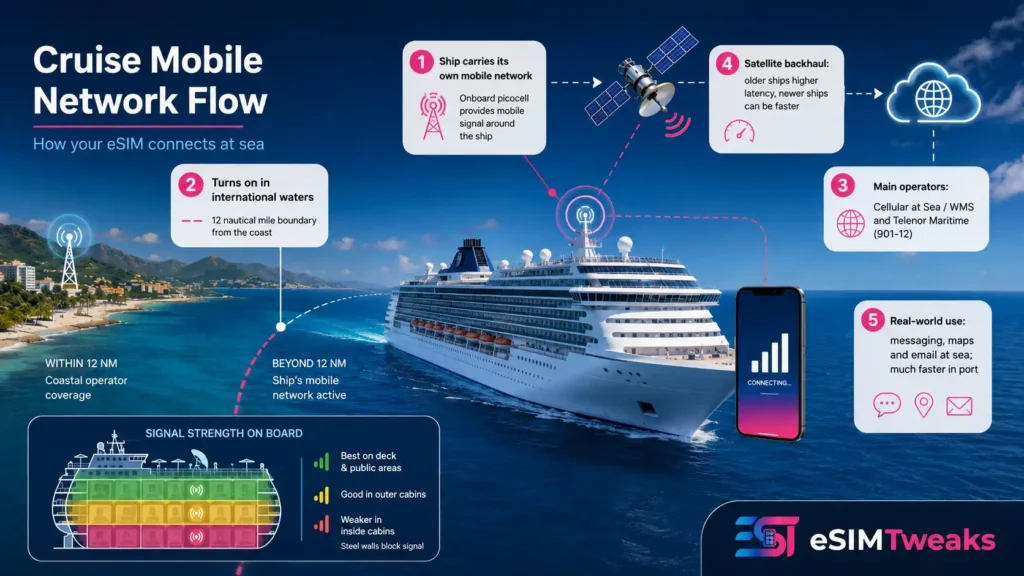
Your ship carries its own mobile network. Not wifi. A picocell, a miniature phone mast bolted into the vessel, broadcasting under a non geographic network code that no country owns.
The two operators running almost all of them are Wireless Maritime Services, which brands itself Cellular at Sea, and Telenor Maritime, on network code 901-12. WMS alone reports 200+ ships across 26 cruise lines and more than 400 international roaming partners, and those partners are how any eSIM reaches your handset out there.
It only switches on in international waters. Ships disable the onboard network within roughly twelve nautical miles of land so they do not interfere with licensed spectrum ashore, which is about an hour after you leave port.
Some operators switch on nearer six. Either way there is a dead window on departure and on approach, and that window is not a fault with your plan.
The backhaul is satellite, and that is the cost. For twenty years that meant a geostationary dish 22,000 miles up, which is why latency at sea ran near 700 milliseconds. WMS integrated Starlink backhaul in 2023 and launched the first live 5G at sea on ocean going cruise ships in 2024. Most ships run some mix of GSM, 3G and LTE, and 5G coverage is still limited to newer tonnage.
What that means in practice. Expect roughly 700 kbps to 4 Mbps with latency from 80 milliseconds on a Starlink backhauled ship to 700 on an older one.
A test on a Norwegian Western Caribbean sailing measured 3.34 Mbps and 696 milliseconds sixty miles off Galveston, against 69.58 Mbps in Costa Maya on the same eSIM the next day. That is the honest shape of the product: messaging, maps and email at sea, a normal fast connection the moment you step onto a dock.
Steel blocks signal. The hull is a Faraday cage with windows. Reception is best on deck and in public rooms near the antennas, worst in a low inside cabin. Ship wifi has access points in the corridors, which is the one thing it genuinely does better.
Why ship wifi costs what it costs?
Cruise lines sell wifi per device, per day, and that model survived Starlink intact. Prices went up, not down. Carnival raised its packages in December 2025 and Disney raised both tiers in January 2026, moving its Internet Package from $26 to $30 a device a day and Internet plus Streaming from $42 to $49.
| Cruise line | Package, one device | Per day | Seven nights |
|---|---|---|---|
| Celebrity | Basic | $20.00 | $140.00 |
| Carnival | Social, pre-cruise | $20.40 | $142.80 |
| Princess | MedallionNet Classic | $24.99 | $174.93 |
| Carnival | Premium, pre-cruise | $25.50 | $178.50 |
| Holland America | Premium | $26.00 | $182.00 |
| Royal Caribbean | Surf and Stream | $26.99 to $38.70 | $188.93 to $270.90 |
| Norwegian | Voyage WiFi Pass | $29.99 | $209.93 |
| Disney | Internet Package | $30.00 | $210.00 |
| Celebrity | Premium | $35.00 | $245.00 |
| Norwegian | Streaming Voyage Pass | $39.99 | $279.93 |
| Disney | Internet plus Streaming | $49.00 | $343.00 |
Against GigSky’s $40.99 unlimited seven day cruise plan, that table runs 3.4 to 8.4 times more expensive for one device. Add devices and it breaks open, because the eSIM tethers and the wifi package does not. Carnival’s four device Premium bundle is $112 a day onboard, so $784 a week against $40.99. Disney’s streaming tier for a family of four is $1,372.
Three lines are worth knowing about because they break the pattern: Virgin Voyages includes basic wifi free for every sailor, and Viking and Oceania both include it fleet wide. If you are on one of those, buy nothing.
The 9 best eSIMs for cruises in 2026, ranked
Price ladder, whether it works on open water, what it does well, and the catch.
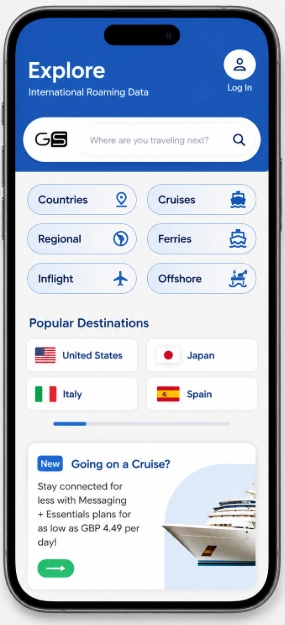
GigSky covers 290 or more cruise ships and 200 or more land destinations on a single profile, and it is the only provider here built to hand off between the ship’s onboard network and terrestrial towers in port without you touching anything. Its own words: “works at sea and in port”.
The cruise line list runs to roughly 35 operators: Royal Caribbean International across 28 ships, Norwegian Cruise Line across 19, plus Disney Cruise Line, Celebrity, Carnival, MSC, Princess, Holland America, AIDA Cruises, Costa Crociere, P&O Cruises, TUI Cruises, Virgin Voyages, Silversea, Seabourn, Regent Seven Seas, Oceania, Explora Journeys, Hapag-Lloyd, Azamara and Windstar.
Regional variants cover the Americas and Caribbean at 48 countries, Europe at 44, Asia Pacific at 25 and a World plan at 128.
Unlimited runs $7.00 for a day, $19.99 for three, $31.49 for five, $40.99 for seven, $55.99 for ten and $69.99 for fourteen, which is where the “from $5 a day” line comes from.
Fixed buckets sit alongside at $31.99 for 1GB over seven days. Tethering is permitted on iPhone with eSIM, on Android and on Windows, which is the single fact that turns a $40.99 plan into a family plan.
The free trial is the reason to start here. GigSky gives new users 100MB valid seven days, up to 500MB across 42 European countries, with no credit card and no auto charge, working on 280 or more ships.
Install it, board, wait for the twelve mile line, and find out whether your vessel attaches before you have spent anything. No competitor offers that.
Two honest catches. The Cruises Only plan does not work on land, so unless you want a second plan for ports you want Cruise plus Land.
And GigSky’s complimentary Visa data allowances, generous on land, do not extend to cruise coverage, so do not board expecting a Visa Infinite benefit to cover the sea days.
Choose GigSky if you want one eSIM for the whole sailing, ship and shore, with a free way to test it first.
ESIMADVICE15 takes 15% off GigSky, turning the $40.99 seven day unlimited cruise plan into $34.84. AFFMAVEN10 gives 10% if the first has expired. Full terms on our GigSky promo code page.
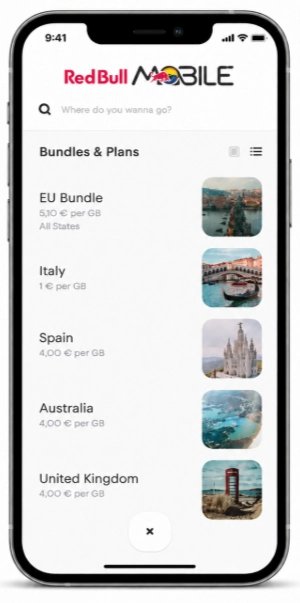
Red Bull Mobile is the only provider that names Telenor Maritime as its maritime partner outright, and it is clear that what you join is a 4G network on the ship rather than a wifi service.
Coverage runs to 160 or more vessels across 40 or more operators, including AIDA across 11 ships, Viking Ocean across 12, Costa Crociere across 9, plus P&O Cruises, Cunard, Carnival and ferry lines including Stena Line and DFDS.
Two ladders, and the difference matters. Cruise Only is €5 for 250MB or €15 for 1GB and works only from about twelve nautical miles out.
Cruise and Land is €6 and €18 for the same volumes, carries no twelve mile limitation and adds 60 or more land destinations. The €15 gigabyte is the cheapest genuine maritime data here.
The catch is that you must buy and install before boarding, and topping up needs connectivity you may not have at sea. Volumes are small: nothing above 1GB, on a 30 day validity period.
Choose Red Bull Mobile if you want a cheap, honest, small at sea allowance and your ship is on their list. Take Cruise and Land unless you have a separate plan for ports.
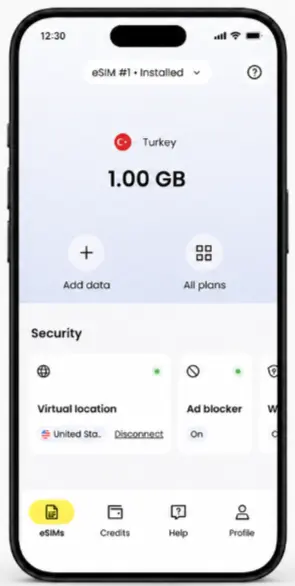
Saily launched dedicated cruise plans on 23 June 2026 and they are the real thing, connecting to maritime networks across 200 or more vessels on Royal Caribbean Group, Carnival Corporation, Norwegian Cruise Line Holdings, MSC, Disney, Virgin Voyages, P&O Cruises and Cunard.
Saily also tells you exactly what to look for on the handset, naming 901-18, WMS or Cellular at Sea. That is the clearest technical disclosure of any provider here.
Two catches. The cruise plan activates only beyond twelve nautical miles and will not connect in port or near the coastline, so it is a sea plan, not a whole trip plan. And the rollout is listed by cruise company rather than by ship, so check your vessel in the app first.
Saily’s separate Caribbean Islands land plan covers 29 countries with unlimited hotspot sharing from $8.99, and pairing the two works well.
Choose Saily if your ship is confirmed in the app and you want a maritime plan from a brand with a proper support desk.
ESIMDUDE takes 10% off Saily, bringing the $29.99 one gigabyte cruise plan to $26.99. AFFMAVEN5 gives 5%. See the Saily coupon code page.
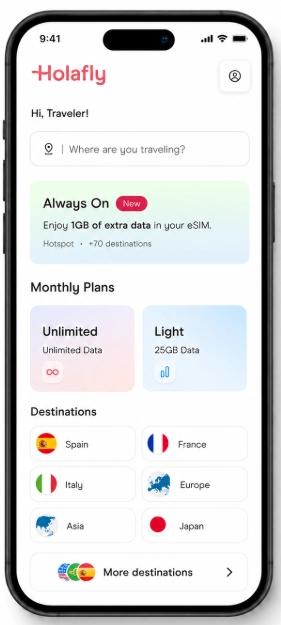
Holafly sells four bundles with “cruise” in the name, covering the Caribbean, Mediterranean, Europe and Alaska, and they are good value for port days.
Unlimited data, and a useful quirk: the Caribbean Cruise bundle is cheaper than the standard Caribbean bundle at every tier, $97.90 against $161.50 over thirty days, because it covers fewer countries. If your itinerary fits its list, buy the cruise version.
The catch is one Holafly states itself, and credit to them for it: “This eSIM provides coverage only on land for the indicated destinations and does not guarantee coverage at sea.” They go further and advise keeping airplane mode on at sea.
The name says cruise and the terms say shore. Hotspot sharing is capped at 1GB a day, and coverage is unavailable at CocoCay, Ocean Cay and Freeport, three of the most common private island calls in the Caribbean.
Choose Holafly if your sailing is port heavy and you want unlimited data ashore, with something else handling the sea days.
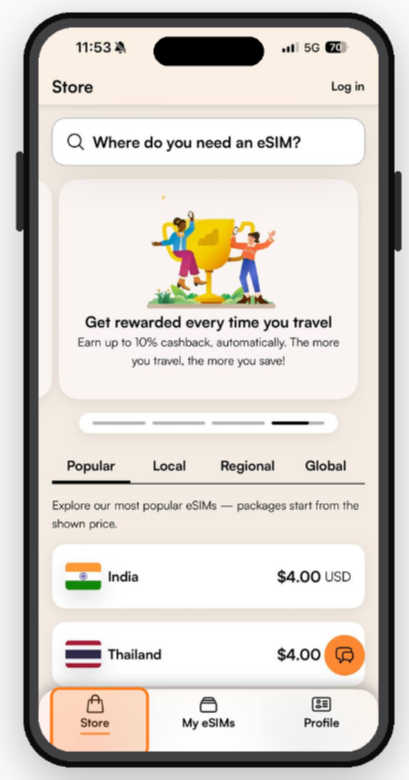
Airalo’s Caribbean Islands plan spans 26 networks and is the easiest thing here to buy and install, with QR code activation or one tap in the app. Unlimited runs $19.50 for three days, $45.00 for seven and $160.00 for thirty, with 3GB a day at full speed before the throttle.
Eurolink covers 41 countries for Mediterranean sailings at $27.00 for seven days.
The catch is that Airalo does not sell a cruise or maritime plan, and unlike Nomad and Holafly it does not warn that a regional eSIM stops working once you pass the twelve mile line.
It is a very good port plan bought by a lot of people who think it is something else.
Choose Airalo if your itinerary is a string of ports and you want the smoothest app experience for the land half of the trip.
ESIMADVICE15 takes 15% off for new customers, turning the $45.00 seven day Caribbean unlimited into $38.25. Existing customers use ESIMADVICE10. See our Airalo promo code page.
Roamic sells an unlimited Caribbean plan covering around 18 islands including Barbados, Puerto Rico, Jamaica, the Dominican Republic, Saint Lucia, the Cayman Islands, Turks and Caicos and the British Virgin Islands, with 3GB a day at full speed before dropping to 1 Mbps.
Tethering is supported and there is a six month refund window on an unused eSIM.
Two catches. It is the most expensive Caribbean plan here at $8.44 a gigabyte, roughly double Breeze and more than triple Nomad. And Roamic makes no claim about working at sea, so treat it as a port plan.
Its coverage list is padded with South American mainland countries no Caribbean cruise calls at, so count the islands rather than the countries.
Choose Roamic if you specifically want unlimited data ashore across the eastern Caribbean and the price does not decide it.
Breeze covers 25 Caribbean countries and prices well at the larger buckets, with 10GB over thirty days at $4.00 a gigabyte and 20GB at $3.30, the second cheapest metered ladder here.
Hotspot is included on every plan, and the validity period begins on first use in the Caribbean rather than at purchase, which is the correct behaviour.
The catch is that Breeze has no cruise or maritime product and does not warn you about open water. Its day plans at 1GB per 24 hours look cheap and work out at over $9 a gigabyte, so read the structure before you tap.
Choose Breeze if you want the most data for the least money on shore and you have the sea days covered separately.
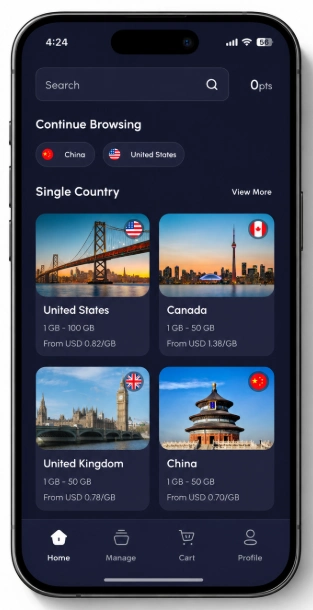
On price per gigabyte ashore, Nomad wins outright. Its Caribbean plan covers 15 destinations at $4.20 a gigabyte at 5GB and $2.45 at 20GB, less than half what most of this list charges.
There is a 60 day window between purchase and activation, top ups chain onto the main plan automatically, and tethering is supported.
Nomad also gives the clearest explanation of the limitation of any provider here, stating plainly that an international eSIM faces the same constraint as roaming, so out on the water and out of range of a cell tower, there is no coverage. That honesty is worth something. It is still a port plan.
Choose Nomad if you want the lowest cost per gigabyte for your ports of call.
Nomad codes rotate. Current ones sit on our Nomad eSIM promo code page.
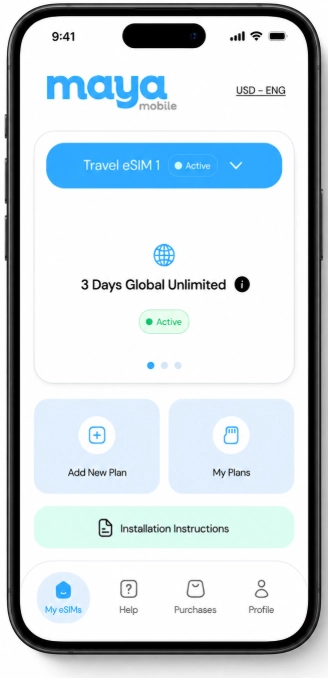
Maya deserves more attention than it gets. Its Global plus Cruise plan covers both sea and port, names more than twenty operators including Royal Caribbean, Carnival, Celebrity, Disney, MSC, Norwegian, Princess, Virgin Voyages, Silversea and TUI, and is the only unlimited at sea option here.
Hotspot and tethering carry no fees and no restrictions, which for a large family is the whole argument.
The catch is the premium. Maya’s plain Global plan is $49.99 for thirty days and Global plus Cruise is $299.99, so the maritime capability carries a six times markup. Maya also does not name its maritime network operator, so the at sea claim is asserted rather than documented.
On a two week transatlantic it can pencil out. On a seven night Caribbean loop it does not.
Choose Maya if you are on a long crossing with many sea days and you want genuinely uncapped data rather than a daily allowance.
ESIMTWEAKS10 — Get 10% Off Maya Mobile
Which cruise lines are actually covered?
Coverage is per ship, not per brand, so the useful question is whether your specific vessel carries a network your eSIM has a roaming deal with.
| Cruise line | GigSky | Red Bull Mobile | Saily | Maya |
|---|---|---|---|---|
| Royal Caribbean International | Yes, 28 ships | Yes | Yes | Yes |
| Norwegian Cruise Line | Yes, 19 ships | Yes | Yes | Yes |
| Carnival Cruise Line | Yes | Yes | Yes | Yes |
| Celebrity Cruises | Yes | Yes | Yes | Yes |
| Disney Cruise Line | Yes | Yes | Yes | Yes |
| MSC Cruises | Yes | Yes | Yes | Yes |
| Princess Cruises | Yes | Yes | Yes | Yes |
| Holland America Line | Yes | Yes | Yes | Yes |
| AIDA Cruises | Yes | Yes, 11 ships | Yes | Yes |
| Costa Crociere | Yes | Yes, 9 ships | Yes | Yes |
| Virgin Voyages | Yes | Yes | Yes | Yes |
| Viking Ocean Cruises | Yes | Yes, 12 ships | Yes | Yes |
| P&O Cruises | Yes | Yes, 7 ships | Yes | Yes |
| TUI Cruises | Yes | Yes | Yes | Yes |
| Silversea, Seabourn, Regent, Oceania | Yes | Some | Yes | Yes |
The instruction is the same regardless: check your ship by name in the provider’s app before you pay, then use GigSky’s free trial on the first sea day to confirm it attaches.
Ferries are the same problem, cheaper to solve
A Channel or Baltic crossing has the same architecture as a cruise, and the same bill shock, on a shorter timescale.
GigSky launched a dedicated ferry service in January 2026 covering 17 European operators: Anek Lines, Blue Star Ferries, Brittany Ferries, Color Line, Condor Ferries, Corsica Ferries, DFDS, Finnlines, Fjordline, GNV, Grimaldi Lines, Irish Ferries, La Meridionale, Polferries, Smyril Line, Stena Line and SuperFast Ferries.
Two shapes: Ferry Only and Ferry plus Europe, the latter adding 41 European land destinations so one profile covers the crossing and the driving at both ends. Pricing starts around $7.99.
Red Bull Mobile covers ferries too, with Stena Line across 12 vessels, DFDS Seaways across 12, Finnlines and Irish Ferries. On an overnight Stockholm to Helsinki, a ferry plan is the difference between working through the crossing and staring at the sea.
How much data do you need on a cruise?
| Trip style | Sailing length | Suggested plan | Cost |
|---|---|---|---|
| Test it before you commit | Any | GigSky free trial, 100MB | $0 |
| Messaging and maps only | 3 to 4 nights | GigSky unlimited, 3 days | $19.99 |
| Normal use, one phone | 7 nights | GigSky unlimited, 7 days | $40.99 |
| Family sharing a hotspot | 7 nights | GigSky unlimited, 7 days | $40.99 |
| Long sailing or transatlantic | 14 nights | GigSky unlimited, 14 days | $69.99 |
| Ports only, sea days offline | 7 nights | Nomad Caribbean 5GB | $21.00 |
| Heavy use, many sea days | 14 nights | Maya Global plus Cruise | $160.99 |
You will use less than you expect at sea, because 700 milliseconds of latency discourages scrolling by itself, and far more in port, where a fast local network plus a day of photos and maps eats a gigabyte without trying.
How to set up a cruise eSIM?
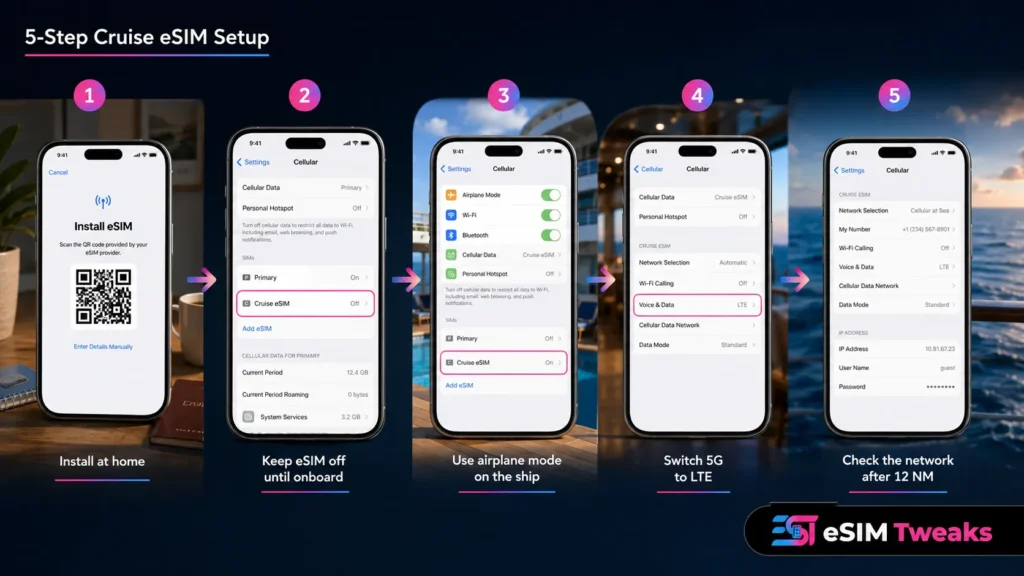
Five steps, and the order genuinely matters here.
Cruise terminal wifi is famously poor, and QR code activation needs a working connection before it will do anything. Install on your own wifi before you leave for the port.
Some plans that include land coverage activate the moment they see a home network, which at a US or Canadian departure port means the clock starts in the car park. Install the profile but leave the line switched off until you are aboard.
Then turn wifi and the travel eSIM back on individually. That is what stops your home carrier attaching to the ship’s network and billing you at maritime rates.
Most ships run GSM, 3G and LTE, and 5G coverage exists only on newer vessels. A handset locked to 5G preferred can sit searching instead of attaching.
Service starts roughly an hour after you leave port. Look at the operator name in your status bar.
Cellular at Sea, WMS, 901-18 or Telenor Maritime means you are on the ship’s network and the plan is working as designed.
Things nobody tells you about cruise connectivity
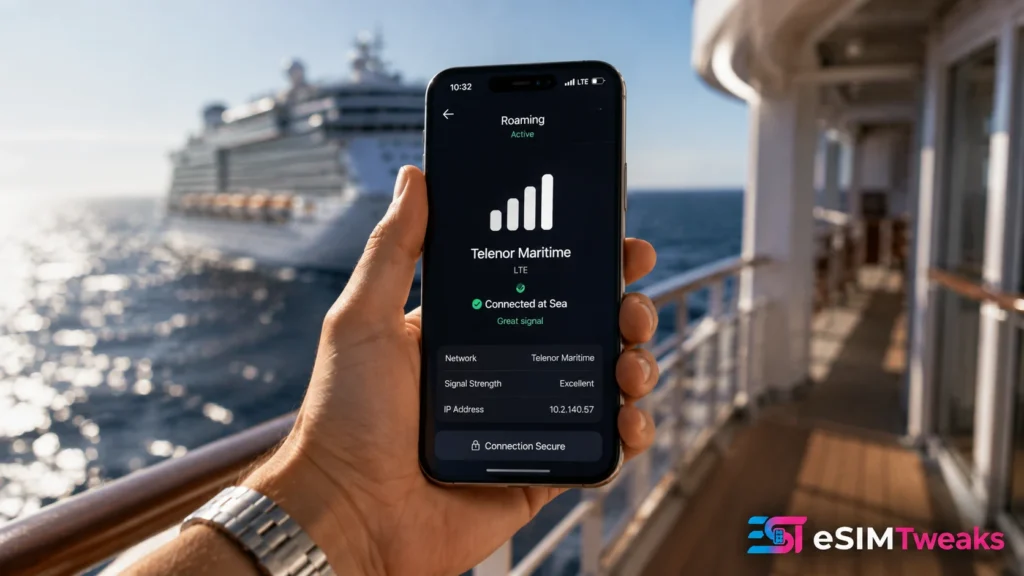
Bars are the trap, not the reassurance. The ship’s network is visible to every handset aboard, and without a cruise plan your home carrier treats it as roaming. At AT&T’s published at sea rate of $2.05 a megabyte, one automatic iOS update of three gigabytes costs about $6,300.
AT&T International Day Pass and Verizon Cruise Daily Pass both offer cruise connectivity as an alternative to buying the ship’s Wi-Fi package.
Inside cabins are the worst place on the ship for cellular. Expect to walk up to a public deck to send anything. Ship wifi wins on in cabin coverage, and that is the one thing worth paying it for.
Pre-cruise wifi pricing is 20 to 30 percent cheaper than onboard. If you are buying the ship’s package anyway, buy it before you sail.
Three lines give it away. Virgin Voyages includes basic wifi for every sailor, and Viking and Oceania include it fleet wide. Check your fare before you buy anything at all.
The market is enormous and growing. According to the 2026 State of the Cruise Industry report, the industry carried 37.2 million ocean passengers in 2025.
The Caribbean, Bahamas and Bermuda account for 16.27 million passengers, 44 percent of the global total, which is why the Americas and Caribbean plan is the one most readers need.
Frequently asked questions
Why does my phone show full bars at sea but nothing loads?
You have attached to the ship’s picocell but have no plan authorised on that maritime network.
What network name should appear when a cruise eSIM is working?
Cellular at Sea, WMS, 901-18 or Telenor Maritime. Anything else means you are still on a land network.
Do I need to disable 5G for a cruise eSIM to connect?
Yes on most ships. Set the handset to 4G or LTE, since many vessels broadcast only GSM, 3G and LTE.
Can one cruise eSIM feed several phones on board?
Yes. GigSky, Maya and Nomad all permit tethering, so one plan can serve a whole cabin.
Why is latency so much worse at sea than in port?
Backhaul is satellite. Older geostationary links add roughly 700 milliseconds; Starlink equipped ships run nearer 80.
Does a cruise eSIM work while the ship is docked?
Only if it includes land coverage. Sea only plans stay dormant within twelve nautical miles of shore.
Will an eSIM drain my battery faster on a ship?
Yes, in weak signal areas like interior cabins, because the radio raises transmit power hunting for the onboard cell.
The bottom line
For most cruise passengers in 2026, GigSky is the best eSIM for cruises. It is the only provider covering 290 or more ships and 200 or more land destinations on one profile that works at sea and in port, and its free 100MB trial lets you confirm it attaches to your vessel before you spend anything.
Unlimited costs $40.99 for seven days against $140 to $343 for a single device of ship wifi on the same sailing, and it shares to a whole family over a personal hotspot where the ship’s package cannot.
If your vessel is not on GigSky’s list, Red Bull Mobile sells the cheapest small at sea allowance on Telenor Maritime and Saily sells a genuine maritime plan on Cellular at Sea.
If you only care about ports of call, Nomad is the cheapest per gigabyte ashore. Everything else here is a land plan wearing a cruise label, and the twelve mile line will find that out for you.
Whatever you choose, install at home, keep the phone in airplane mode until you are past the coast, and never let your home carrier attach to the ship’s network without a plan on it.
Start with the free trial. GigSky gives new customers 100MB across 280+ cruise ships with no credit card required, so you can prove it works on your ship before you pay for anything. Then use ESIMADVICE15 for 15% off any paid plan.
Details on our GigSky promo code page.
Why trust eSIMTweaks.
59 providers tested.
388 speed tests run.
20 countries covered.
More like this



About the author

Head of Network Testing
I lead field testing at eSIMTweaks, conducting speed, latency and reliability trials on live networks across Latin America and Southern Europe. In the past year I evaluated more than 60 eSIM profiles under real travel conditions. Every performance figure we publish originates from testing I run or supervise.