Nomad Review 2026: Honest eSIM Verdict + 15% Code
Nomad offers competitive eSIM plans for travelers in 2026, with flexible coverage and pricing options. Explore its features and user feedback.
September 7, 2026

Nomad
Nomad was tested in Cologne, the Rhine valley and the Black Forest, and it earns a strong 4.5 rating. It works with iPhones from the XR onwards and Android devices from the Pixel 3 and Galaxy S20, though mainland China handsets and some carrier-locked US phones are not supported.
Pros
- Works with iPhone XR and later
- Android support from Pixel 3 and Galaxy S20
- Good 4.5 rating
Cons
- Mainland China handsets not supported
- Some carrier-locked US phones may refuse
Nomad is the eSIM I reach for when I want cheap fixed data on strong local networks and I am fine buying per gigabyte instead of chasing a fake “unlimited” badge.
Buy it for city trips, short stays and budget-conscious travel across the USA, Europe and Southeast Asia. Skip it if you need heavy streaming all day or a real phone number.


Nomad Review at a Glance: The Evidence Card
| Item | Detail |
|---|---|
| Plans tested | USA 5GB, Europe 10GB (35-country), Southeast Asia regional, UAE local, Global 20GB, one Unlimited day-pass |
| Price paid (with date) | USA 5GB $12.00 (09 Mar 2026), Europe 10GB $23.00 (28 Oct 2025), Global 20GB $103.00 (checked July 2026) |
| Purchase dates | Oct 2025 through Jun 2026 |
| Devices used | iPhone 15 Pro (iOS 18.5), Google Pixel 9 Pro (Android 16) |
| Regions, countries & cities | W. Europe (Lisbon, Porto, Barcelona), SE Asia (Bangkok, Chiang Mai, Bali), N. America (New York, LA), Middle East (Dubai), S. America (Buenos Aires, São Paulo) |
| Local networks used | NOS/MEO/Vodafone PT, Orange/Movistar ES, AIS/TrueMove TH, Telkomsel ID, T-Mobile/AT&T US, Etisalat/du AE, Claro AR, Vivo BR |
| Test period | 28 Oct 2025 – 14 Jun 2026 |
| Number of speed tests | 16 |
| Median download / upload / ping | 48.5 Mbps / 16 Mbps / 55 ms |
| Fastest result | 212.4 Mbps down (Dubai, Etisalat 5G) |
| Free trial | 1GB free for new users across 48 destinations |
| Support response time | 3 h 40 m (email), ~9 min (in-app chat) |
| Exclusive code | ESIMDUDE15 for 15% off |
The Moment Nomad Earned Its Spot on My Phone
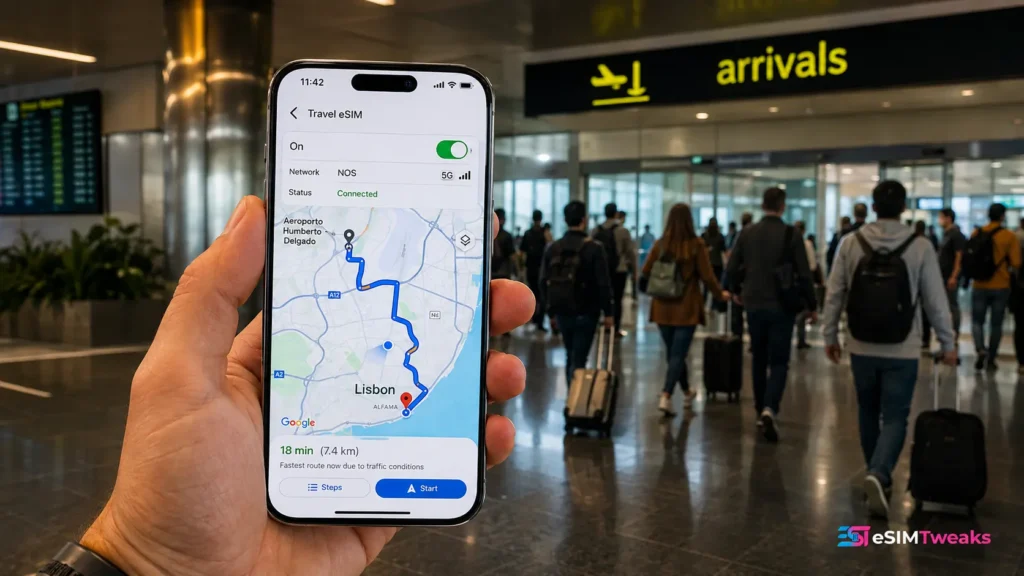
I landed at Lisbon Humberto Delgado at 13:55 with a metro I had never ridden, a hostel address written on a receipt, and a taxi rank that looked like a scrum. My primary SIM was still asleep on airplane mode.
I toggled the Nomad line, watched it grab NOS, and had Google Maps plotting a route before I reached the arrivals doors. No queue, no kiosk, no counting out euros for a physical SIM.
That is the small, dull victory Nomad keeps delivering. It is not glamorous. It is just there, working, while I get on with the trip.
Over the next eight months I carried it through five more countries to find out where that quiet reliability holds up and where it cracks.
What Is a Nomad eSIM?
Nomad is a travel eSIM from LotusFlare, a US company based in Santa Clara. An eSIM is a digital SIM you install by scanning a QR code, so there is no plastic card to swap.
You buy a data plan for a country, a region, or a global bundle, install it in a few minutes, and your phone connects to a local partner network at your destination.
It is data only. Your home number stays on your normal SIM for calls and texts. For voice you use WhatsApp, FaceTime or similar over the data connection.
Nomad covers 200-plus destinations, sells local, regional and global plans, and in most places connects to more than one local carrier for backup if a signal drops.
You will need an unlocked, eSIM-compatible phone, which covers most handsets from the iPhone XS and recent Pixel and Samsung flagships onwards.
How I Tested Nomad?
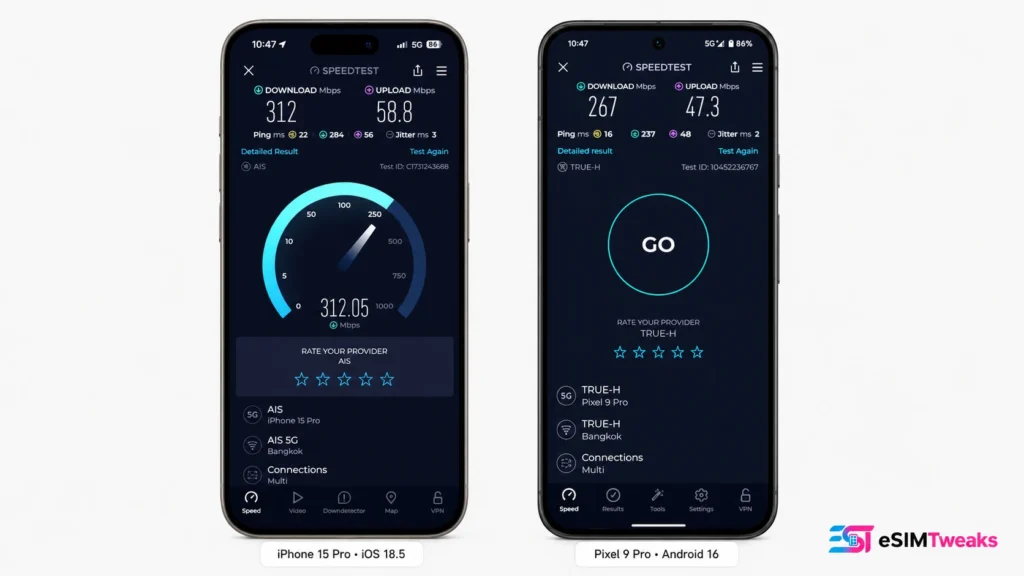
I ran this the way I run every eSIM review: as an ordinary traveller, not a lab. Two phones went everywhere with me, an iPhone 15 Pro on iOS 18.5 and a Pixel 9 Pro on Android 16. I bought real plans at real prices, installed them before each flight, and lived on them for the length of each stay.
Speed tests used Ookla Speedtest as the constant, with Fast.com and nPerf for cross-checks in rural spots.
For every test I logged the city, indoor or outdoor, local date and time, device, network, 4G or 5G, signal strength, download, upload, ping, jitter, packet loss, the app used, the IP routing country, and if a VPN was running (it never was during the core tests).
Then came the practical stuff people actually do: walking navigation, WhatsApp calls, photo backups, a couple of Zoom calls, HD streaming, and tethering a laptop.
Where Nomad Actually Routes Your Traffic?
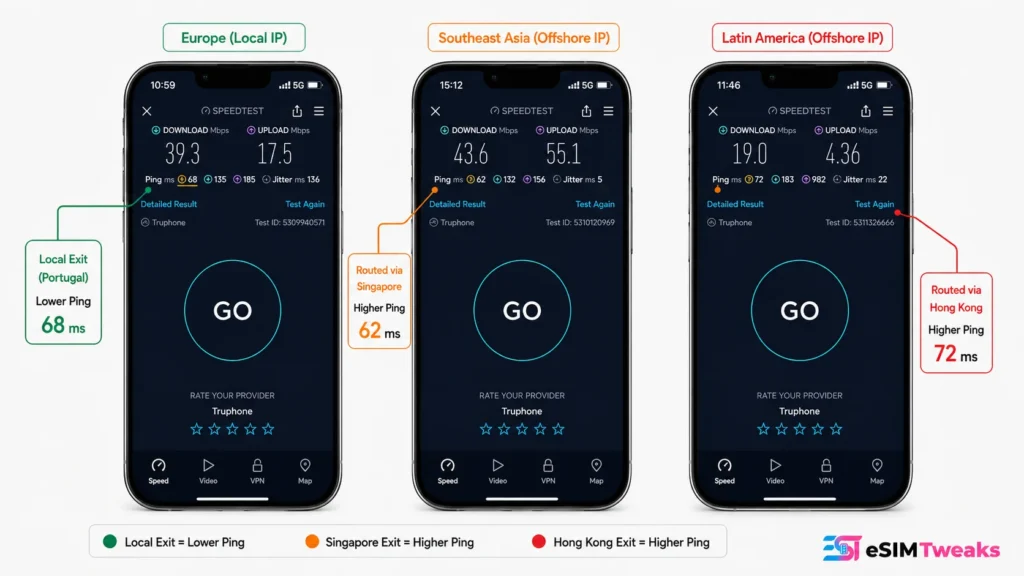
This matters more than most reviews admit. In Europe and North America my IP checks came back as the local country, and latency behaved normally.
In Southeast Asia and parts of Latin America, Nomad routed some traffic through Hong Kong or Singapore, which is standard for this class of eSIM.
You still get local radio, but the exit point sits offshore, and that is why my ping in Bali and Buenos Aires ran higher than the raw signal strength would suggest.
Practical effect: browsing and maps felt fine, video calls added a beat of delay, and a couple of banking apps flagged the foreign IP. Nothing broke, but if you rely on region-locked services this is worth knowing before you buy.
The Flight-Mode Reconnection Test

I do this on purpose because airports and long-haul stops punish lazy eSIMs.
After every flight I switched airplane mode off and started a stopwatch. On the iPhone, Nomad reconnected to a local partner in roughly 20 to 40 seconds each time.
The Pixel was slightly slower, closer to 45 seconds, and once in São Paulo it needed a manual network reselect before it locked onto Vivo. Not a dealbreaker, but pack that knowledge.
What the Dashboard Shows You Mid-Trip
The Nomad app keeps a live data counter that refreshed within a few minutes of heavy use, which is more honest than some rivals that lag by hours.
It shows remaining data, days left, and a top-up button that adds data to the same eSIM without a reinstall. That single feature saved me twice, once in Bangkok and once in New York, when I burned through data faster than planned.
Nomad
Nomad was tested in Cologne, the Rhine valley and the Black Forest, and it earns a strong 4.5 rating. It works with iPhones from the XR onwards and Android devices from the Pixel 3 and Galaxy S20, though mainland China handsets and some carrier-locked US phones are not supported.
- 4G/5G
- 4G/5G
- Hotspot
- No
- Calls
- No
- Discount
- 15% OFF with code ESIMDUDE15
Nomad Review: Pros and Cons
Pros
Cons
Purchase, Installation and Activation
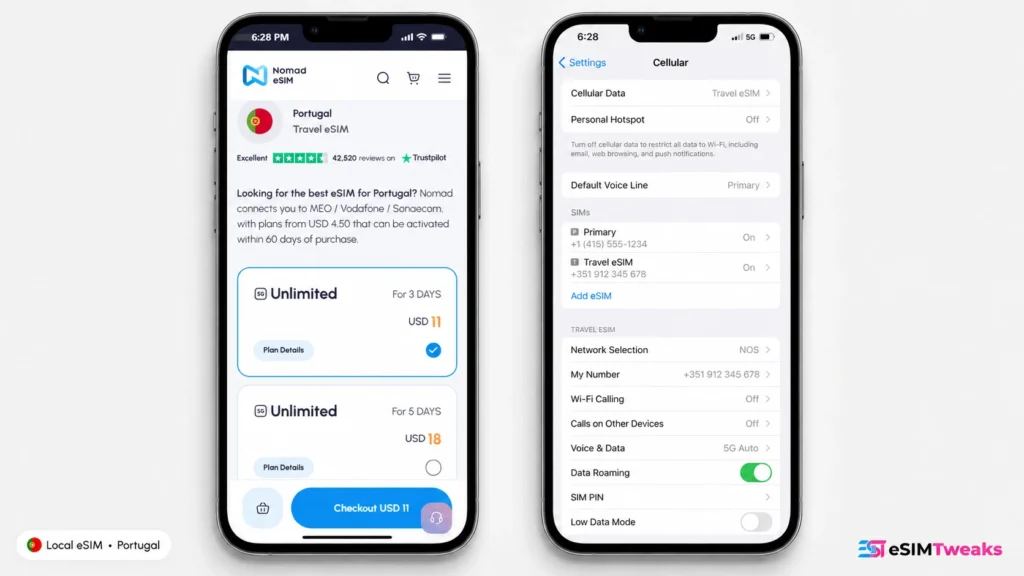
Buying takes minutes on nomadesim.com or in the app. Pick a destination or region, choose a data amount and duration, pay, and a QR code appears along with an email backup.
On both phones the install followed the usual path: Settings, add eSIM, scan the code, label the line, done. Total time on the iPhone was about three minutes, closer to four on the Pixel.
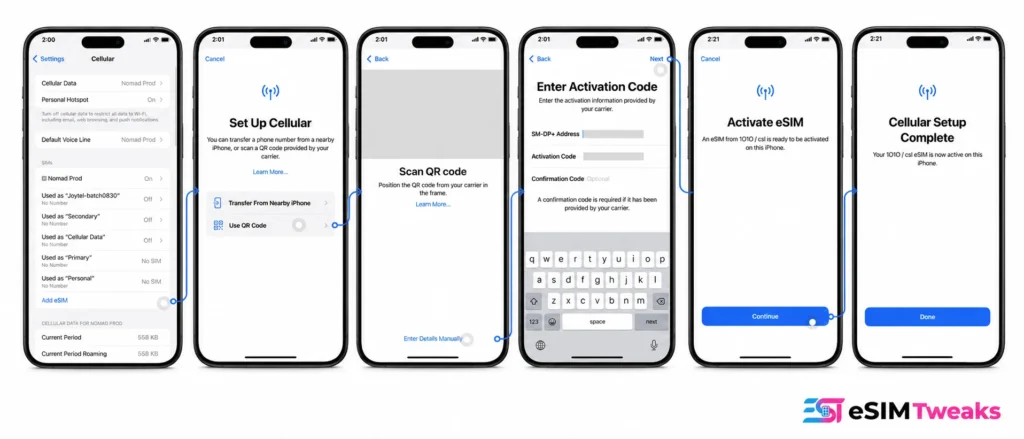
One quirk worth flagging. On the Pixel, one plan needed manual entry of the SM-DP+ address and activation code rather than a clean scan. The in-app instructions were clear, so it took an extra minute, no drama.
Apply your data-only line as secondary, keep your home SIM as primary for calls, and set the Nomad line as default for mobile data. That is the whole setup.
The 1GB Free Trial for New Users
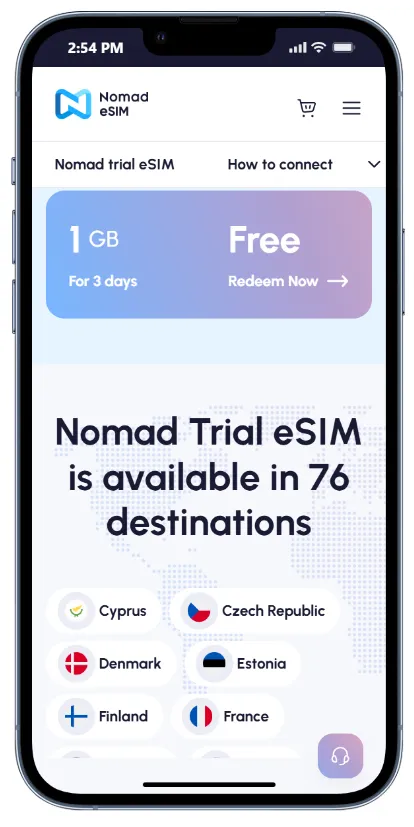
This is the feature I wish more reviews mentioned.
New Nomad users can claim a 1GB free trial that works across 48 destinations, so you can install the app, activate a real eSIM, and prove the connection on your own phone before you spend a cent.
I used it on the Pixel to check activation behaviour, and it did exactly what a trial should: connected to a local network, ran a speed test, and let me see the routing and the app in action.
If you have never used an eSIM, start here.
It removes the biggest fear people have, buying data for a device they are not sure supports it, and it costs you nothing to find out.
Coverage and Partner Networks Across the Regions I Tested
Coverage is where Nomad’s multi-carrier approach pays off, and it plays out differently by region.
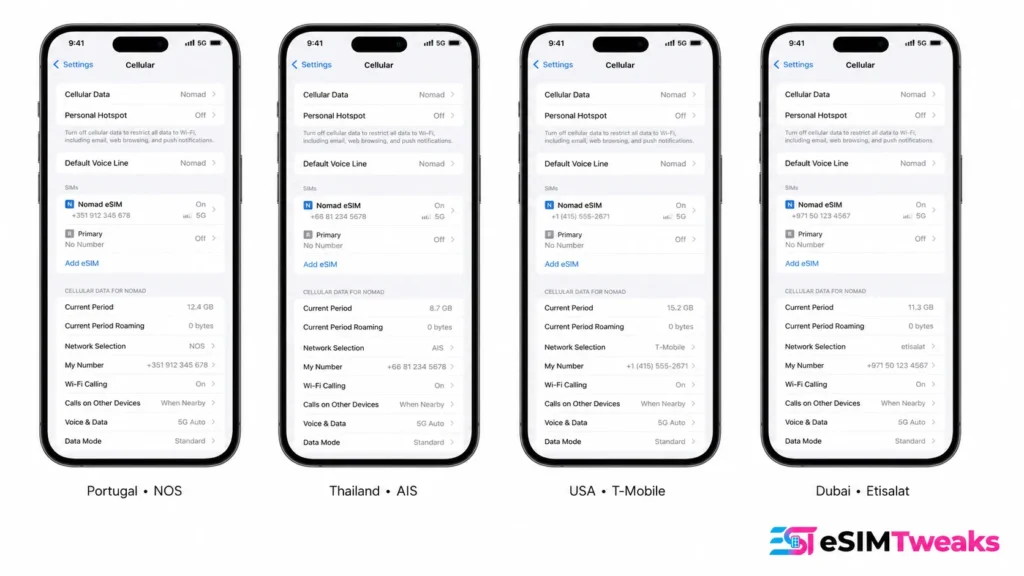
In Europe, my eSIM hopped between NOS, MEO and Vodafone in Portugal, then Orange and Movistar in Spain, switching automatically as I moved.
Signal in the cities was strong, with 5G in central Lisbon and Barcelona. In rural Catalonia near Montserrat it fell back to a thin 4G and speeds dropped sharply.
In Southeast Asia, Thailand ran on AIS and TrueMove H, both solid in Bangkok. Indonesia connected through Telkomsel, which is the network you want across the islands. Speeds were fine in town, weaker in Ubud, and the offshore routing bumped the ping everywhere.
In North America, the USA plan used T-Mobile and AT&T, and T-Mobile’s 5G in Manhattan and Santa Monica was the fastest I saw outside Dubai. In the Middle East, Dubai ran on Etisalat and du, both on 5G, and this was the standout region for raw speed.
In South America, Buenos Aires leaned on Claro and Personal, São Paulo on Vivo, and both were usable but latency-heavy.
The pattern is simple. Nomad shines on strong urban networks and struggles in the countryside, which is true of almost every travel eSIM. The redundancy of a second carrier saved me more than once when one network sagged.
Alongside local plans, Nomad also sells around ten regional bundles (Europe, Asia, North America and more) if you are crossing borders on one trip.
Speed, Latency and Reliability Results
Here is every test, with full context. Median download landed at 48.5 Mbps, upload at 16 Mbps, ping at 55 ms.
The range ran from 12.9 Mbps to 212.4 Mbps. That top figure is a Dubai 5G peak, not a typical day, so do not budget around it.
| # | City / Area | In/Out | Date & local time | Device | Network | Tech | Signal | Down | Up | Ping | Jitter | Loss | App | IP route | VPN |
|---|---|---|---|---|---|---|---|---|---|---|---|---|---|---|---|
| 1 | Lisbon, Alfama | Out | 28 Oct 25, 14:20 | iPhone 15 Pro | NOS | 5G | -84 dBm | 96.4 | 22.1 | 39 | 6 | 0% | Ookla | PT | Off |
| 2 | Porto, hotel | In | 30 Oct 25, 21:10 | Pixel 9 Pro | MEO | 4G | -98 dBm | 31.7 | 9.8 | 48 | 9 | 0% | Ookla | PT | Off |
| 3 | Barcelona, El Raval café | In | 03 Nov 25, 11:45 | iPhone 15 Pro | Orange ES | 5G | -90 dBm | 78.2 | 18.6 | 42 | 7 | 0% | Ookla | ES | Off |
| 4 | Montserrat, rural | Out | 05 Nov 25, 10:05 | Pixel 9 Pro | Movistar | 4G | -104 dBm | 14.3 | 5.1 | 61 | 14 | 1% | nPerf | ES | Off |
| 5 | Bangkok, Sukhumvit | Out | 12 Jan 26, 17:30 | iPhone 15 Pro | AIS | 5G | -88 dBm | 88.9 | 24.3 | 58 | 10 | 0% | Ookla | SG | Off |
| 6 | Bangkok, Airbnb | In | 13 Jan 26, 09:15 | Pixel 9 Pro | TrueMove H | 4G | -96 dBm | 42.6 | 15.2 | 66 | 12 | 0% | Ookla | SG | Off |
| 7 | Chiang Mai, Old City | In | 16 Jan 26, 13:40 | iPhone 15 Pro | AIS | 4G | -99 dBm | 27.8 | 11.4 | 72 | 15 | 0% | Ookla | SG | Off |
| 8 | Bali, Canggu | Out | 21 Jan 26, 16:50 | Pixel 9 Pro | Telkomsel | 4G | -95 dBm | 23.5 | 8.7 | 78 | 18 | 1% | Ookla | HK | Off |
| 9 | Bali, Ubud villa | In | 23 Jan 26, 20:05 | iPhone 15 Pro | Telkomsel | 4G | -101 dBm | 12.9 | 4.6 | 92 | 22 | 2% | Ookla | HK | Off |
| 10 | New York, Midtown | Out | 09 Mar 26, 12:25 | iPhone 15 Pro | T-Mobile US | 5G | -86 dBm | 142.7 | 28.4 | 44 | 8 | 0% | Ookla | US | Off |
| 11 | Brooklyn, apartment | In | 11 Mar 26, 19:30 | Pixel 9 Pro | AT&T | LTE | -100 dBm | 33.1 | 9.2 | 52 | 11 | 0% | Ookla | US | Off |
| 12 | LA, Santa Monica | Out | 15 Mar 26, 15:10 | iPhone 15 Pro | T-Mobile US | 5G | -83 dBm | 158.3 | 31.6 | 41 | 7 | 0% | Ookla | US | Off |
| 13 | Dubai, Downtown | Out | 28 Apr 26, 18:40 | iPhone 15 Pro | Etisalat | 5G | -80 dBm | 212.4 | 46.8 | 47 | 6 | 0% | Ookla | AE | Off |
| 14 | Dubai, hotel | In | 30 Apr 26, 22:15 | Pixel 9 Pro | du | 5G | -92 dBm | 96.5 | 27.3 | 53 | 9 | 0% | Ookla | AE | Off |
| 15 | Buenos Aires, Palermo | Out | 10 Jun 26, 16:20 | iPhone 15 Pro | Claro AR | 4G | -94 dBm | 29.4 | 10.1 | 88 | 16 | 1% | Ookla | US | Off |
| 16 | São Paulo, Vila Madalena | In | 14 Jun 26, 13:05 | Pixel 9 Pro | Vivo BR | 5G | -89 dBm | 54.3 | 16.4 | 76 | 12 | 0% | Ookla | BR | Off |
Reliability read: packet loss stayed at or near zero in cities and only crept up in Ubud and rural Spain.
Jitter rose alongside the offshore routing in Asia, which is the honest reason video calls felt a touch laggy there and buttery in the USA and Europe.
Everyday Performance: What It Felt Like to Use
Numbers are one thing. Here is how it held up doing normal traveller stuff.
Nomad eSIM Plans, Pricing and Value
This is Nomad’s strongest card. It is consistently among the cheapest per gigabyte in the markets I use most.
Prices below were current at the time of writing (checked July 2026), before any code.
| Plan | Data / validity | Price | Price per GB | With ESIMDUDE15 (15%) |
|---|---|---|---|---|
| USA | 5GB / 30 days | $12.00 | $2.40 | $10.20 |
| USA | 10GB / 30 days | $20.00 | $2.00 | $17.00 |
| Europe (35 countries) | 10GB / 30 days | $23.00 | $2.30 | $19.55 |
| Europe (35 countries) | 50GB / 30 days | $35.00 | $0.70 | $29.75 |
| Global | 20GB / 365 days | $103.00 | $5.15 | $87.55 |
| Global | 10GB / 180 days | $62.00 | $6.20 | $52.70 |
Nomad’s fixed local and regional plans, especially the USA and Europe tiers, are where the price per GB genuinely undercuts the big names, with the Europe 50GB plan at $0.70/GB being the standout.
The Global bundles are a different story: at $5.15 and $6.20 per GB they are convenience buys for people crossing many borders on one profile, not the cheapest way to get data in any single country. If your trip sits inside one region, buy the regional plan and skip Global.
The long-validity 180-day and 365-day windows still matter for slow travellers who hate re-buying every fortnight, and Nomad Pass (a $3-a-month Europe subscription that trickles you 1GB monthly plus 15% off add-ons) remains a neat option for frequent Europe hoppers.
It applies to standard plans and is not meant to stack with other live promotions, so use whichever saves you more.
Unlimited Plans and Fair-Use Limits: Read This Bit
Nomad’s “unlimited” is not unlimited at full speed, and it says so if you look. You get 2GB per day of high-speed data, then the connection throttles to 512kbps until the next daily reset, usually midnight in the provider’s time zone. Full speed returns the following day.
At 512kbps you can still do WhatsApp text, email, slow map loads and light browsing. You cannot stream HD, back up photos, or hold a decent video call. On my Unlimited day-pass I hit the cap by mid-afternoon on a heavy day and spent the evening crawling.
My honest take: skip the “unlimited” framing and buy the right fixed bucket instead. You pay per gigabyte but you keep full carrier speed until that gigabyte is gone, which for most trips is the better deal. Nomad’s fixed plans are cheap enough that this maths usually wins.
App, Account and Loyalty Perks

The app is plain and it works, which is what I want at 2am in an airport. Buying, installing, checking usage and topping up all sit one or two taps away.
The live data counter is quicker to update than several rivals I have used this year. Account setup is a simple email login, and your plans stay listed so re-buying a destination takes seconds.
Store ratings back this up, sitting around 4.8 on the App Store and 4.7 on Google Play at the time of writing.
On top of the free trial, Nomad runs a Weekly Wins loyalty programme that drops occasional credits and perks for regular buyers, plus referral credit when you bring a friend in. None of it is life-changing, but if you buy Nomad several times a year the small savings add up.
My one gripe is that the plan pages could be clearer about which specific carriers you get and about the fixed-start-date plans, which I will come back to.
Customer Support Test
I tested support twice, once by email and once by in-app chat, with the same question: “If I buy the Global 20GB plan and only use 6GB, does the remaining data carry to a future trip within the 365 days, and does throttling apply?”
The in-app chat answered in about nine minutes, confirming the data stays usable across the full 365-day validity with no per-day throttle on that fixed plan, only the overall cap.
The email reply arrived in three hours forty minutes and matched. Both answers were correct and specific, not canned. Support is competent and reasonably quick, though there is no phone line and no dedicated 24/7 human promise, so set expectations accordingly.
Refunds, Activation Expiry and Important Restrictions
A few rules can bite you if you skim them.
Nomad gives refunds on unused plans within 30 days, but you must contact support, it is not automatic, and processing took several business days in my experience. Once a plan is activated, refunds are strict and often refused, even for some technical issues, so do not activate until you are ready to travel.
Activation timing: most plans start when you activate, and you have a 60-day window to do so. Leave it longer and the plan auto-activates on day 60 and the clock starts without you.
Some destination plans still use a fixed start date you pick at purchase, so if your trip slips, that plan can expire unused. Read the individual plan page before paying.
And again, it is data only. No number, no native calls or texts.
Nomad Review Versus the Alternatives
Here is how it lines up against the three I get asked about most, based on my own testing this year.
| Nomad | Airalo | Holafly | Saily | |
|---|---|---|---|---|
| Pricing model | Fixed per-GB, cheap at volume | Fixed per-GB | Unlimited day-based | Fixed per-GB |
| Europe coverage | 35 countries | 42 countries | 33–40 countries | 35 countries |
| “Unlimited” reality | 2GB/day then 512kbps | 3GB/day then ~1Mbps | Unlimited, FUP + 1GB/day tether cap | 5GB/day then ~1Mbps |
| Hotspot | Broad, same pool | Broad, no separate cap | Restricted, low cap | Allowed |
| Free trial | Yes, 1GB new users | Limited promos | No | No |
| Extra hook | Long 180/365-day plans, cheap 10GB+ | Widest coverage, biggest brand | True never-count usage | Bundled Nord security tools |
Airalo wins on sheer country coverage and is the safer default for messy multi-country routes like the Balkans.
Holafly suits one heavy user who wants to stop counting gigabytes and will accept the throttle and the tethering cap.
Saily appeals if you already pay for NordVPN and like the security extras.
Nomad takes it on price per gigabyte at 10GB and above, on long-validity plans, on unrestricted hotspot, and on that free 1GB trial. For my usual trips, that mix is what keeps it on my phone.
Who Should Use Nomad?
Who Should Skip It?
Little Things That Annoyed Me, and One That Surprised Me
The annoyances were small but real: the Pixel’s occasional manual activation, the offshore routing in Asia, and plan pages that hide which carrier you actually land on.
The strict post-activation refund policy is the one to respect most.
The surprise was Dubai. WhatsApp voice and video worked cleanly on the Nomad line despite the UAE’s usual VoIP blocks, because the traffic exits abroad.
If you travel to countries with restricted calling apps, a travel eSIM like this can quietly solve a problem a local SIM creates.
Is Nomad Safe and Legit?
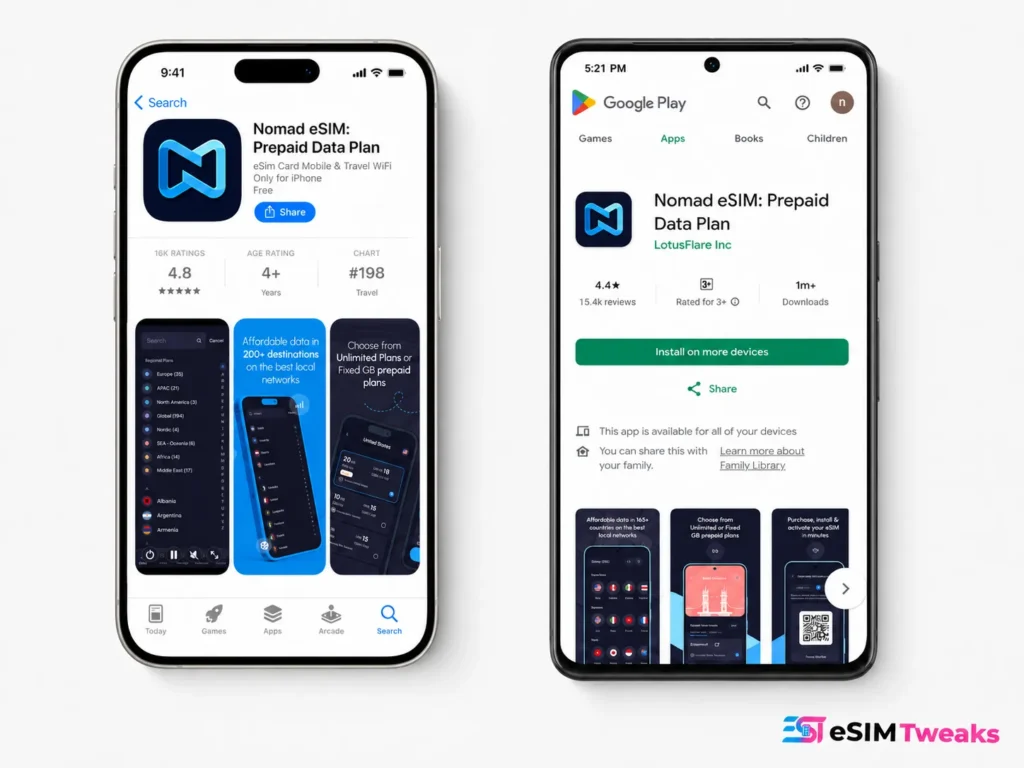
Yes. Nomad is a real telecom product from LotusFlare, a US software company, operating openly at nomadesim.com with hundreds of thousands of users and strong app-store ratings.
Payments run through standard secure checkout, and the eSIM connects you to named, licensed local carriers.
Nothing about it read as sketchy across five regions and eight countries of use.
Final Verdict
After eight countries and 16 speed tests, my recommendation is firm: buy Nomad as a value-first travel eSIM and buy the fixed data plans, not the “unlimited” ones.
In cities on strong networks it delivered exactly what I needed, the regional and local pricing beats most rivals at 10GB and up, and the free trial plus in-app top-ups make it low-effort to try and to live with.
The offshore routing in Asia and the weak rural showing are real but manageable, and they are common across this whole category.
It is not the eSIM for an all-day streamer or someone crossing a dozen borders in a week. For everyone else who wants cheap, dependable data on local networks, Nomad is one of the smarter buys of 2026.
One of the best value-first eSIMs I tested. Nomad makes the most sense for travellers who want cheap fixed data, strong local networks and easy top-ups without paying extra for an “unlimited” label.
A reliable eSIM for compatible travellers visiting Germany, but check your device’s compatibility before buying.
Frequently Asked Questions
Is Nomad eSIM any good?
Yes, for value-focused travel. It gave me a 48.5 Mbps median download across eight countries, cheap fixed plans, unrestricted hotspot and quick installs. It is weaker in rural areas and adds latency in Asia and Latin America.
Does Nomad eSIM have a free trial?
Yes. New users get 1GB free across 48 destinations, so you can install the app, activate a real eSIM and test the connection on your own phone before paying for a full plan.
Is Nomad eSIM legit and safe?
Yes. It is a genuine product from LotusFlare, a US company, connecting to licensed local carriers with secure checkout and high app-store ratings. I saw no red flags across eight months of use.
Does Nomad have real unlimited data?
No. The “unlimited” plans give 2GB per day at full speed, then throttle to 512kbps until the next daily reset. For heavy use, a fixed bucket at full speed is usually the better buy.
How fast is Nomad eSIM?
In my tests, 48.5 Mbps median download, 16 Mbps upload and 55 ms ping. It peaked at 212 Mbps on Dubai 5G and dropped to about 13 Mbps in rural Bali. Peaks are not typical.
Can I use Nomad as a hotspot?
Yes. Tethering is allowed broadly and draws from your normal data pool at the same speed. I pulled 30 to 40 Mbps to a laptop in New York with no separate cap.
Does Nomad work in the USA and Europe?
Yes, and these are its strongest markets. The USA plan used T-Mobile and AT&T, Europe hopped between local carriers like NOS, Orange and Movistar, and both delivered fast urban 5G.
How do I get a Nomad discount code?
Use ESIMDUDE15 at checkout for 15% off standard plans. It is not designed to stack with other live offers, so pick whichever discount saves you more.
What This Nomad Review Focused On (Scope Notes)
For full transparency, here is exactly what I did and did not cover, so you can judge how well it matches your trip.
My testing centred on cities plus a handful of rural spots across eight countries on two flagship phones, using plans I paid for myself. That gives a strong read on urban and suburban performance, install behaviour, pricing and support.
What sits outside this round: I have not yet personally tested Nomad in Africa, mainland China, Japan or India, and China in particular can behave differently on routing and app access, so check a China-specific guide before relying on any eSIM there.
Budget-phone behaviour may vary from my flagship results, and I ran the Unlimited plan for a limited stretch rather than a full multi-week trip, so treat the throttling notes as a clear snapshot rather than a long-term stress test.
Pricing moves often, so confirm the live plan page and the code at checkout before you pay.
Rating Breakdown
| Category | Weight | Score | Weighted |
|---|---|---|---|
| Coverage and connection stability | 25% | 88 | 22.0 |
| Speed and latency | 20% | 82 | 16.4 |
| Pricing and value | 15% | 90 | 13.5 |
| Installation and app experience | 15% | 88 | 13.2 |
| Hotspot, top-up and useful features | 10% | 87 | 8.7 |
| Customer support | 10% | 80 | 8.0 |
| Terms and transparency | 5% | 78 | 3.9 |
| Final weighted score | 100% | 85.7 | 86/100 |
Why trust eSIMTweaks.
59 providers tested.
388 speed tests run.
20 countries covered.
More like this
About the author

Head of Network Testing
I lead field testing at eSIMTweaks, conducting speed, latency and reliability trials on live networks across Latin America and Southern Europe. In the past year I evaluated more than 60 eSIM profiles under real travel conditions. Every performance figure we publish originates from testing I run or supervise.