Best eSIM for Nepal 2026: 9 Plans Ranked by Price & Coverage
Kathmandu has 4G. Everest Base Camp has other plans. We ranked 9 Nepal eSIMs by price and coverage—and found out why Namche Bazaar is where your signal starts losing the climb.
October 14, 2026
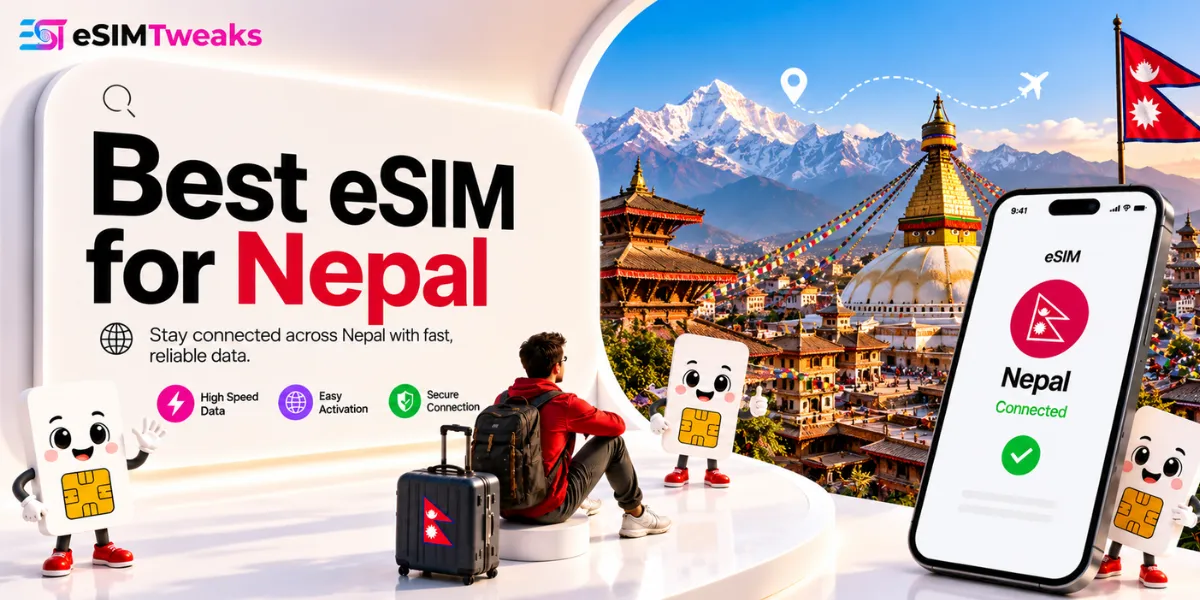
Nepal has two mobile networks and one rule that decides everything: almost every travel eSIM sold for Nepal runs on Ncell, and Ncell stops working above Namche Bazaar.
That single fact reshapes what you should buy. A travel eSIM is a Kathmandu, Pokhara and lower valley product.
Above about 4,000 metres, the network that still finds you is Nepal Telecom, and no mainstream travel brand sells it.
We ranked nine plans to find the best eSIM Nepal sells, on price per gigabyte, on the network each one rides, and on where they actually stop.
An eSIM in Nepal is a city product, and this guide explains why. Prices are standard rates before any code.
Top 3 eSIM for Nepal
Bottom line:

Billion Connect
- Lowest 10GB price in this ranking
- Only $1.60 per GB
- 5GB plan available for $8.90

MobiMatter
- Full 30-day validity
- Just $2 per GB
- Flexible plans from 1GB to 20GB

Airalo
- Runs on Ncell network
- 11 plan options in the article
- Unlimited data options available
All three cover Kathmandu, Pokhara, Chitwan and Lumbini comfortably. What happens on the trail is a different question, and it gets its own section below.
Price comparison: all 9 Nepal eSIMs
| Provider | 1GB | 5GB | 10GB | 20GB | Best cost per GB | Runs on | Code |
|---|---|---|---|---|---|---|---|
| Billion Connect | $3.30 / 3d | $8.90 / 7d | $16.00 / 15d | $33.40 / 30d | $1.60 | Local networks | ESIMADVICE |
| MobiMatter | $3.99 / 5d | $13.99 / 30d | $19.99 / 30d | $35.99 / 30d | $1.80 | Local networks | ESIMDUDE |
| Airalo | $5.00 / 3d | $17.00 / 30d | $24.00 / 30d | $36.00 / 30d | $1.75 | Ncell | ESIMADVICE15 |
| Nomad | $6.00 / 7d | $15.00 / 30d | $24.00 / 30d | $36.00 / 45d | $1.80 | Ncell | ESIMDUDE15 |
| Sim Local | $4.75 / 3d | $16.75 / 30d | $23.50 / 30d | n/a | $2.35 | Local networks | ESIMDUDE10 |
| Global YO | $9.64 / 3d | $17.24 / 15d | $24.24 / 30d | $36.84 / 30d | $1.19 (100GB) | Ncell | ESIMDUDE10 |
| Esimx | $3.90 / 7d | $15.80 / 30d | $31.80 / 30d | $56.80 / 30d | $2.84 | Local networks | ESIMX10 |
| Maya Mobile | unlimited only | unlimited only | unlimited only | unlimited only | $0.33 at 5GB a day | Local networks | ESIMTWEAKS10 |
| GigSky | $19.99 / 15d | $79.99 / 15d | $149.99 / 30d | n/a | $15.00 | Local networks | ESIMADVICE15 |
Read the last row twice. GigSky charges $149.99 for the 10GB that Billion Connect sells for $16.00. That is not a premium, it is a different currency.
Nepal has two networks, and Smart Telecom is gone
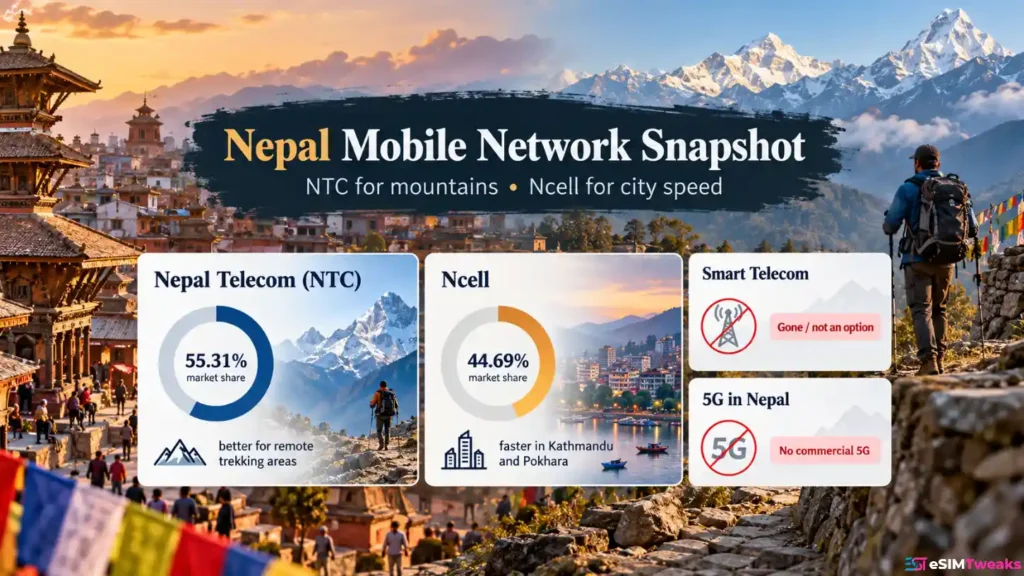
Nepal Telecom, sold as NTC or Namaste, is the state operator and the bigger one. An NTC eSIM Nepal line is the one trekkers want, and it is the one no travel brand sells. It carries 15,335,318 mobile broadband subscribers, 55.31% of the market.
Its coverage obligation as a state carrier pushed towers into villages a commercial operator would never have built for, and that is why it is the network trekkers name at altitude.
Ncell is the faster one and the smaller one. It holds 12,392,852 subscribers, 44.69%, and an Ncell eSIM Nepal profile is what almost every travel brand you can buy actually sells you.
Travellers report 40 to 60 Mbps on Ncell in Kathmandu and Pokhara. Its ownership changed in December 2023 when Axiata sold an 80% stake to Spectrlite UK for $50 million.
Smart Telecom is not an option. Its licence was revoked in April 2022 over roughly 30 billion rupees in arrears and it is off the air. Any guide still listing three Nepali networks is out of date.
There is no 5G in Nepal. Not commercially, not on either operator. Nepal Telecom ran a 2600 MHz trial and the regulator later reclaimed the spectrum.
The national master plan targets nationwide 5G by 2035. Several travel brands print a 5G badge on their Nepal plans. Those badges are decorative and you should not pay extra for one.
One more thing worth knowing about the numbers. Nepal has been off Ookla’s mobile Speedtest Global Index since June 2024, dropped under Ookla’s precision threshold because the two operators’ results diverge too widely to publish a single national median.
Nepal still appears on the fixed broadband index at 90th place with 84.60 Mbps down and 5 ms latency, which is why Kathmandu cafe wifi is often better than the mobile network above it.
Practical summary: Ncell for speed in the cities, NTC for existence in the mountains. A travel eSIM gives you the first one.
Where the signal stops on the trek?
This is the section that matters, and it is the reason most Nepal eSIM guides are useless.
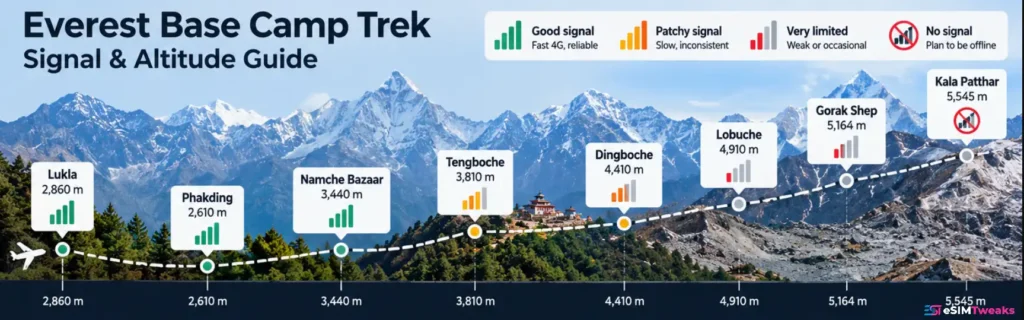
Kathmandu, Pokhara, Chitwan, Lumbini and Nagarkot. Solid 4G on both networks and Ncell is faster. No Nepal eSIM tourist plan on this page will struggle here.
Lukla to Phakding, 2,860 to 2,610 metres. Good service on both. You will land, message home and be fine.
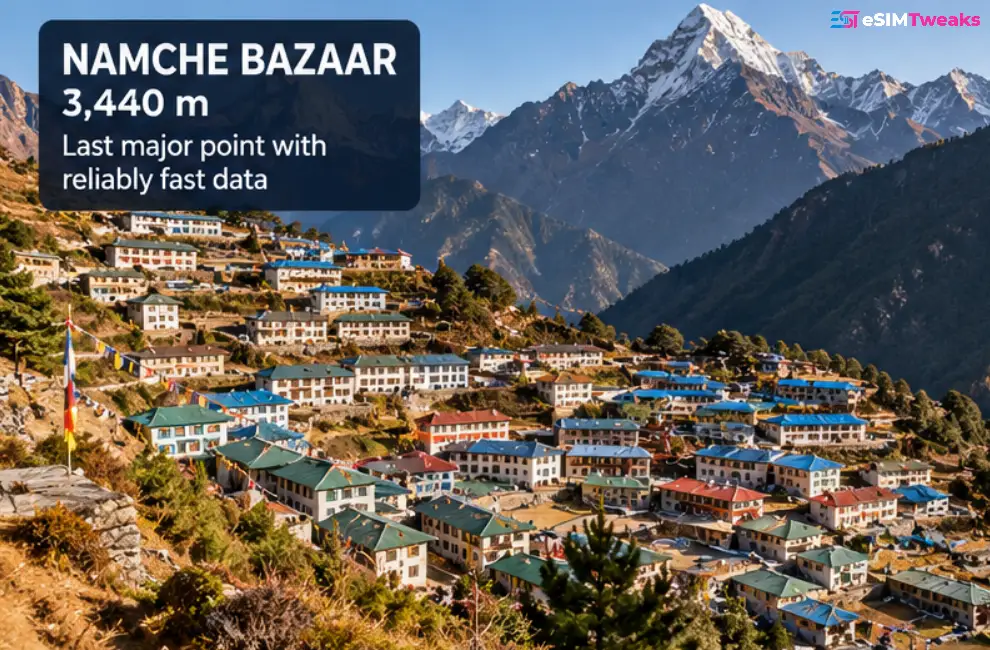
Namche Bazaar, 3,440 metres. This is the hinge. It is the last point on the Everest route with reliably fast data, and it is also the last place with working ATMs.
Send everything from here. Upload your photos, message the people who worry, download the offline maps you forgot.
Tengboche, 3,810 metres. Ncell goes weak and patchy. NTC still works and starts degrading.
Pheriche and Dingboche, 4,371 and 4,410 metres. Ncell is limited to effectively gone. NTC is limited but present.
Lobuche, Gorak Shep, Kala Patthar and Everest Base Camp, 4,910 to 5,545 metres. On Ncell, nothing. On NTC, an occasional weak signal that comes and goes.
Some sources argue the reverse, and one village table claims strong Ncell 3G right up to base camp. Every other account contradicts it. Plan for no signal and be pleased if you get one.
Annapurna Base Camp, 4,130 metres. Better than Everest Base Camp, oddly. NTC 4G is confirmed at ABC and Ncell is unreliable. The Annapurna region is denser and sits closer to Pokhara’s backhaul.
Thorong La, 5,416 metres, on the Annapurna Circuit. Assume nothing in either direction.
Manaslu, Langtang, Gokyo and Upper Mustang. NTC is the recommended network across all four. Teahouses run card based satellite internet instead.
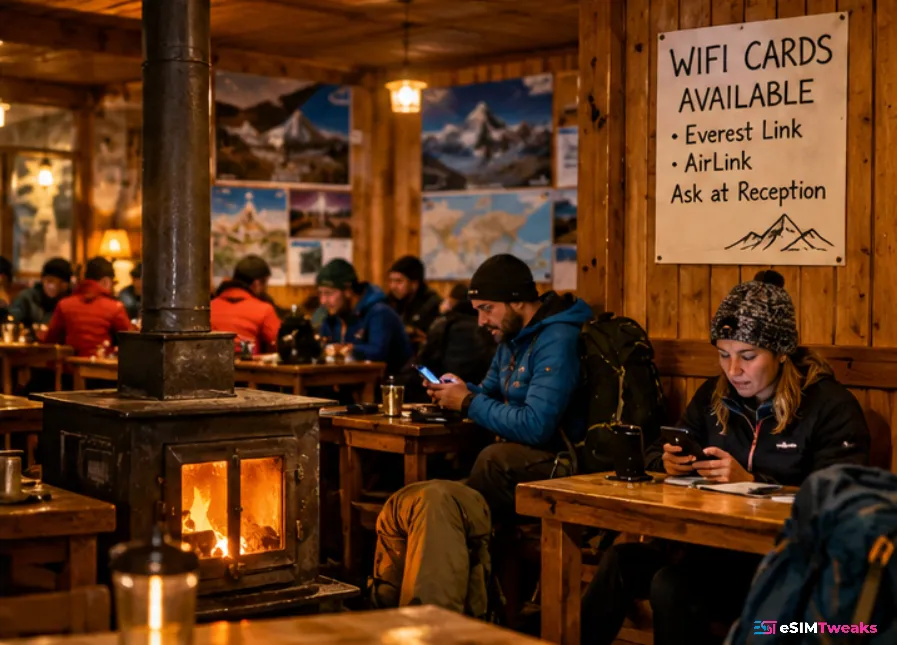
So what do trekkers actually use above Namche? Two satellite and microwave providers sell prepaid scratch cards in the teahouses: Everest Link and AirLink. Neither is included with any eSIM and both are bought in the lodge.
AirLink covers Namche, Tengboche, Dingboche, Lobuche and Gorak Shep. Everest Link is available almost everywhere above Namche.
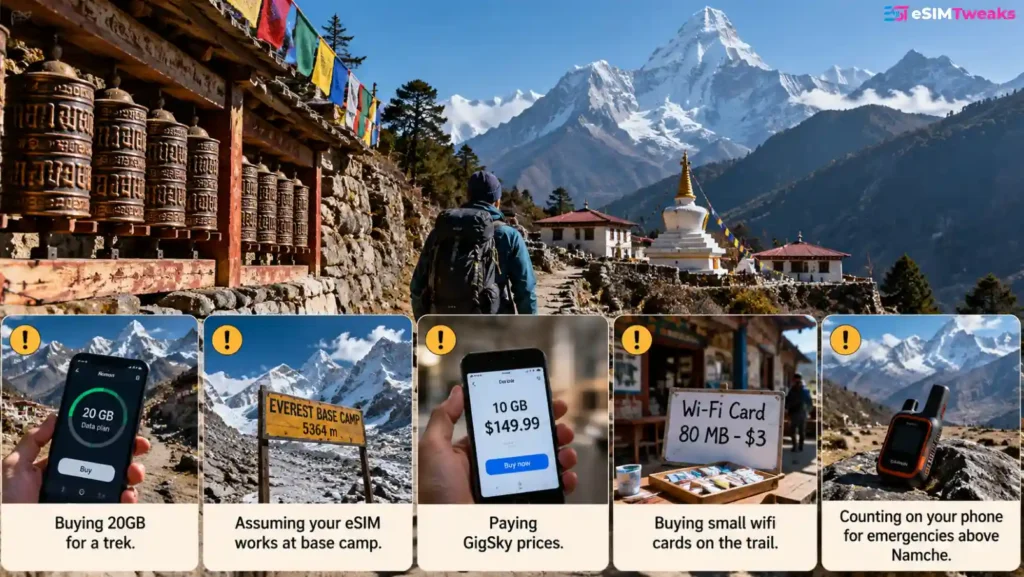
The pricing rewards buying big. A small card runs $2 to $4 for 50 to 100 MB, which works out at $20 to $80 a gigabyte.
At Machermo in the Gokyo valley, around $8 buys half a gigabyte. But a $20 to $30 package carrying 10 to 20GB lands at $1 to $3 a gigabyte.
AirLink sells a 5GB 24 hour card and a 12GB 48 hour card sized for people dumping photos. Budget $50 to $100 on wifi cards for a full Everest Base Camp trek, and buy the large denominations.
Speeds up there run 0.5 to 3 Mbps in the high villages and 3 to 15 Mbps lower down, shared across everyone in the dining room.
On the Annapurna Base Camp approach, teahouse wifi mostly exists below Deurali at around 200 to 400 rupees a session, and charging costs another 200 to 300 rupees, on solar above that point, which means an overcast day is a day without power.
One safety note worth more than any data plan. Apple’s Emergency SOS via satellite is not available in Nepal. The country is not on Apple’s supported list.
Above Namche, a dedicated satellite messenger such as a Garmin inReach is the only reliable emergency link, and Nepal has historically restricted satellite communication devices, so check the current position before you pack one.
Our coverage checker shows which networks each eSIM profile can reach, but no eSIM covers a Himalayan pass.
Travel eSIM, local SIM or your own carrier?
Your home carrier charges $12 a day. Verizon’s TravelPass lists Nepal at exactly that. A two week trek plus a few days in Kathmandu comes to $204 to $216 per line.
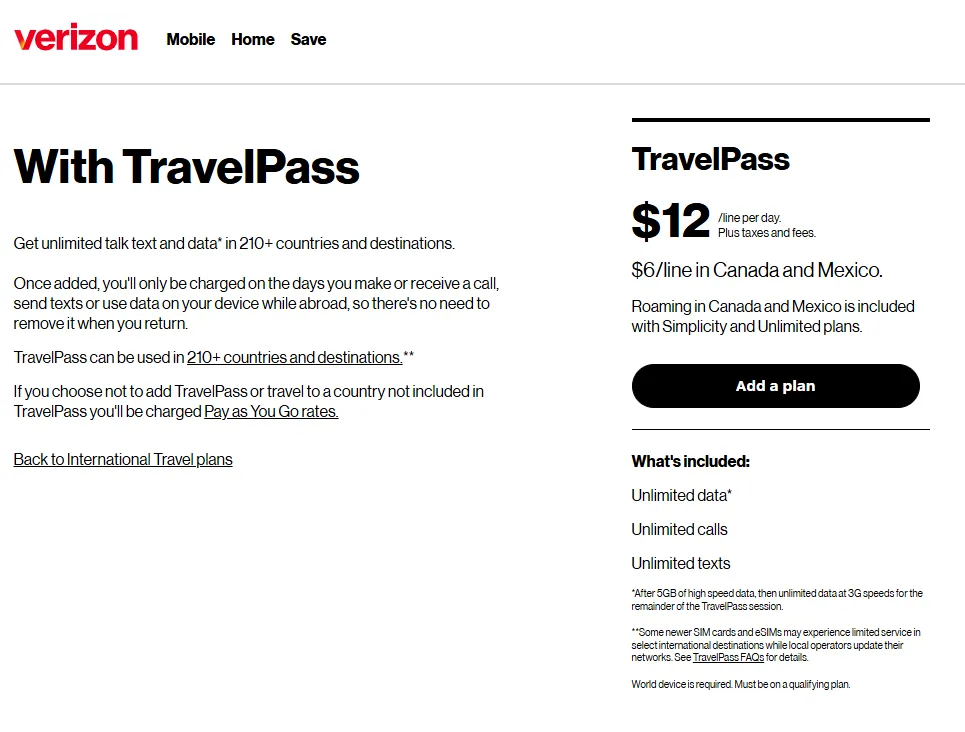
T-Mobile includes Nepal on its roaming list but the baseline runs at roughly 128 kbps, which is a text messaging connection and nothing more, with higher tiers giving 5GB of full speed first. AT&T’s Day Pass covers more than 210 destinations at $12 a day.
Run your own figures through our roaming versus eSIM calculator.
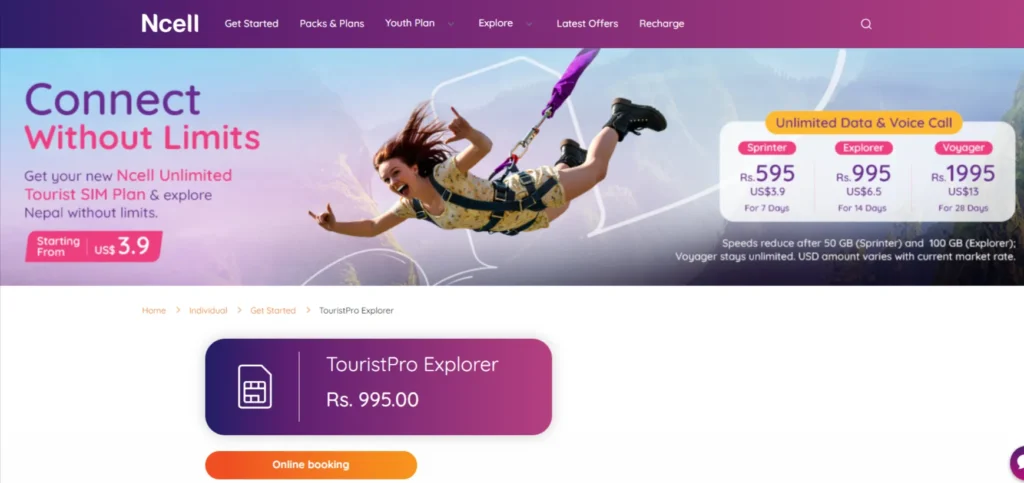
A local SIM is the cheapest option and Ncell now sells one as an eSIM. The Ncell TouristPro eSIM runs 595 rupees for seven days, 995 for fourteen and 1,995 for twenty eight, which is roughly $4.50, $7.50 and $15.
It is unlimited with a throttle to 256 kbps after 10GB on the seven day plan and 25GB on the fourteen day.
It is sold to non Nepali passport holders only and you need your original passport. Nepal Telecom runs its own eSIM portal, though the path for a tourist is less clear cut.
A travel eSIM installs before you fly and works the moment you clear customs at Kathmandu, with no counter and no passport handed over.
The honest recommendation for Nepal: a travel eSIM for the arrival and the city days, and an NTC SIM if your trek goes high.
For a two week Everest or Annapurna trip, the twenty eight day Ncell tourist eSIM at around $15 is also very hard to beat on price, and it rides the same network most travel brands use anyway.
Hot tip: buy your data in Kathmandu, not Lukla. Prices climb with altitude and the choice narrows to whatever the lodge is selling. And spend the last twenty minutes in Namche uploading everything, because it is the last place the upload will finish.
The 9 best eSIMs for Nepal
Ranked on price per gigabyte, the network each one rides, and what happens when the data runs out. Every plan is data only.
1
Billion Connect
Billion Connect prices Nepal like a local operator and nothing else here comes close.
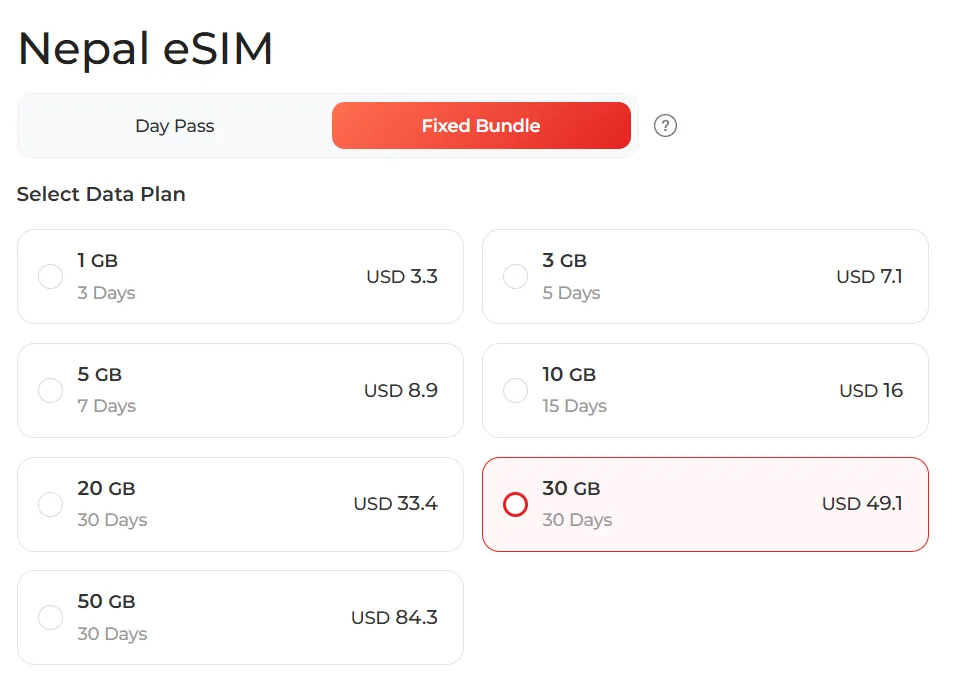
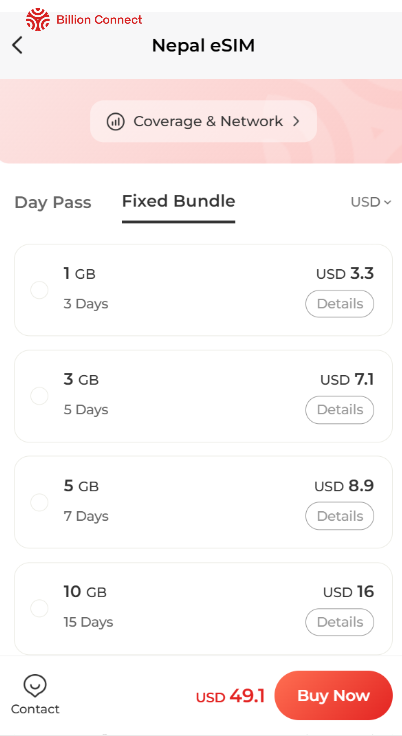
1GB for three days costs $3.30. 3GB for five days costs $7.10. 5GB for seven days costs $8.90. 10GB for fifteen days costs $16.00. 20GB for thirty days costs $33.40.
30GB costs $49.10 and 50GB costs $84.30. That 10GB tier at $1.60 per gigabyte is the lowest figure in this guide.
There are daily options too, at $3.57 for a gigabyte a day and $4.93 for two.
For the shape of a normal Nepal trip, this is the right product. A week in Kathmandu and Pokhara before you fly to Lukla, a trek where you barely use anything, then a few days back in the city at the end.
Ten gigabytes over fifteen days for sixteen dollars covers all of that with room to spare.
The trade off is the tail. After the allowance runs out the connection continues at a heavily reduced speed, so buy the tier you need rather than counting on the overflow.
What we like:
What we don’t:
2
MobiMatter
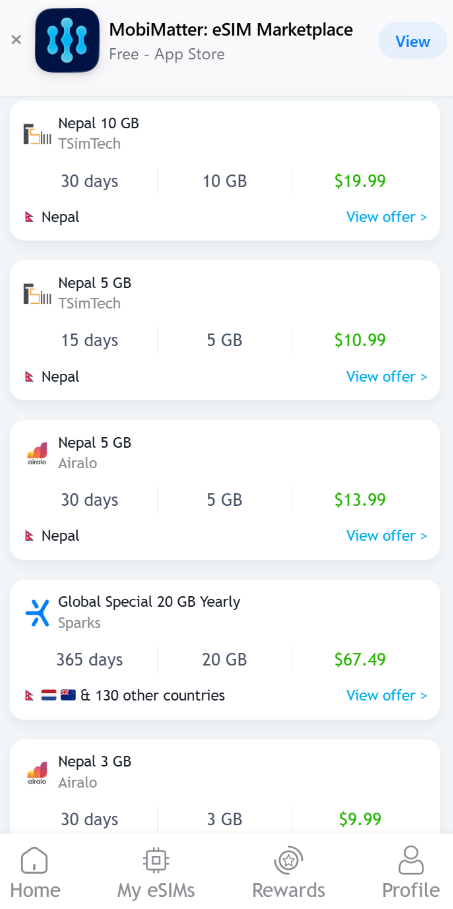
MobiMatter is a marketplace and its Nepal shelf has the best full month pricing here.
1GB for five days at $3.99. 3GB for seven days at $6.99. 2GB for fifteen days at $7.49. 3GB for thirty days at $9.99. 5GB for fifteen days at $10.99. 5GB for thirty days at $13.99. 10GB for thirty days at $19.99. 20GB for thirty days at $35.99.
That 10GB at $19.99 is four dollars under Airalo and Nomad for the same data and the same window, and the 20GB tier at $1.80 per gigabyte is joint second cheapest in this guide.
Look at the 5GB rows and you can see the marketplace at work: fifteen days costs $10.99 and thirty days costs $13.99.
Three dollars buys you double the window. If your trek dates might move, that is three dollars well spent.
Being a marketplace, listings vary by seller. Read the specific tier you are buying, and remember support runs through MobiMatter rather than whoever provisioned the profile.
What we like:
What we don't:
The platform is covered in our MobiMatter review.
3
Airalo
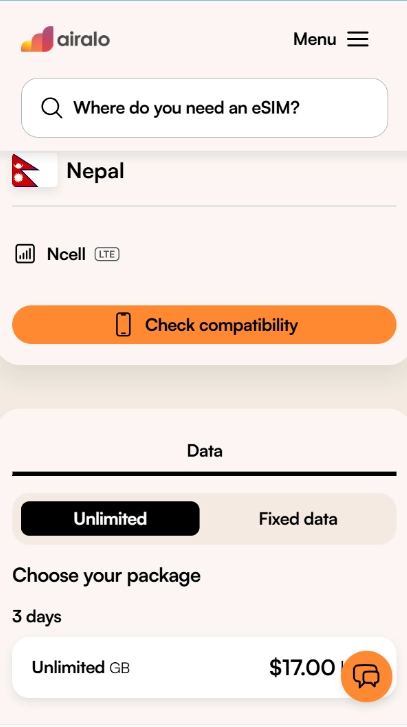
Airalo sells Nepal under the Patancell label and it rides Ncell, which it names openly. That matters here more than in most countries, because knowing you are on Ncell tells you exactly where your plan stops working.
Eleven plan sizes is more than anyone else offers. 1GB for three days at $5.00. 3GB for three days at $10.00 or seven days at $11.00. 5GB for seven days at $13.00, fifteen days at $15.00 or thirty days at $17.00.
10GB for seven days at $22.00, fifteen days at $23.00 or thirty days at $24.00. 20GB for fifteen days at $35.00 or thirty days at $36.00.
The pattern is worth understanding: at every data size, adding two more weeks of validity costs about one dollar. Buy the longest window in your size and stop worrying about your flight moving.
Unlimited runs 3GB a day at full speed then 1 Mbps, priced from $17 for three days to $99 for thirty.
For a traveller who wants a proper company behind the profile but does not want to pay Airalo prices, it is the sensible middle.the fifteen day unlimited plan at $79 is poor value beside the thirty day at $99.
What Airalo gives you that the cheaper listings do not is a support desk that answers, an app that works, and a named host network.
What we like:
What we don't:
Current stacking sits on our Airalo promo code page, and the full Airalo review covers the app.
4
Nomad
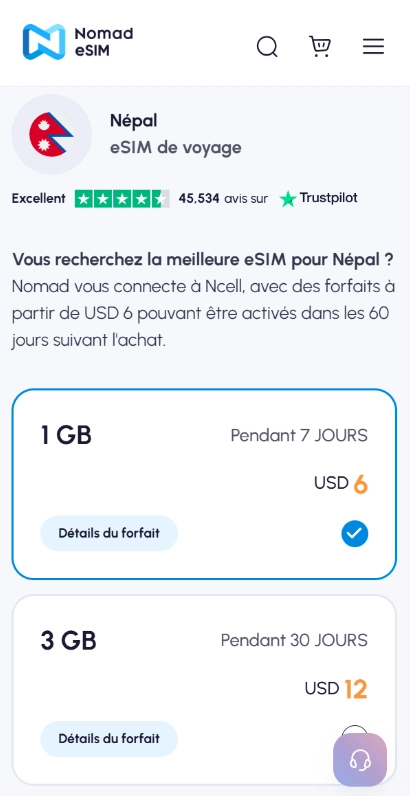
Nomad keeps Nepal simple: six plans, no unlimited tier, no decisions to make.
1GB for seven days at $6.00. 3GB for thirty days at $12.00. 5GB for thirty days at $15.00. 10GB for thirty days at $24.00. 15GB for thirty days at $28.00. 20GB for forty five days at $36.00.
Two of those are worth pointing at. The 15GB tier at $28.00 is a size almost nobody else sells and it works out at $1.87 per gigabyte, which is better than the 10GB plan by a wide margin. And the 20GB plan comes with 45 days rather than 30, which is the longest window from a premium brand here and suits a trip that runs Kathmandu, trek, Pokhara, Chitwan and back.
It is reported to ride Ncell, so the same altitude limit applies.
Refunds run thirty days, handled case by case where the profile was installed but unused, sometimes issued as Nomad Points rather than cash.
What we like:
What we don't:
Our Nomad promo code page tracks the current offer, and the Nomad review covers the app.
5
SimLocal
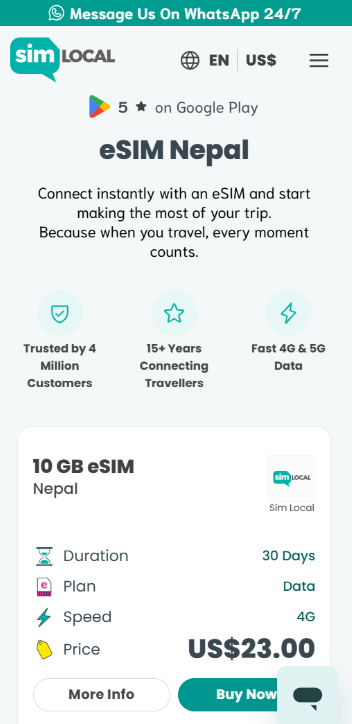
Sim Local is a Dublin company with airport shops across Europe, and in Nepal it undercuts the other premium brands at the small end.
1GB for three days costs $4.75. 3GB for seven days costs $9.75. 5GB for thirty days costs $16.75. 10GB for thirty days costs $23.50.
That $4.75 entry is a dollar under Airalo and $1.25 under Nomad, and the 10GB tier is the cheapest of the three premium brands.
For a traveller who wants a proper company behind the profile but does not want to pay Airalo prices, it is the sensible middle.
The ladder stops at 10GB, so a month long trip means stacking plans or buying elsewhere. Support runs around the clock on chat and WhatsApp, which is a real advantage if something goes wrong at four in the morning in a Thamel guesthouse.
What we like:
What we don't:
6
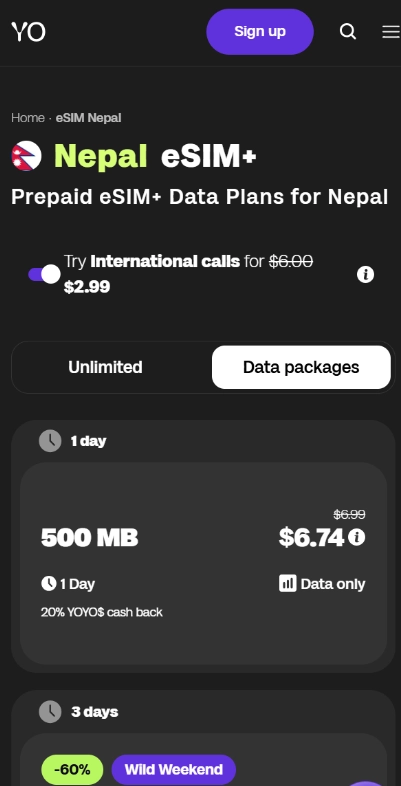
Global YO
Global YO is the second brand here that names Ncell as its host, and it is the only one that states its activation rule plainly.
You can install the profile immediately or activate it manually when you need it. For Nepal that is more useful than it sounds.
Kathmandu flights get delayed, Lukla flights get cancelled for days at a time, and a plan that starts counting when you say so rather than when you pay removes a real risk.
Pricing is mid market at the small sizes and good at the top. 1GB for three days at $9.64. 3GB for fifteen days at $17.74.
5GB for fifteen days at $17.24. 10GB for thirty days at $24.24. 20GB for thirty days at $36.84. 50GB for forty five days at $64.14.
. At 10GB you are payi100GB for sixty days at $118.94. That 100GB tier is $1.19 per gigabyte, the best large bucket figure on this page.
Tethering is supported on every plan, no ID is required, and the plans run 4G LTE, which is all Nepal has anyway.
The 500MB single day plan at $6.74 is the one to avoid. It works out at $13.48 a gigabyte.
What we like:
What we don't:
7
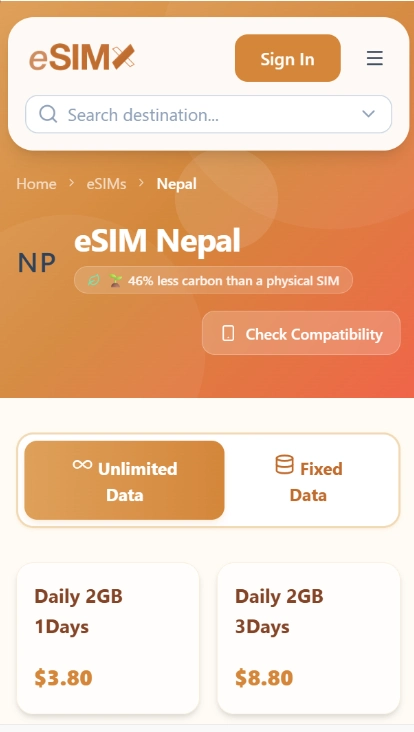
Esimx
Esimx has the lowest entry price of any brand in this guide and a steep climb after it.
1GB for seven days costs $3.90. That is the cheapest full week of data on this page, and for a traveller who only needs maps, WhatsApp and a taxi app in Kathmandu it is the whole product.
Then it gets expensive. 3GB for thirty days at $9.90. 5GB for thirty days at $15.80. 10GB for thirty days at $31.80. 20GB for thirty days at $56.80.
At 10GB you are paying almost twelve dollars more than MobiMatter for the same data.
Buy the 1GB or the 3GB. Above that, the rest of this page is cheaper.
What we like:
What we don't:
8
Maya Mobile
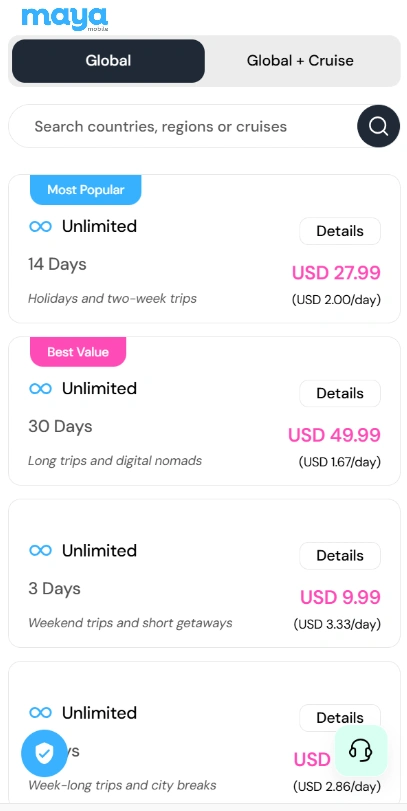
Maya sells no Nepal only plan. Nepal is covered by its global unlimited product, which wins on one number.
After the 5GB daily cap, Maya runs at 3 Mbps. Airalo drops to 1 Mbps. aloSIM drops to 500 kbps. Billion Connect drops well below that.
Maya makes sense if Nepal sits inside a longThree megabits streams and holds a video call, and it is the only post cap speed here you could work on.
Pricing is by duration: $9.99 for three days, $19.99 for a week, $27.99 for fourteen days and $49.99 for thirty, covering 165 or more countries on one profile.
At full daily use the thirty day plan works out at $0.33 per gigabyte, the best figure on this page.
The catch is that nobody uses 5GB a day in Nepal, because for half the trip there is no signal to use it on.
Maya makes sense if Nepal sits inside a longer route through India, Thailand or the Gulf. For a Nepal only trip, Billion Connect is a third of the price.
One setting to get right. Maya plans auto renew while Travel Mode is on. Switch it off when you get home.
What we like:
What we don't:
The current rate sits on our Maya Mobile coupon page.
9
GigSky
GigSky is a real company with a real product and it connects in Nepal. We are including it because we hold a code and because somebody needs to say this out loud.
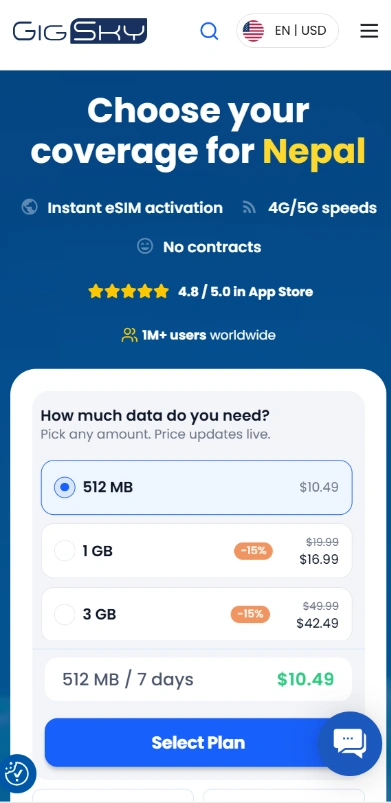
500MB for seven days costs $10.49. 1GB for fifteen days costs $19.99. 3GB for thirty days costs $49.99. 5GB for fifteen days costs $79.99. 10GB for thirty days costs $149.99.
That is $15 to $21 per gigabyte, six to ten times the rest of this page. Billion Connect sells the same 10GB for $16.00. Even after the 15% code, GigSky's 10GB lands at $127.49.
Prices also vary by the region setting in the app, which means two people standing in the same Kathmandu guesthouse can see different numbers.
If every other plan in this guide sold out on the same afternoon, GigSky would get you online. That is the case for it.
What we like:
What we don't:
How much data do you need in Nepal?
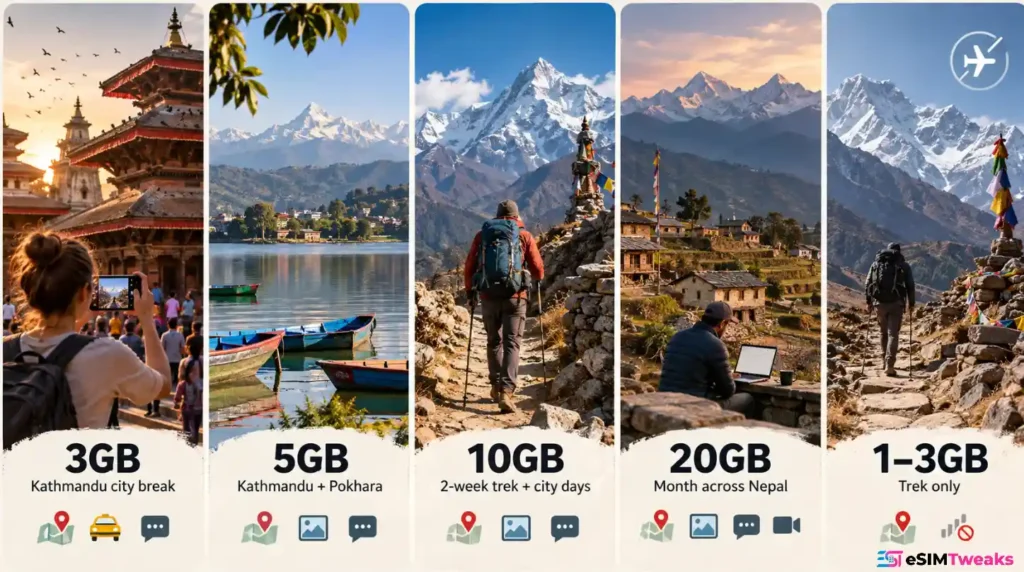
That last line is the one nobody tells you. Trekkers buy 20GB plans and come home having used four, because from Tengboche upwards the network cannot deliver it.
The money that actually gets spent goes on Everest Link and AirLink cards in the teahouses. Budget for those separately.
Our data planner does the city side of the sums.
Setting up before you land
Do this at home on wifi, not in the Tribhuvan arrivals hall.
Check the phone first. Dial *#06#. An EID under the IMEI means the handset has an eSIM chip, and it also has to be carrier unlocked. Our Android compatibility list covers the models people get wrong, and the install walkthrough has the screenshots.
iPhone: Settings, Mobile Data, Add eSIM, Use QR Code. Android: Settings, Network and Internet, SIMs, Add eSIM.0
Landing checklist. Select the travel line. Turn Data Roaming ON. Set it as your default data line. Turn roaming OFF on your home SIM so it cannot bill you on the taxiway.
If nothing loads, wait five minutes, then set network selection to Manual and pick Ncell or Nepal Telecom by name depending on which your plan rides.
Download before you fly. Offline maps of the Kathmandu valley, Pokhara and your whole trek route. Your permits. Your teahouse and flight confirmations. Maps.me and Gaia both work offline and both are worth having, because Lukla flights get cancelled and plans change on the trail.
Five mistakes that cost people money here
Our verdict
Nepal is two connectivity problems in one trip. The cities are easy and cheap. The mountains are not solvable with an eSIM at any price, and the honest thing to do is tell you that before you buy.
Buy Billion Connect for the cities and the approach. 10GB at $16.00 or 5GB at $8.90 with ESIMADVICE for 10% off is the cheapest Nepal eSIM card on this page and covers Kathmandu, Pokhara, Chitwan and everything up to Namche.
Buy MobiMatter if you want a full thirty day window without watching the clock. 10GB at $19.99 with ESIMDUDE for $50 off is four dollars under the premium brands for the same data.
And if your trek goes above Namche Bazaar, add a Nepal Telecom SIM in Kathmandu and budget $50 to $100 for teahouse wifi cards. That is the whole answer, and no eSIM changes it.
Those are our best Nepal eSIM picks. Still deciding? Our eSIM finder picks one for you in under a minute, and if Nepal sits alongside India, Bali or a Gulf stopover on your route, the multi country optimiser works out whether one regional bundle beats separate country plans.
Why trust eSIMTweaks.
59 providers tested.
388 speed tests run.
20 countries covered.
More like this





About the author

Head of Network Testing
I lead field testing at eSIMTweaks, conducting speed, latency and reliability trials on live networks across Latin America and Southern Europe. In the past year I evaluated more than 60 eSIM profiles under real travel conditions. Every performance figure we publish originates from testing I run or supervise.