Best eSIM for Türkiye 2026: 11 Ranked by Cost Per GB
Same 10GB, $5.80 or $18. Same speed. Here’s which eSIM for Türkiye is worth your money, and which carrier actually works in Cappadocia.
September 29, 2026
eSIM4Travel
- All three Turkish carriers disclosed
- Choose Turkcell for rural coverage
- Reliable option for Türkiye travel

eSIMX
- Lowest Türkiye eSIM price
- Only $0.58 per GB
- Turkcell, Vodafone TR & Türk Telekom support
Buying a Türkiye eSIM should be the easiest decision of your trip, and it is the one most travellers get wrong. The same 10GB over the same 30 days costs $5.80 from one provider and $18.00 from another.
That is a 3.1 times difference for a product that behaves identically once the profile is on your phone, and the expensive option is not the faster one. It is usually just the one with the bigger advertising budget.
Two things about this country change the answer in ways no other destination does. Türkiye’s regulator, BTK, blocked the websites and apps of most major eSIM providers from inside the country in July 2025, so if you run out of data mid-trip you may not be able to reach the shop to buy more.
And Türkiye operates a device registration regime that can blacklist your handset’s IMEI, with a 2026 fee of 54,258 lira, roughly $1,136. Almost every English-language guide describes that rule incorrectly. The version that applies to a foreign eSIM is not the 120-day rule everyone quotes.
The Short Answer
Buy eSIM4Travel at $6.28 for 10GB if you want the best balance of price and evidence, or eSIMX at $5.80 if you want the cheapest option and accept a thin track record.
If you are heading to Cappadocia or anywhere east of Ankara, choose a provider that names Turkcell in writing, because the network behind your plan is the difference between 20 Mbps and 3 Mbps in the balloon valleys. Buy and install before you fly, and buy more data than you think you need.
Everything below is ranked by cost per gigabyte at the 10GB tier, checked on 8 August 2026, not by what any provider pays us.
Best eSIM for Türkiye in 2026 at a glance
| Provider | Best 10GB-equivalent | Cost per GB | Turkish network operator | Exclusive Coupon |
|---|---|---|---|---|
| eSIMX | $5.80 / 10GB | $0.58 | Turkcell, Vodafone TR, Türk Telekom | ESIMX10 |
| eSIM4Travel | $6.28 / 10GB | $0.63 | All three, disclosed per plan | ESIMADVICE |
| MobiMatter | $7.99 / 12GB (NextLink) | $0.67 | Not disclosed | ESIMDUDE |
| BNESIM | $8.19 / 10GB | $0.82 | Not disclosed | none |
| GoMoWorld | $12.99 / 12GB | $1.08 | Not disclosed | none |
| GigSky | $14.29 / 10GB | $1.43 | Not disclosed | ESIMADVICE15 |
| Esimatic | $14.29 / 10GB | $1.43 | Türk Telekom + Turkcell | AFFNINJA7 |
| Airalo | $15.50 / 10GB | $1.55 | Türk Telekom (Avea) | ESIMADVICE15 |
| Saily | $15.99 / 10GB | $1.60 | Not disclosed | ESIMDUDE |
| Yesim | $16.80 / 10GB | $1.68 | Not disclosed | none |
| Amigo eSIM | $18.00 / 10GB | $1.80 | Türk Telekom + Vodafone TR | ESIMDUDE |
The market splits cleanly into two tiers. eSIMX, eSIM4Travel, MobiMatter and BNESIM sit between $0.58 and $0.82 per gigabyte. Everyone from GigSky down sits between $1.43 and $1.80, roughly two and a half times more for the same data allowance.
The cheap tier is also, MobiMatter excepted, the tier with the thinnest reputational record. That is the trade, and it is a real one.
The 11 best eSIMs for Türkiye, ranked
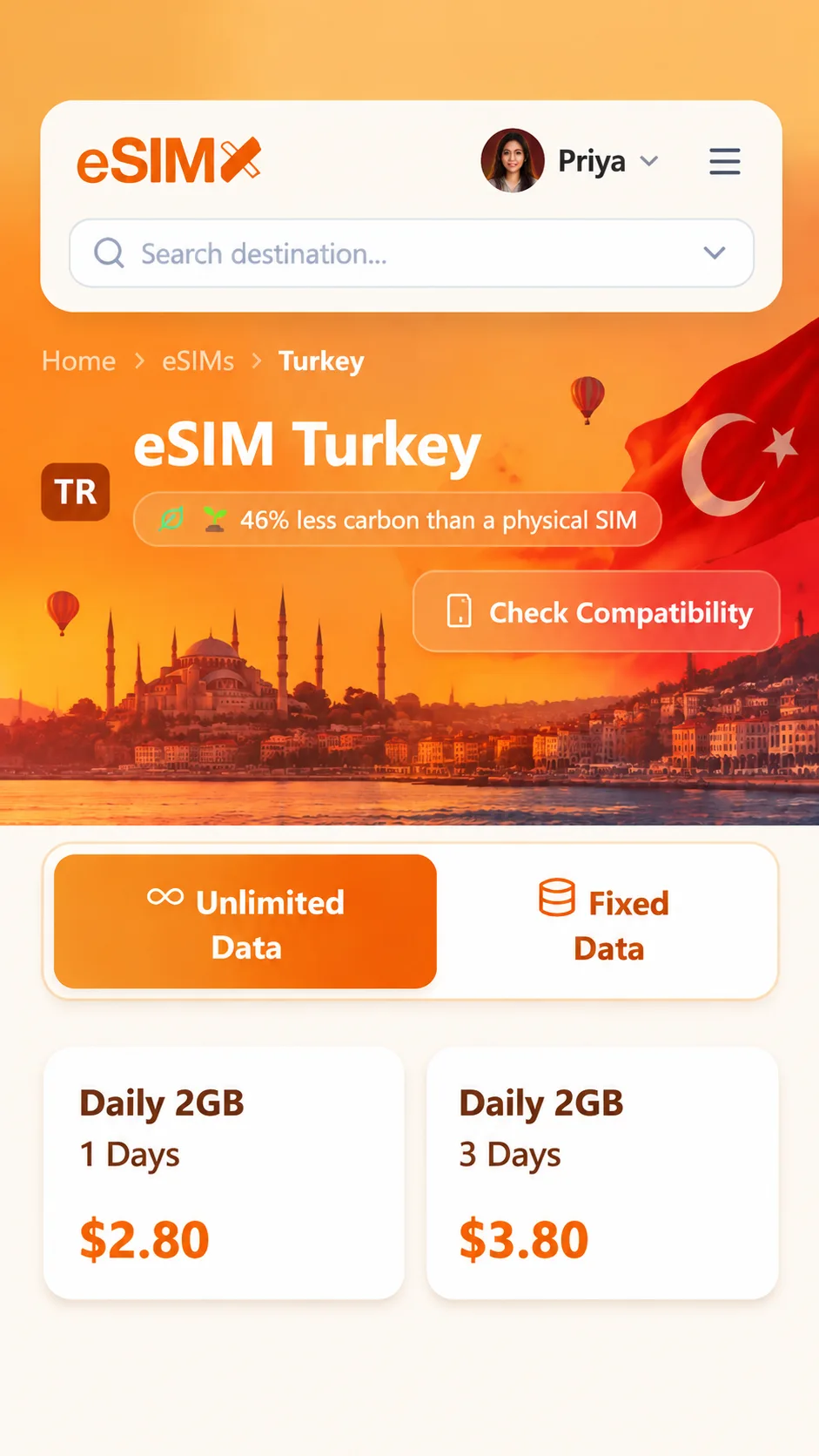
Operated by Skylark Connect LLC of El Segundo, California, with a domain registered since December 2019 and paid through 2034.
Plans run 3GB/30d at $3.50, 5GB at $4.00, 10GB at $5.80, 20GB at $10.80 and 30GB at $14.80, plus 2GB daily passes from $2.80.
It is the cheapest provider on this list by a clear margin, and one of only three that names all three Turkish operators rather than hiding behind “local networks”.
The limitations are serious and worth weighing. Trustpilot sits at 3.0 across 37 reviews and Google Play at 1.6 across 8.
Both of its Türkiye reviews on the independent comparison indexes are one star, both citing slow speeds.
It does not support top-ups at all, which is a particular problem in a country where you may not be able to reach the website anyway. Its daily-plan throttle floor is 128 kbps, the harshest here, and independent testing found 4G only with no 5G.
Buy it if price is the binding constraint and you purchase enough data upfront that topping up never arises.
ESIMX10 takes 10% off eSIMX, bringing 10GB down to $5.22.
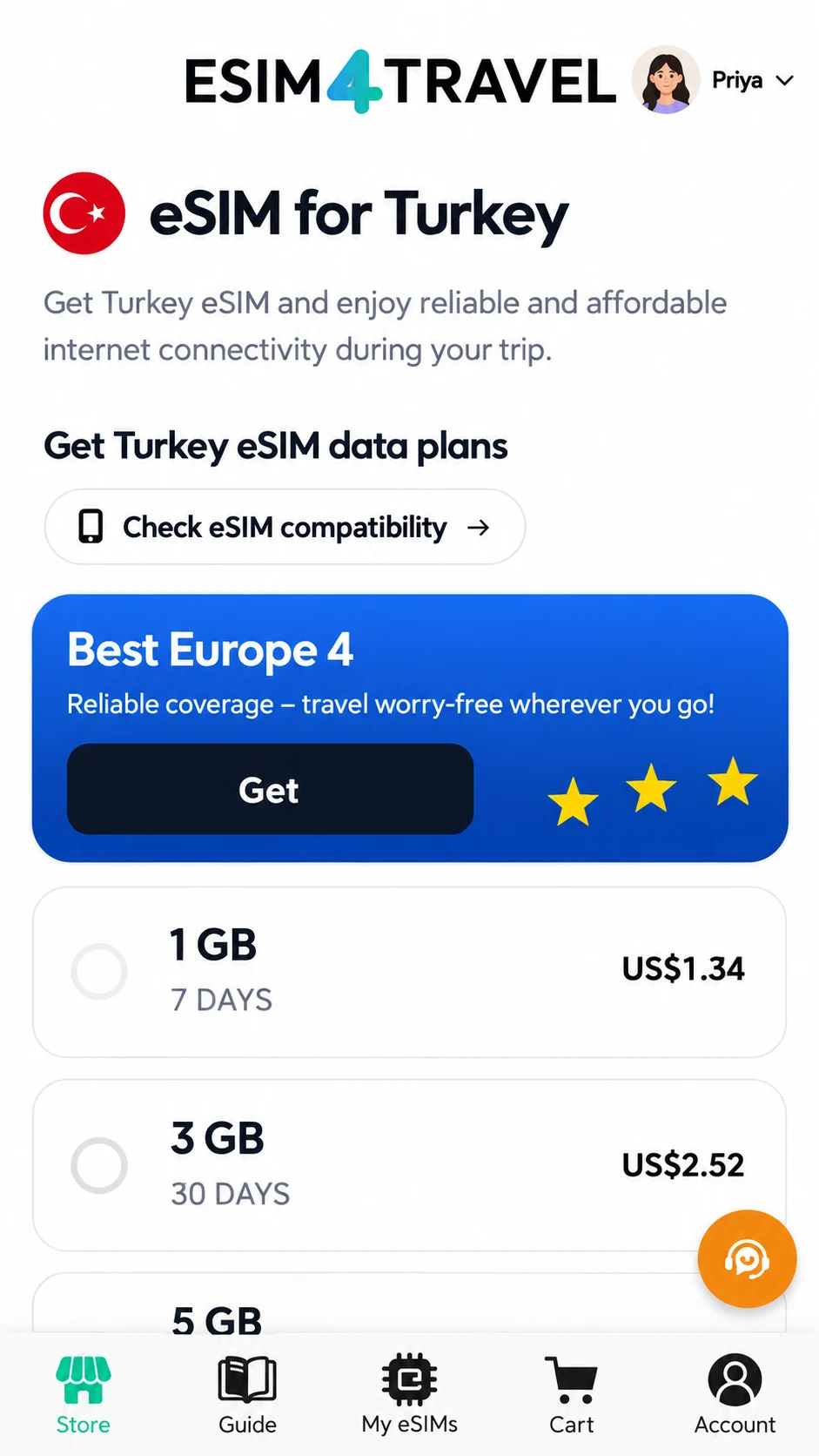
Operated by FreshQ Inc. in California, not the UK as is commonly assumed.
Plans run 1GB/7d at $1.34, 3GB at $2.52, 5GB at $3.59, 10GB at $6.28, 20GB at $11.65 and 50GB at $31.16, with unlimited data from $5.83 for three days at 3GB per day before throttling to 1 Mbps.
Its carrier disclosure is the most granular of any provider here. It names Türk Telekom, Vodafone and Turkcell, and the listing shows the network operator per individual plan, so you can deliberately choose a Turkcell product before a Cappadocia trip.
Trustpilot sits at 4.4 across 191 reviews, thin but not negligible, and a verified March 2026 review praises Türkiye support for resolving a problem in ten minutes.
The catch: no refunds once the eSIM is activated, support is AI-chat-first, and there is a 2023 complaint about activation failing across three separate phones.
Buy it if you want cheap-tier pricing without eSIMX’s reputational risk, and you want to pick your network.
ESIMADVICE takes 10% to 15% off eSIM4Travel.
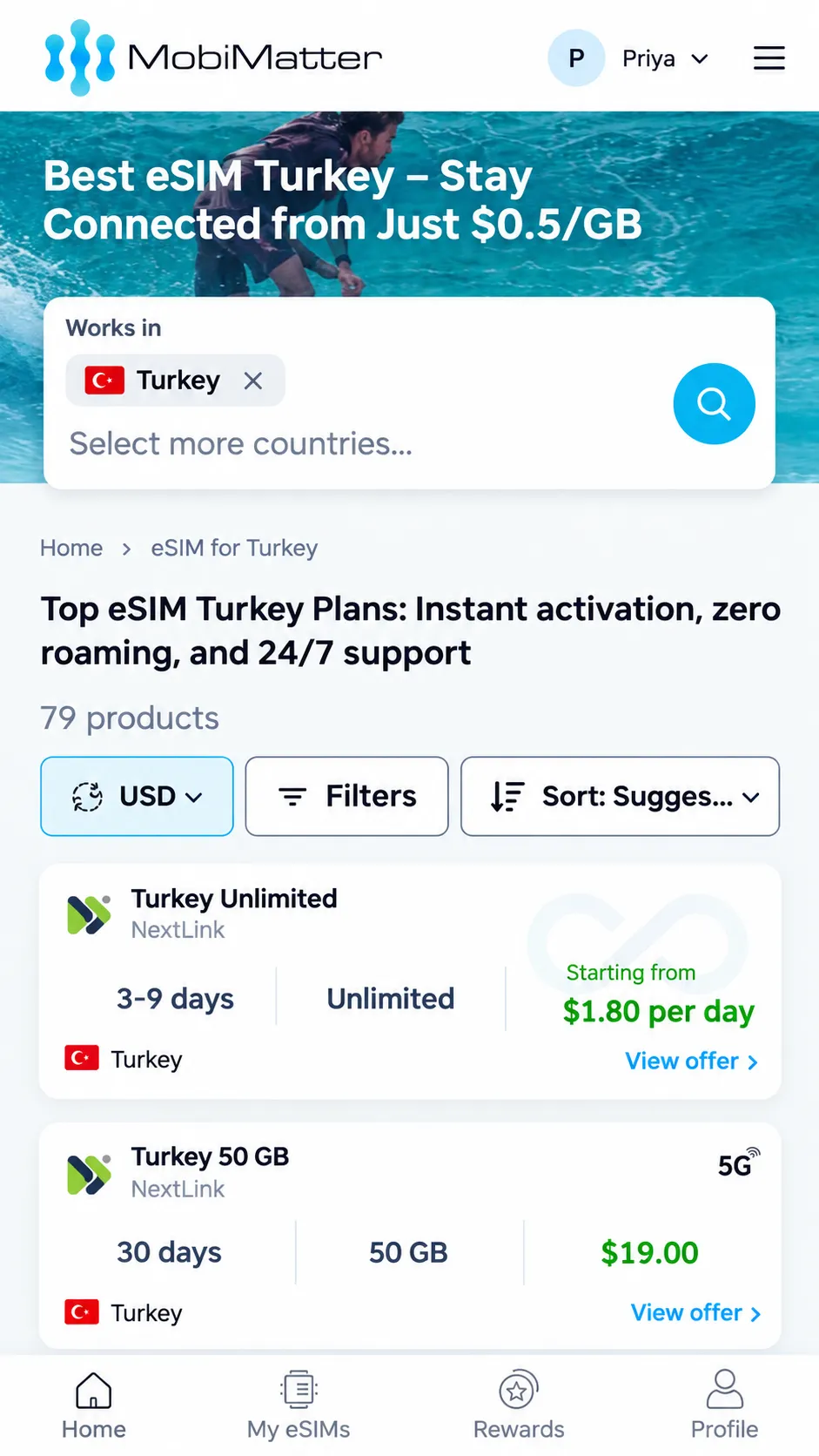
MobiMatter is a marketplace rather than a single operator, reselling more than thirty underlying suppliers, so the Turkish carrier depends on which plan you pick.
Türkiye products run 3GB/15d at $3.49, 5GB at $4.49, NextLink 12GB at $7.99, standard 10GB at $9.49, Sparks 15GB at $13.49, NextLink 25GB at $13.99 and NextLink 50GB at $24.99.
Its Trustpilot base of roughly 52,800 reviews at 4.5 is by far the largest of any provider here, with Google Play at 4.7 across 26,200 reviews. It also sells a Greece, Cyprus and Türkiye regional bundle, which is genuinely useful if you are island-hopping across the Aegean.
The catch: the refund policy varies by supplier, one traveller reported being charged a refund fee on an eSIM that never worked, and one buyer paid for a 5G-labelled plan and received Turkcell 4G.
MobiMatter is also on BTK’s original blocked list and does not mention it anywhere in its own Türkiye buying guide, which is a meaningful omission on a page whose entire job is advising Türkiye buyers.
ESIMDUDE gives 50% cashback on your first MobiMatter order, capped at $5.
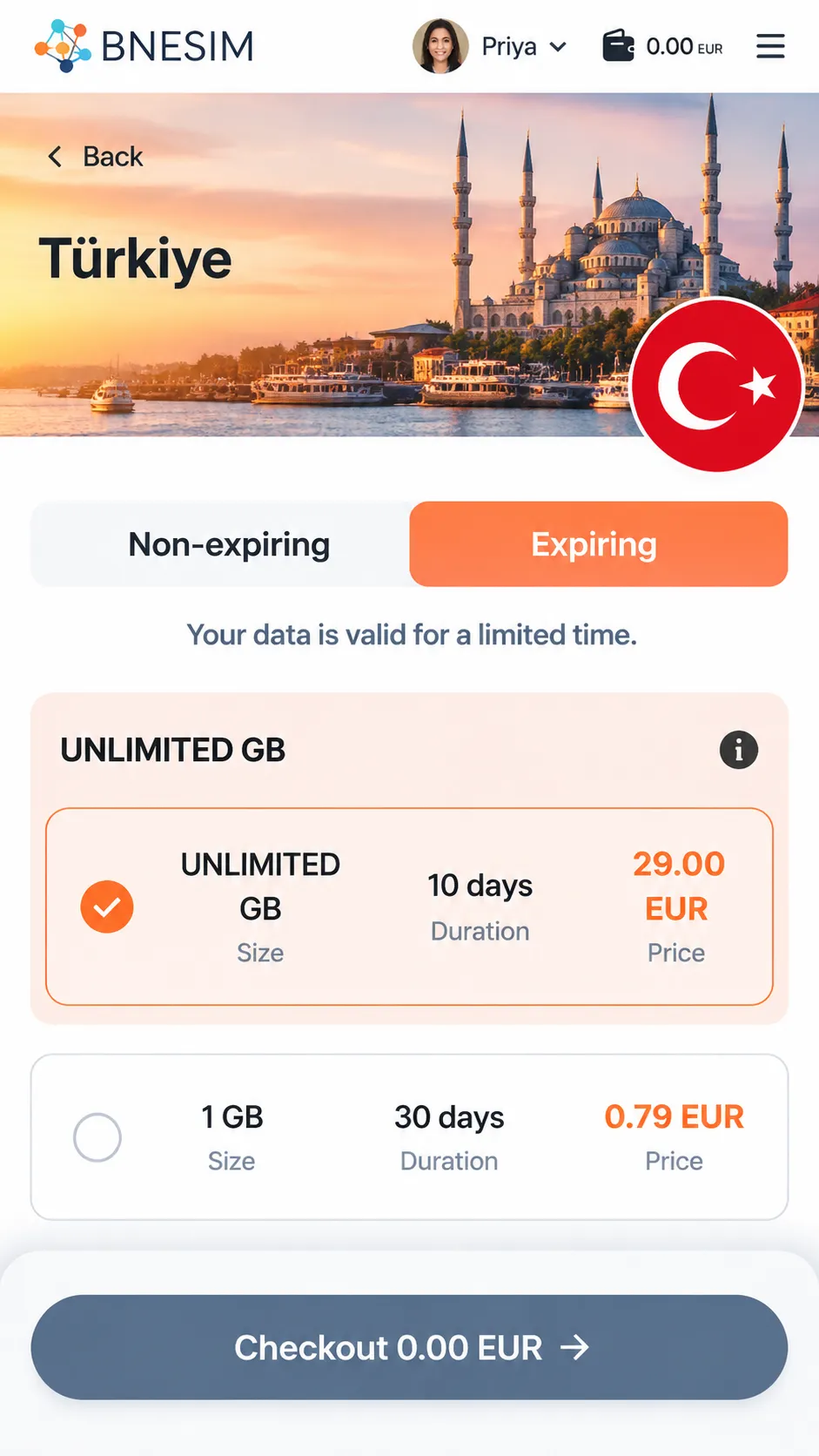
Operated by BNESIM Limited in Kowloon, Hong Kong, and trading since 2017.
Its distinguishing product is the no-expiry tier: 10GB with no validity window at all for $9.83, against $8.19 for the standard 30-day version.
Nobody else here offers that, and for anyone who visits Türkiye repeatedly it is a genuinely different proposition. Unlimited data runs $33.53 for ten days at 3GB per day before 1 Mbps.
The catch is customer service. Trustpilot sits at 3.5 across 366 reviews with a stated reply time of around two weeks, and there are multiple reports of unexpected automatic top-up charges, including an App Store reviewer who describes being billed almost $18 per day.
An r/eSIMs thread titled “Why BNE SIM Is the Worst Service I’ve Ever Used” cites unacknowledged support tickets. As a counterweight, one Türkiye reviewer measured 70 to 100 Mbps in Istanbul.
Buy it if the no-expiry structure fits how you travel, and disable auto top-up the moment you create the account.
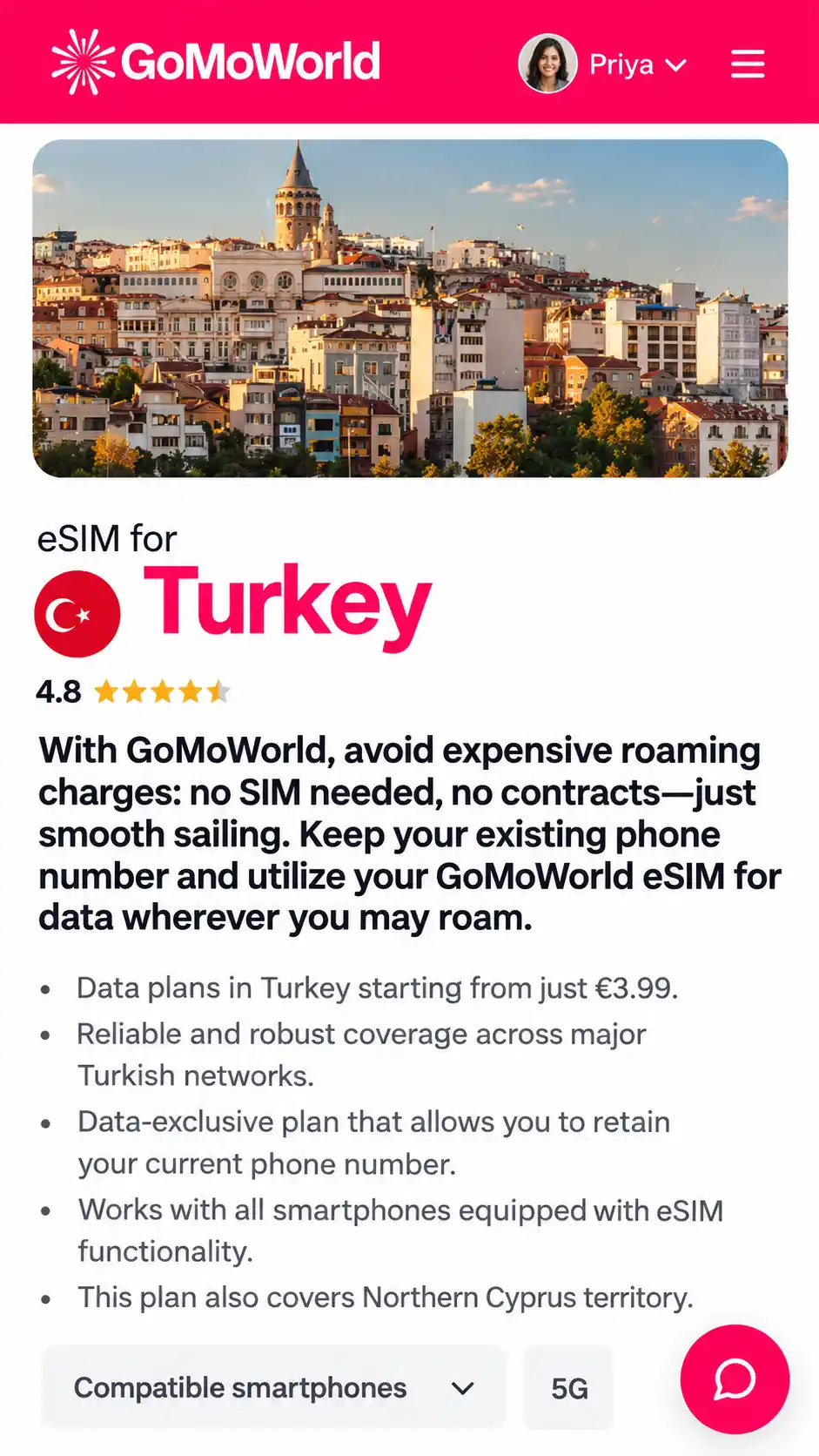
Owned by eir, the Irish incumbent, which is a stronger corporate backer than most names on this list.
The plan ladder is awkward: a 500MB free trial, 2.5GB/7d at €3.99, 12GB at €10.99, 25GB at €19.99 and 38GB at €29.99. There is no 5GB, 10GB or 20GB tier and no unlimited data option, which makes like-for-like comparison harder than it should be.
The catch: it is the only provider here with no regional plan covering Türkiye at all, so it cannot serve a multi-country itinerary.
The frequently repeated claim that it runs on Vodafone Türkiye traces back to a single user review rather than to eir. It sits on the blocked list and acknowledges the problem only by naming competitors.
Reddit sentiment is poor, including “extremely dodgy” in r/travel.
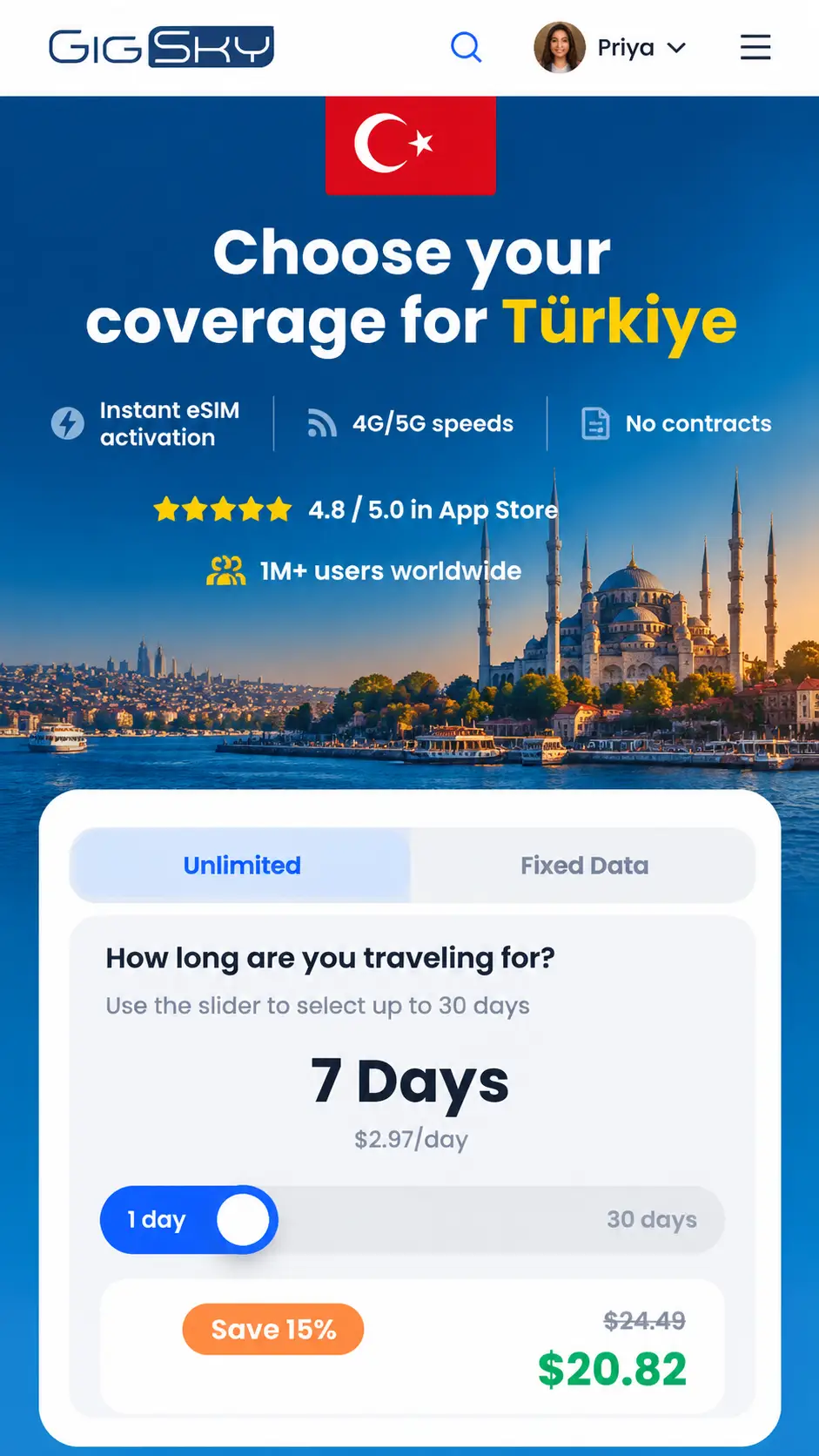
Plans run 500MB/7d free, 1GB at $2.99, 3GB/15d at $5.99, 5GB at $9.29 and 10GB at $14.29, plus 3.5GB daily passes from $10.99. The model is 3.5GB per day at full speed, then slowed but never cut off entirely.
Two things earn GigSky a place despite the price. The free 500MB trial lets you confirm the profile attaches to a Turkish network before you spend anything, which no other provider on this list offers. And GigSky publicly acknowledges the BTK block on its own blog, which Airalo and MobiMatter both fail to do.
The catch: it does not name its Turkish carrier, its app struggles when you hold several plans at once, and at $1.43 per gigabyte it costs two and a half times what eSIMX charges.
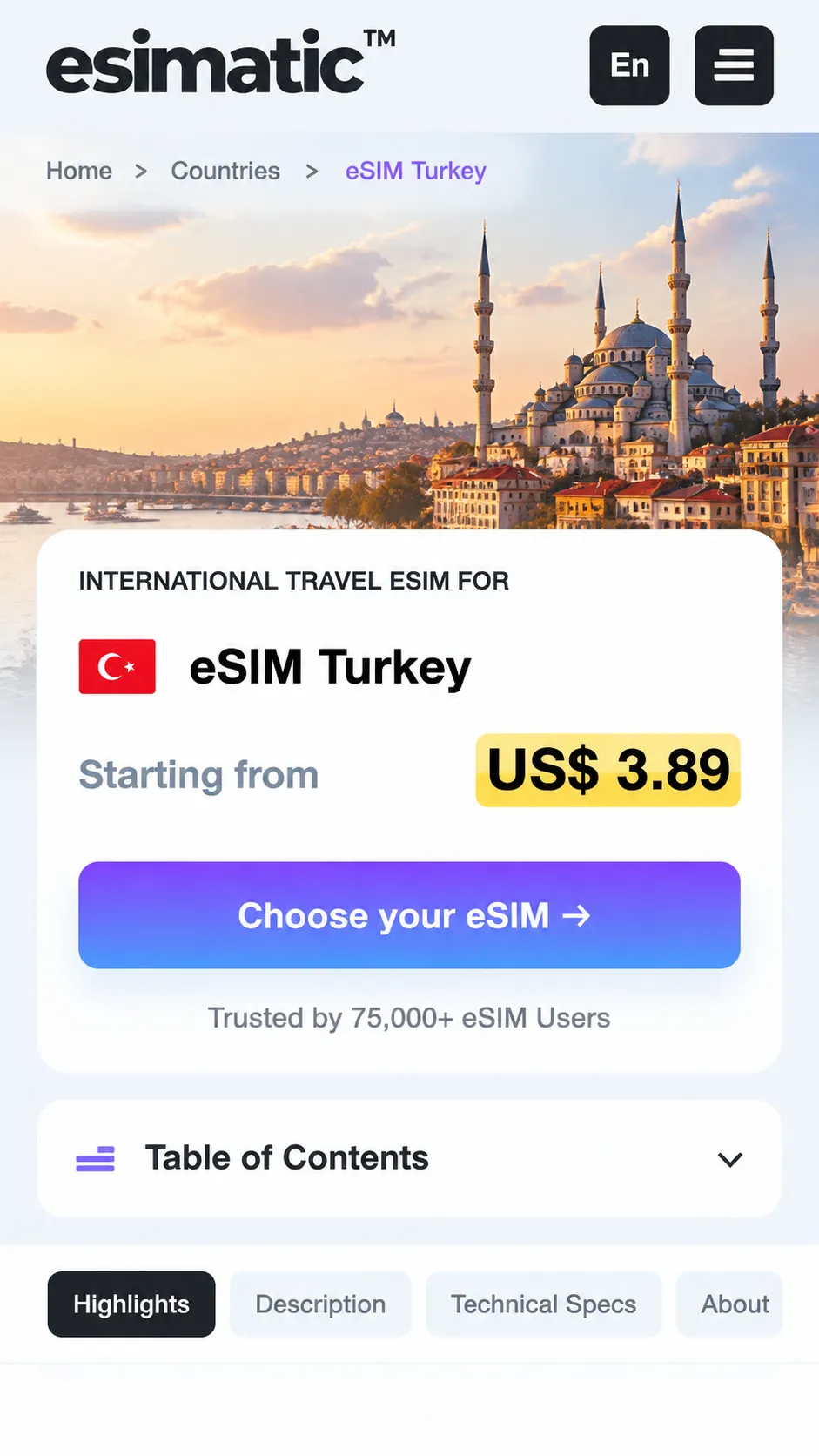
Operated by eSIM SIA, a Latvian company. Plans run 1GB/7d at $3.89, 3GB at $6.69, 5GB at $9.49, 10GB at $14.29, 20GB at $19.99 and 50GB at $44.99, with day passes at 1GB before dropping to 1.25 Mbps.
Its carrier disclosure is the most precise of any provider here, naming Avea İletişim Hizmetleri A.Ş. and Turkcell İletişim Hizmetleri A.Ş. outright. That means Turkcell’s rural footprint in writing, which is the single most useful thing you can know before booking a Cappadocia trip.
A verified May 2025 review reports streaming without issues on the bus from Istanbul to Cappadocia, which is exactly the leg where weaker networks fall over.
The catch: Trustpilot sits at 3.9 across just 28 reviews and the indexed snippet dates from 2023, so treat the score as low confidence.
Reviewers also complain that the 1GB day-pass throttle is not obvious before purchase.
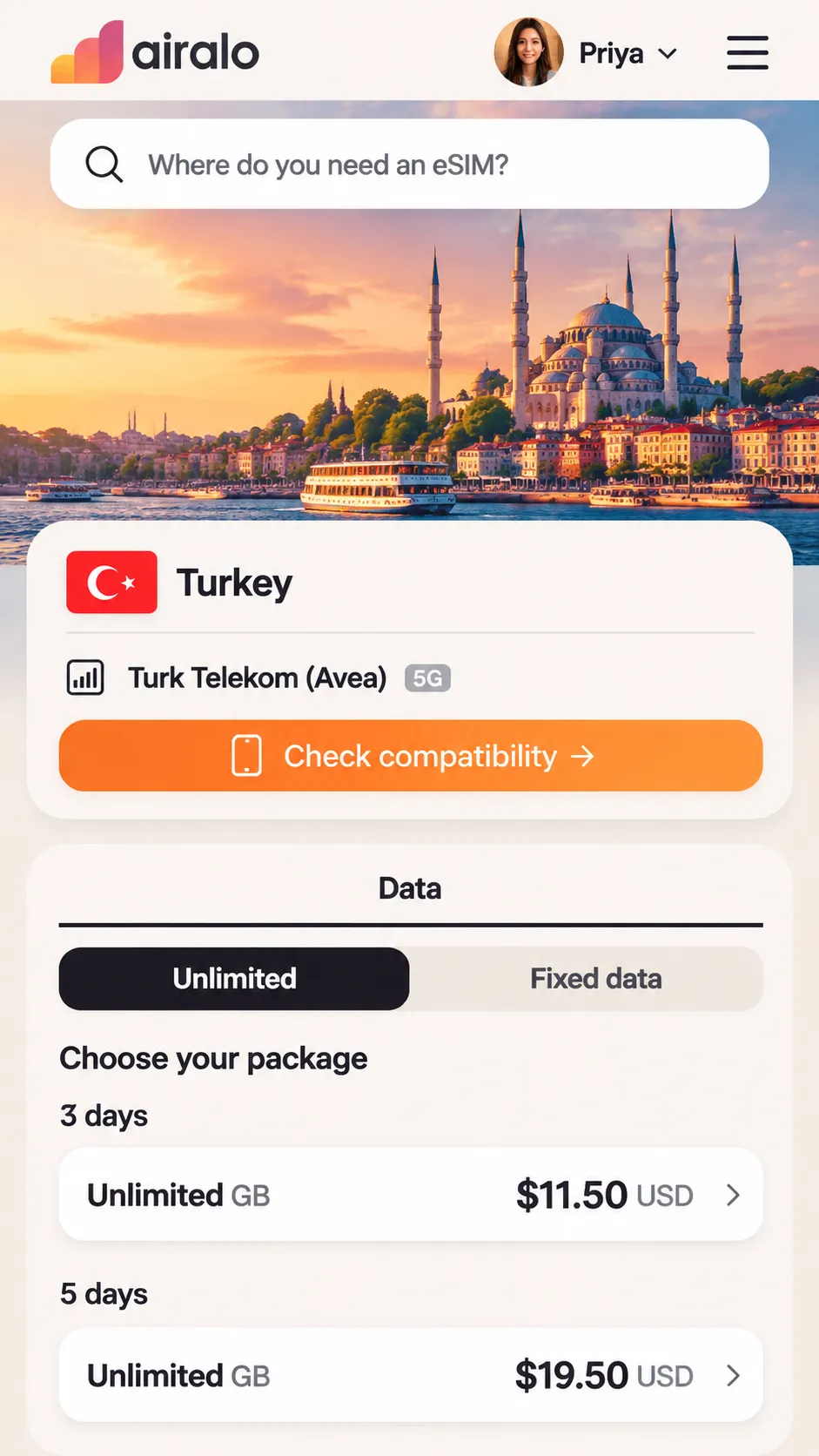
Plans run 1GB/3d at $4.00, 3GB/7d at $6.50, 5GB at $10.00, 10GB at $15.50 and 50GB at $34.50. Unlimited data runs $11.50 for three days, $24.50 for seven, $39.00 for fifteen and $69.00 for thirty, with fair use at 3GB per day before 1 Mbps.
Airalo names its Turkish carrier openly on the product page, which most competitors do not. And contrary to what most guides say, Airalo’s Eurolink regional plan does include Türkiye, confirmed four separate ways including field testing, so it works if you are combining Türkiye with Greece or Bulgaria on one profile.
The catch is the network itself. Türk Telekom has the weakest rural footprint of the three, and it shows: independent testing measured an Airalo connection in Cappadocia at under 3 Mbps against 20 Mbps or better on a Turkcell-based competitor in the same valleys.
Trustpilot sits at 4.0 across 37,800 reviews, the lowest of the major names, though its app store ratings are far stronger.
Airalo is also number one on BTK’s blocked list with no acknowledgment of it anywhere on its site.
Buy it if you are staying in Istanbul and along the coast, or you need Eurolink for a multi-country trip.
New to Airalo? ESIMADVICE15 takes 15% off, bringing 10GB to $13.18. Already a customer? ESIMADVICE10 gives you 10%.
Plans run 1GB/7d at $3.99, 3GB at $6.99, 5GB at $9.99, 10GB at $15.99 and 20GB at $22.99. Unlimited data runs from $18.99 for five days to $71.99 for thirty, with fair use at 5GB per day before throttling, the most generous daily allowance of any provider on this list.
Trustpilot sits at 4.7 across roughly 29,000 reviews, the best score at meaningful scale here, and Saily names itself in the blocked-provider list on its own blog, which almost nobody else does.
Türkiye is confirmed in its 35-country Europe plan. Field reports are strong: one traveller reported it working without a hitch in both Istanbul and Cappadocia in December 2025, and independent testing measured it fastest in Istanbul at 65 Mbps, with 35 to 38 Mbps in Göreme and Ürgüp, attributing the performance to Turkcell.
The catch: Saily will not confirm the carrier itself, refunds are issued as app credit rather than money back, and at $1.60 per gigabyte it costs 2.8 times what eSIMX charges.
Operated by Genesis Group AG. Plans run 1GB/30d at $2.40, 5GB at $10.80, 10GB at $16.80, 20GB at $25.20 and 50GB at $43.20, on a wallet model with Ycoins that returns 5% cashback.
Yesim is the single most transparent provider here about the BTK block, carrying a banner on the Türkiye product page itself telling you to buy and install before your trip. That is exactly the right behaviour and it deserves credit.
The catch is a pricing problem. Yesim’s unlimited data pricing was inconsistent across three of its own surfaces on the same day: $3.96 per day on the calculator, $30.00 for seven days on a landing page and $65.90 for thirty days on the comparison index.
Check the price at checkout rather than trusting the marketing page. Hotspot use is qualified as “depends on operator” rather than a straight yes. And Türkiye is not in any Yesim Europe plan, so a multi-country trip would need its Balkans bundle instead.
Operated by Core Communication Retail Limited in Slough, UK. There are three plans and no more: 5GB/14d at $11, 10GB at $18 and 20GB at $25. No 1GB option, no 3GB, no 7-day validity and no unlimited data.
It does name its carriers, which is worth something, and it states unlimited tethering and hotspot use in writing, which several rivals will not.
The catch is price and sample size. At $1.80 per gigabyte it costs 3.1 times what eSIMX charges for the same data allowance.
Trustpilot sits at 4.5 across just 76 reviews, Google Play shows 500-plus installs with no rating displayed, and there is no Türkiye-specific field evidence anywhere: no Reddit thread, no TripAdvisor mention, no forum report.
ESIMDUDE takes 12% off Amigo eSIM, bringing 10GB to $15.84, still 2.7 times eSIMX.
Which Türkiye eSIM should you actually buy?
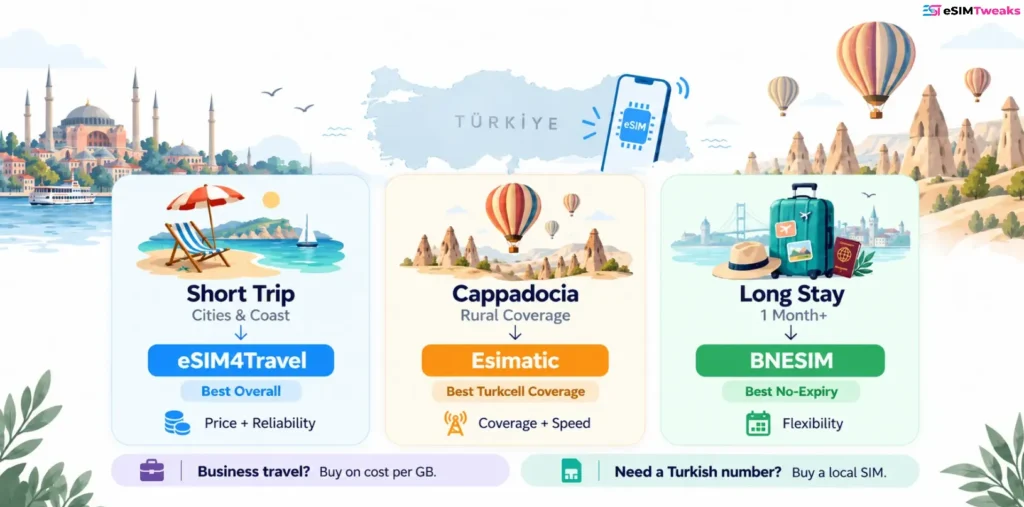
Buy 10GB. Take eSIM4Travel at $6.28 for cheap-tier pricing with evidence behind it, or Saily at $15.99 if support quality matters more to you than price and you want the most generous unlimited data threshold. Either is a sound choice, and the registration rules do not touch you.
Carrier choice becomes the whole decision. Take Esimatic or eSIM4Travel, both of which name Turkcell in writing. Avoid a Türk Telekom-only product for the rural legs.
Buy the volume upfront, because you may not be able to top up from inside the country. BNESIM’s no-expiry tier suits repeat visitors well. Keep an eye on the 90-day counter explained below.
None of these providers will give your finance team a consolidated invoice with per-line reporting and a VAT receipt. If that is the requirement, you are buying a corporate roaming product rather than a travel eSIM. For a one-off trip, buy on cost per gigabyte and expense it.
None of these eleven provides one. That is the single case where a physical SIM card wins outright, and it comes up more often than people expect. Turkish banks, long-term rentals and some domestic delivery apps all want a 05xx number.
Do you need to register your phone in Türkiye?
Almost certainly not, but the reason why matters, because nearly every English-language guide explains this rule incorrectly.
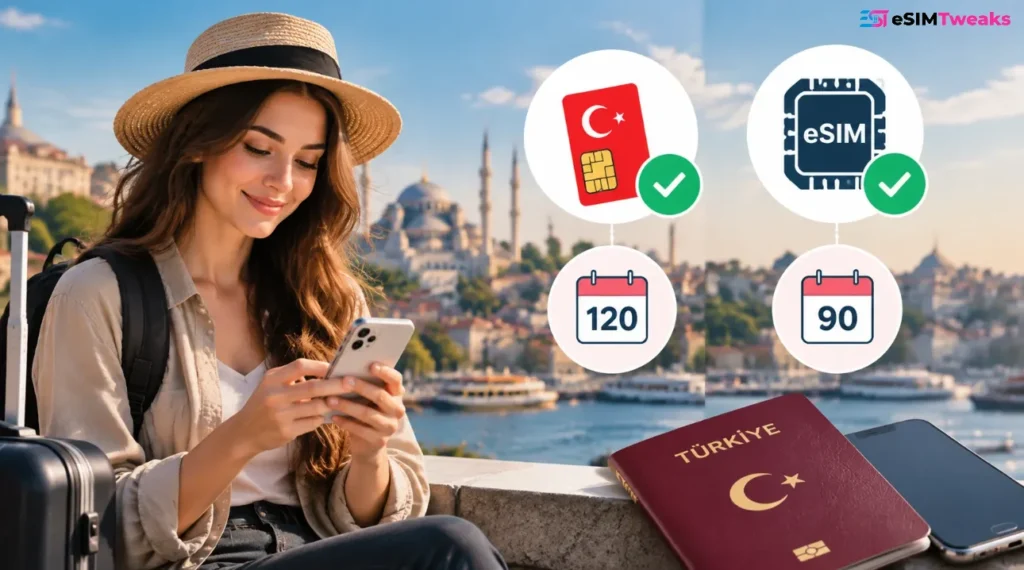
There are two separate legal regimes in Türkiye, and only one of them is the famous 120-day rule.
| Category | Regime A: Turkish SIM | Regime B: foreign SIM or eSIM |
|---|---|---|
| Turkish term | Yolcu beraberinde getirilen cihaz | Uluslararası daimi veri dolaşımı |
| What triggers it | A foreign handset matched to a Turkish subscriber number under your passport | A device with a non-286 IMSI leaving network traces for more than 90 cumulative days in any 120 consecutive days, without voice traffic |
| Grace period | 120 days if resident in Türkiye, 180 days if resident abroad | 90 cumulative days in a rolling 120-day window |
| Consequence | IMEI blacklisted, all three Turkish operators cut service | IMEI blacklisted, service cut within 30 days |
| Does it affect a two-week tourist? | No | No |
Regime B comes from the regulation published in the Resmî Gazete on 20 February 2021, number 31401.
Read the definition closely: a foreign IMSI prefix, more than 90 cumulative days in any 120, leaving traces on the network, without voice communication.
A data-only travel eSIM is precisely the profile that definition describes. Foreign IMSI, no voice, continuous data.
This is not theoretical. In Ombudsman decision 2022/170 of 23 January 2023, a complainant brought a Samsung S10+ into Türkiye and used it with a foreign SIM only.
BTK blacklisted the IMEI under the permanent-roaming rule with no prior notice, and the Ombudsman found the blacklisting lawful.
Airalo concedes the same point in its own guidance: use eSIM data for 91 accumulated days or more in a 120-day period and you must register the IMEI and pay the tax.
What this means in practice. Two weeks in Istanbul and Cappadocia, or a month on the Turquoise Coast, requires nothing at all.
No registration, no fee, no risk, because you are nowhere near 90 days. But four months a year in Türkiye, or a remote worker running a data-only eSIM continuously, is genuinely exposed.
Ninety cumulative days in a rolling 120-day window is easier to reach than it sounds, and the counter does not reset because you left and came back.
The 2026 registration fee is 54,258 lira, set by presidential decision on 1 January 2026, roughly $1,136 at 47.74 lira to the dollar. You may register one device per passport every three calendar years.
Since a July 2026 amendment, e-Devlet is the only registration channel, with the subscriber registration centres and the SMS route both removed. Paying the tax at a tax office is a separate step, and paying it does not register you.
If a phone is blacklisted, the block applies to the handset rather than the SIM, at the operator equipment identity register. All three Turkish networks cut service and swapping SIMs does not help. A blacklisted phone cannot even roam in Türkiye, which is exactly what happened in the Ombudsman case.
Wi-Fi keeps working normally, and the phone works fine the moment you leave the country, because the block is national rather than the GSMA global stolen-device list.
One piece of folklore worth correcting. BTK ran a registration crackdown in 2026 and Turkish media merged two separate stories. What is confirmed is that a dual-SIM handset carries two IMEIs, and people were registering a second, different phone against the spare IMEI to defeat the one-device-per-three-years rule.
BTK flagged hundreds of thousands of irregular registrations from 1 January 2026 with a compliance deadline of 1 May 2026. What is not confirmed is the widely repeated claim that people were running slot one for 120 days and then slot two for another 120.
Turkish tech media itself labelled that an uncited allegation, and no BTK release supports it.
Are eSIMs banned in Türkiye?
No, and the confusion here costs travellers real money.
On 10 July 2025 BTK blocked the websites and apps of eight eSIM providers inside Türkiye: Airalo, Holafly, Saily, Nomad, Instabridge, MobiMatter, aloSIM and BNESIM. In-country testing in May 2026 found the list had grown past twenty.
This is a geoblock on the purchase portal, not a kill switch on the eSIM itself. A plan installed and activated before you land keeps working exactly as normal.
What you lose is the ability to buy a new plan or top up an existing one from inside the country. Only three providers are honest about this on their own sites.
| Provider | On the blocked list | Admits it on its own site |
|---|---|---|
| Yesim | Yes | Yes, a banner on the Türkiye product page itself |
| Saily | Yes, original eight | Yes, names itself in the blocked list |
| GigSky | Yes | Yes, on its blog |
| GoMoWorld | Yes | Only obliquely, and it names competitors rather than itself |
| Airalo | Yes, original eight | No acknowledgment anywhere |
| MobiMatter | Yes, original eight | No, and its own Türkiye guide omits it entirely |
| BNESIM | Yes, original eight | Discusses Turkish restrictions, never admits its own |
| eSIMX, Esimatic, Amigo, eSIM4Travel | Not on any published list | Unconfirmed either way |
Absence from the list is not proof of accessibility. The people who compiled it describe it as a snapshot, and note that access varies by network and by day.
The practical advice: buy and install before you fly, and over-buy your data. If you do run dry mid-trip on a blocked provider, your options are a VPN, hotel Wi-Fi on a bypass DNS, or walking into a shop and buying a local SIM card.
Türkiye’s mobile networks, and why the carrier behind your plan matters
| Operator | Subscribers, Q3 2025 | Position |
|---|---|---|
| Turkcell | 39.03 million | Best rural and eastern Anatolia coverage |
| Türk Telekom | 30.81 million | Overtook Vodafone for second place for the first time in twenty years |
| Vodafone Türkiye | 29.30 million | Solid urban, mid-table rurally |
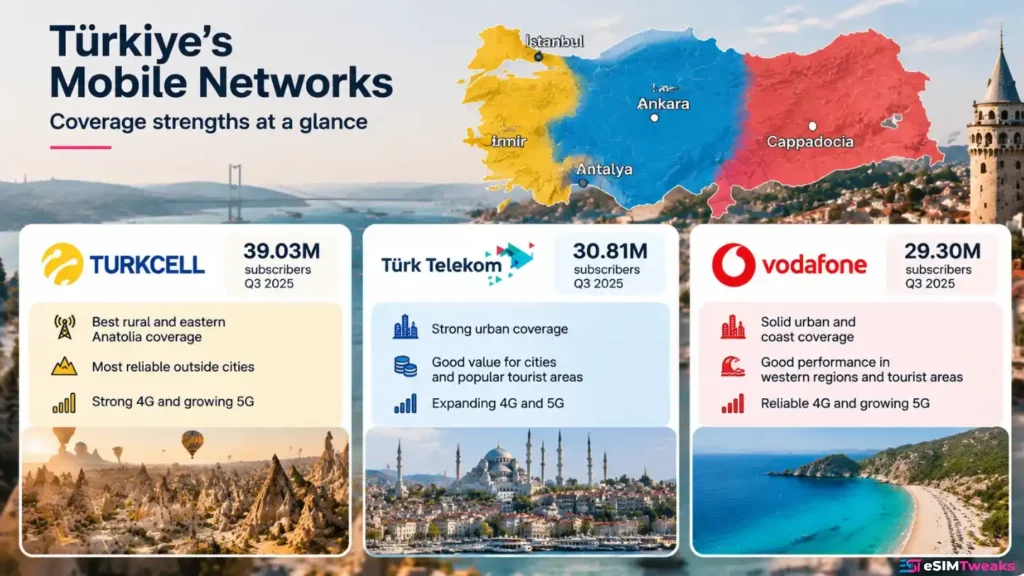
That is 99.13 million connections against a population of 85 million, so penetration runs at about 113%. Average monthly data per subscriber reached 20.8GB in the first quarter of 2026, up from 11.3GB in 2021, which tells you Turkish networks are built for heavy use.
Türkiye launched commercial 5G on 1 April 2026, across all 81 provincial centres on all three operators simultaneously, following an October 2025 spectrum auction that raised around $2.95 billion.
Roughly 21 million subscribers were on 5G on day one and more than 29 million within ten days. Measured national speeds jumped from 43.7 Mb/s download in January 2026 to 169.0 Mb/s in April, with upload rising from 13.1 to 25.8 Mb/s.
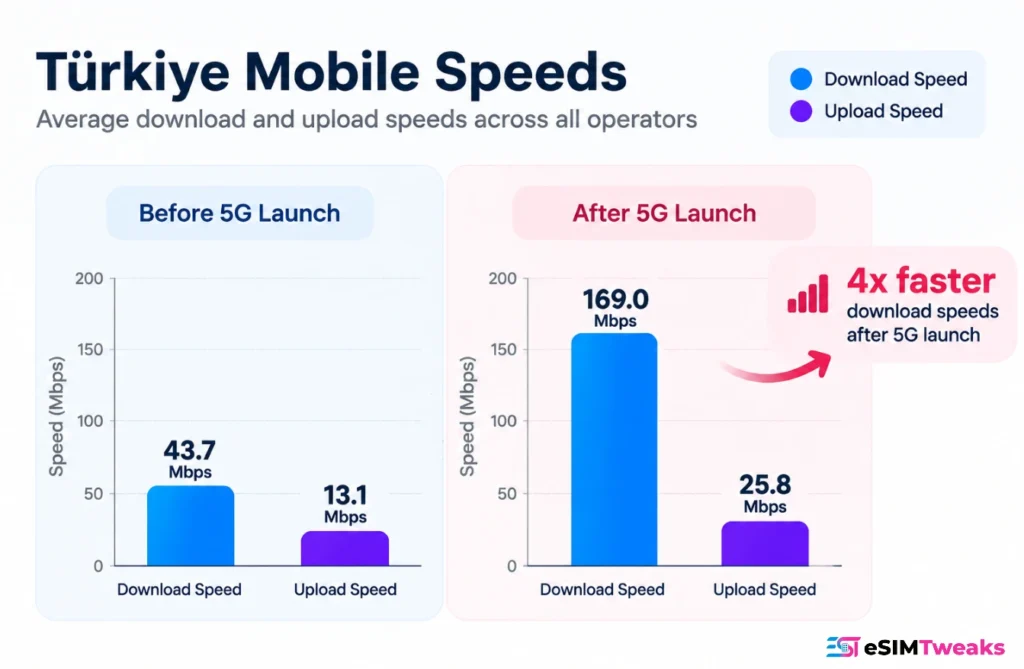
Treat that jump with some care. A country does not become four times faster in three months. What changed is who runs speed tests, because 5G handset owners self-select into them.
Whether your eSIM actually gets 5G coverage is a separate question, and the honest answer is probably not. No provider on this list publishes a Türkiye 5G roaming guarantee.
Independent testing in early 2026 found 5G limited to central Istanbul business districts on two providers and 4G LTE everywhere else, and one MobiMatter buyer paid for a 5G-labelled plan and received Turkcell 4G. Assume 4G and treat 5G as a bonus.
On bands, Türkiye runs LTE on B1, B3, B7, B8 and B20, and 5G on 700 MHz and 3.5 GHz. B3 and B20 do most of the work, and a handset without B20 will have poor rural and indoor coverage. Türkiye does not use B28 or B71, worth knowing if you carry a US-market phone, although B20 is standard on international models.
2G and 3G are both still running, with a hard shutdown deadline of 30 April 2029 written into the renewed concession agreements, and roughly 6.8 million subscribers still on the older networks as of March 2026.
Here is why all of this matters to your purchase. Five of the eleven providers name their Turkish carrier and six do not, and the three networks are not interchangeable once you leave the cities.
Turkcell has the strongest rural footprint; Türk Telekom has the weakest. Airalo runs on Türk Telekom only and says so openly, which is to its credit, but independent testing measured an Airalo connection in Cappadocia at under 3 Mbps against 20 Mbps or better on a Turkcell-based competitor standing in the same place.
Rick Steves forum posters describe Airalo as inconsistent in the remote valleys while rating Turkcell most reliable overall.
For Istanbul, Antalya and the coast, none of this matters. For Cappadocia balloon country, the Lycian Way, or anything east of Ankara, it matters a great deal.
The three providers you can choose on carrier evidence rather than marketing are eSIMX, Esimatic and eSIM4Travel, all of which reach Turkcell and all of which say so.
eSIM or physical SIM card in Türkiye?
Most guides answer this with generic talk about convenience. In Türkiye the answer turns on country-specific facts instead.
| Features | Travel eSIM | Turkish prepaid SIM card | Home carrier roaming |
|---|---|---|---|
| Where you buy it | Online, before departure | In-store, passport required | Already on your account |
| How it installs | QR code scan or in-app activation, about two minutes | Physical swap, staff-assisted | Nothing to do |
| Typical 20GB cost | $10.80 to $36 | ~$37.80 (₺1,800 Turkcell tourist pack) | $60 to $200 in day passes |
| Turkish phone number | No | Yes, plus domestic minutes | No |
| Top-up from inside Türkiye | Often blocked | Anywhere, any kiosk | Yes |
| IMEI registration exposure | Regime B after 90 days | Regime A after 120 days | Regime B after 90 days |
| Tethering and mobile hotspot | Usually allowed, check per plan | Allowed | Usually allowed |
| Keeps your home number live | Yes, the eSIM sits alongside it | Only if your phone is dual-SIM | Yes |
The real eSIM advantage here is not that it is easier. It is that you arrive already connected. Your mobile data works before you reach passport control, which matters at Istanbul Airport, where the taxi queue is exactly where tourists get overcharged and your ride-hailing app is the defence against it.
The real advantage of a Turkish prepaid SIM is that you can top it up. Because BTK blocks most eSIM websites from inside the country, an eSIM that runs dry mid-trip is genuinely awkward, whereas a local SIM tops up at any corner kiosk. That is a legitimate point against eSIMs that is specific to this country.
A physical tourist SIM does cost three to six times more per gigabyte, though, and buying one at the airport rather than a city-centre store adds a further 50% to 70% on top.
A Turkcell tourist pack is 20GB plus 200 domestic minutes for ₺1,800, about $37.80, valid 28 days, with your passport required at the point of sale. eSIMX sells the same 20GB for $10.80.
For most visitors the answer is: buy the eSIM, over-buy the data allowance, and treat a local SIM as the fallback if you end up needing a Turkish number.
How to install and activate your Türkiye eSIM
Your handset needs to be eSIM compatible and carrier-unlocked, which in practice means an iPhone XS or newer, a Pixel 3 or newer, a Galaxy S20 or newer, or most flagship models from 2019 onward. Buy the plan on home Wi-Fi and scan the QR code before you fly, then leave the line switched off until you land.
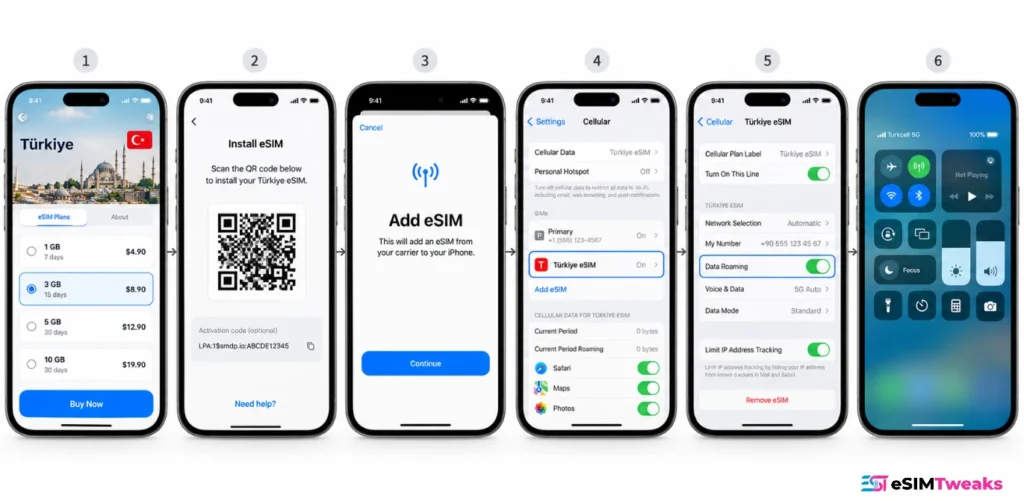
On arrival, set the Turkish eSIM as your mobile data line, keep your home number active for voice and SMS only, and switch data roaming on for the eSIM line. That last step catches more people than any other, because the setting looks like the one you have spent years keeping firmly switched off.
On a travel eSIM it is the switch that makes the plan work at all.
Where you will actually use it: coverage by destination
Türkiye received 52.78 million foreign visitors in 2025, plus 11.17 million Turkish citizens resident abroad, for 63.94 million arrivals in total and tourism revenue of $65.23 billion.
One correction to the usual narrative, though: 2026 is running down rather than up. First-half foreign arrivals came to 20,767,048, a fall of 2.96%, with revenue essentially flat.
| Province | 2025 foreign visitors | Share |
|---|---|---|
| Istanbul | 17,478,000 | 34.92% |
| Antalya | 15,749,551 | 31.46% |
| Edirne | 4,160,000 | 8.3% |
| Cappadocia (Nevşehir) | 4,523,000 site visits | Record year |
The top source markets in 2025 were Russia at 6.90 million, Germany at 6.75 million, the United Kingdom at 4.27 million and Iran at 3.05 million. Average stay in the first half of 2026 was 10.01 nights.
Ten nights at Türkiye’s own consumption rate of 20.8GB per month works out to roughly 7GB, so once you add navigation, translation and photo uploads, 10GB is the right data allowance for a typical trip.
No provider publishes a Türkiye coverage map worth reading, so the table below is assembled from operator footprint and traveller reports rather than marketing pages.
| Destination | What the connection is actually like | What to buy |
|---|---|---|
| Istanbul | Dense on all three networks. 65 Mbps measured on Saily, 70 to 100 Mbps reported on BNESIM. 5G in central business districts only | Any provider on this list |
| Antalya and the Turquoise Coast | Strong along the resort strip, thinner in the mountains behind Kaş and Kalkan | Any provider, 10GB for a fortnight |
| Cappadocia (Kapadokya) | The one place carrier choice decides the outcome. Under 3 Mbps measured on Türk Telekom against 20 Mbps plus on Turkcell in the same valleys | Esimatic, eSIM4Travel or eSIMX for named Turkcell access |
| İzmir and Ephesus | Good urban coverage. Ephesus sits in open country and holds 4G LTE fine | Any provider |
| Pamukkale | Adequate on the travertines, patchy in the far reaches of Hierapolis | Turkcell-based for the walking legs |
| Fethiye, Ölüdeniz and the Lycian Way | Coastal towns are fine. The trail itself has genuine dead zones on all three networks | Download offline maps whatever you buy |
| Bodrum | Solid, and busy in season, so expect congestion rather than absence of signal | Any provider |
| Ankara | Full urban coverage on all three networks, no issues | Any provider |
| Eastern Anatolia, Nemrut, Van | Turkcell’s footprint is materially better and the gap widens with distance from the coast | Turkcell-named provider, no exceptions |
The pattern is simple. West of Ankara and along the coast, every eSIM here works and you should buy on price. East of Ankara, or up in the balloon valleys, the network operator behind your plan is the entire decision.
One thing you do not need to worry about: the Bosphorus. Istanbul spans two continents and your phone does not care. Both sides are the same country, the same mobile country code 286 and the same three operators, so crossing from Europe to Asia is an ordinary cell handover.
Expect nothing beyond the usual bridge and tunnel dead spots.
Türkiye as the gateway between Europe and Asia
Where the two continents genuinely do matter is in how providers design their regional plans, and they disagree with each other more than you would expect.
| Provider | Is Türkiye in the Europe plan? |
|---|---|
| Airalo Eurolink | Yes, confirmed by field testing |
| Saily Europe | Yes, named in the 35-country list |
| eSIMX, Esimatic, eSIM4Travel, MobiMatter, GigSky, BNESIM | Yes |
| Yesim | No. Use its Balkans bundle instead |
| GoMoWorld | No regional plan covers Türkiye at all |
| Amigo eSIM | A Europe plan exists but publishes no country list |
Türkiye is the classic regional orphan: too far east for some Europe bundles and never included in Asia bundles.
Istanbul Airport moves 84 million passengers a year with 48% of them transferring, and land borders run west into Greece and Bulgaria, both EU and Schengen members, and east into Georgia, Armenia, Iran and Iraq. So a lot of people pass through on the way to somewhere else, and that is where the trap sits.
A traveller doing Athens, then Istanbul, then Sofia assumes one Europe regional plan will cover all three. Usually it does, but Yesim’s Europe plan excludes Türkiye and GoMoWorld covers it in no regional plan whatsoever.
Türkiye is also outside the European Union, which means the roam-like-at-home rules that let a Greek prepaid SIM card work across the bloc stop dead at the Turkish border. International roaming rates begin the moment you cross at İpsala.
The clean answer for a multi-country trip: either buy a Europe plan that names Türkiye in its country list in writing, which Airalo Eurolink and Saily Europe both do, or run two separate eSIMs and switch lines at the border. And if you are transiting Istanbul rather than visiting, buy nothing at all.
TK WiFi inside the terminal is free and unlimited.
Arriving by cruise? Read this before you sail
Cruise is the fastest-growing part of Turkish tourism.
The first half of 2026 brought 756,455 passengers on 488 calls, the best first half in sixteen years, against 2.14 million for the whole of 2025 and a 2026 projection of 2.3 million.
| Port | Latest figures |
|---|---|
| Kuşadası | 617 calls and more than 995,000 passengers in 2025, Türkiye’s busiest |
| Istanbul (Galataport) | Around 200 calls and 520,000 passengers forecast for 2026 |
| Bodrum | 116 ships and 138,149 passengers in 2025 |
Your Türkiye eSIM does not work at sea, and this is the single biggest bill-shock risk on this page. Terrestrial networks fade shortly after you leave coastal waters, at which point the ship’s own onboard cellular service takes over, running over satellite backhaul and marketed as Cellular at Sea.
It is a separate maritime network excluded from every travel eSIM and from normal roaming bundles, and it is priced at $15 to $25 per megabyte. At $20 a megabyte, uploading a single 50MB photo costs $1,000.
The rule is simple: airplane mode the moment you leave port, Wi-Fi only at sea, data back on when you dock. In port your eSIM reconnects to the Turkish network automatically.
Flying in with Turkish Airlines
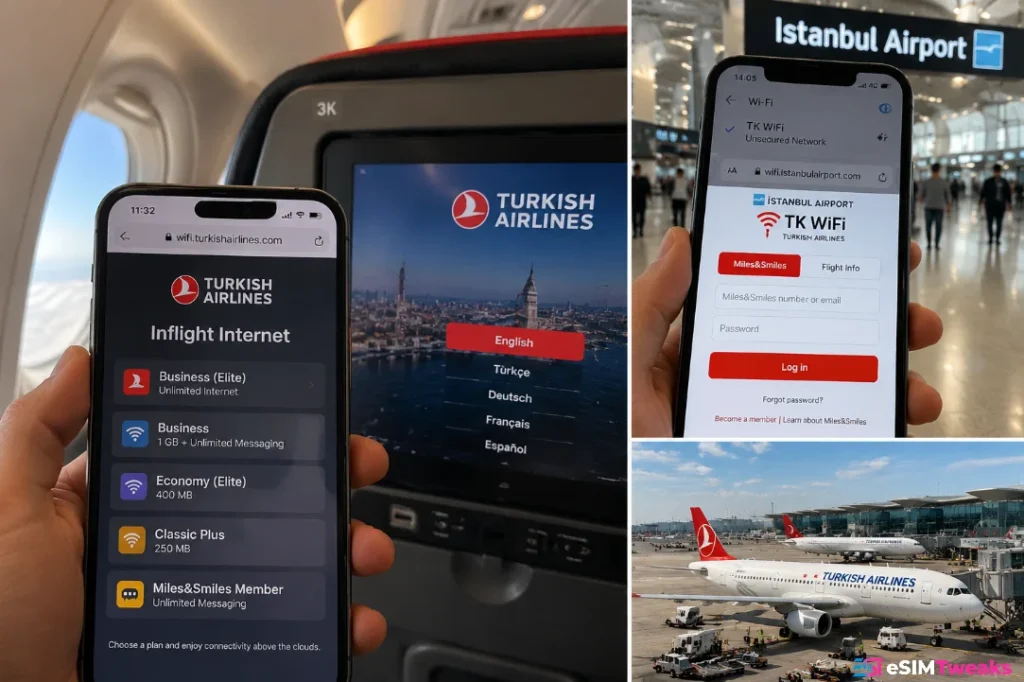
Turkish Airlines carried 92.6 million passengers in 2025 across 516 aircraft to 356 destinations in 132 countries, which it states is more countries than any other airline serves.
Its inflight wifi is tiered rather than free for everyone: unlimited for Business passengers with Elite status, 1GB plus unlimited messaging for Business, 400MB for Elite in economy, 250MB for Classic Plus, and unlimited messaging for any Miles&Smiles member. That last tier costs nothing and is worth signing up for before you fly.
At Istanbul Airport, use TK WiFi. It is free, unlimited, requires no passport kiosk, and you log in with your Miles&Smiles credentials or your flight details. The general airport wifi requires a passport-scanning kiosk instead, and its SMS verification reportedly fails often for international numbers.
A few words of Turkish
Not required, universally appreciated. Note that Turkish has both a dotted and a dotless i, which is why the capital of internet is written İ.
| English | Turkish |
|---|---|
| Hello | Merhaba |
| Thank you | Teşekkür ederim (formal), Teşekkürler (casual) |
| Welcome | Hoş geldiniz. The reply is Hoş bulduk |
| Please | Lütfen |
| How much is it? | Ne kadar? |
| Where is…? | … nerede? |
| Internet | İnternet |
| SIM card | SIM kart |
| What is the Wi-Fi password? | Wi-Fi şifresi nedir? |
| Excuse me | Affedersiniz |
Two of those are worth memorising above the rest. Ne kadar? will save you money in every market in the country, and Wi-Fi şifresi nedir? will save you data in every café.
The bottom line
Türkiye is one of the few destinations where the cheapest eSIM and the best eSIM are not the same product, and where the gap between them is small enough that most people should stop agonising over it.
eSIM4Travel at $6.28 for 10GB is the pick for the majority of travellers: it costs 48 cents more than the cheapest option and buys you a real support record and a network you can choose. eSIMX at $5.80 is the right call if price is all that matters and you buy enough data upfront that you never need to top up.
What actually decides your trip is not the brand. It is three things. Buy before you fly, because you may not be able to reach the shop once you land. Buy more data than you think you need, for the same reason.
And if Cappadocia or eastern Anatolia is on the itinerary, pick a provider that names Turkcell in writing, because that single choice is worth more than every price difference on this page.
Everything else, including the registration fee that sounds terrifying and the ban that is not a ban, will leave an ordinary holiday completely untouched.
Why trust eSIMTweaks.
59 providers tested.
388 speed tests run.
20 countries covered.
More like this

About the author

Director of Research, Pricing & Coverage
I lead pricing and coverage research at eSIMTweaks and maintain the dataset behind every comparison we publish across 200+ destinations. My background is in telecommunications analytics, where I spent six years building rate and coverage models for carrier partners. My analysis determines which providers earn a recommendation.