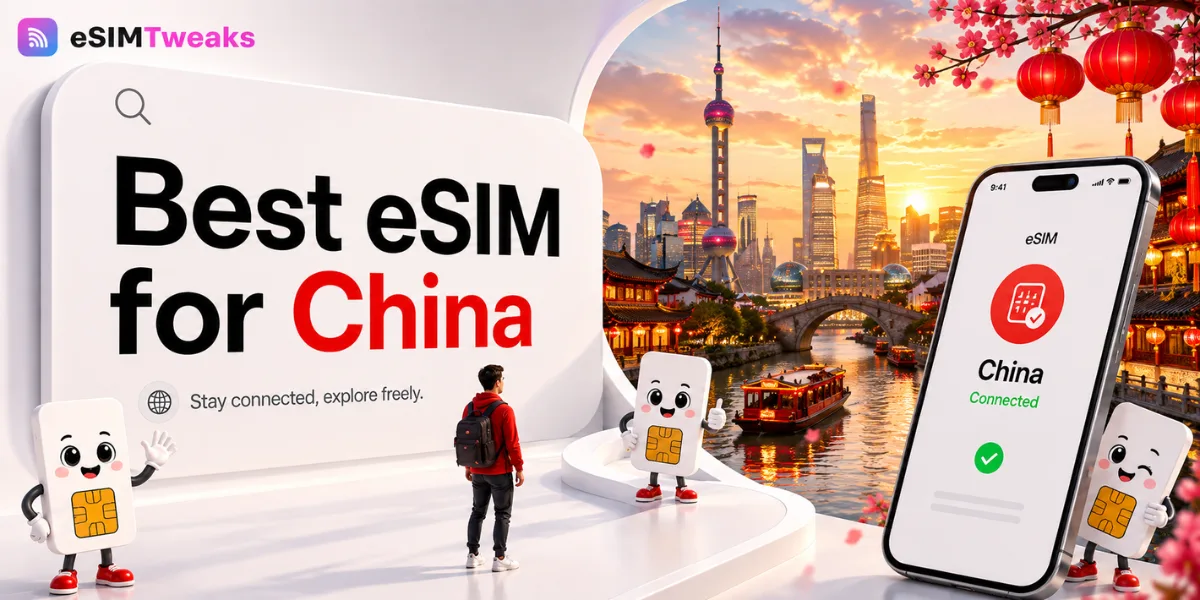
eSIM for China 2026: 9 Best Picks Behind The Firewall
Most China eSIM guides stop at prices, but the real question is routing. We tested 9 providers to see which plans actually keep your apps, work tools, and business trips connected behind the firewall.
August 21, 2026
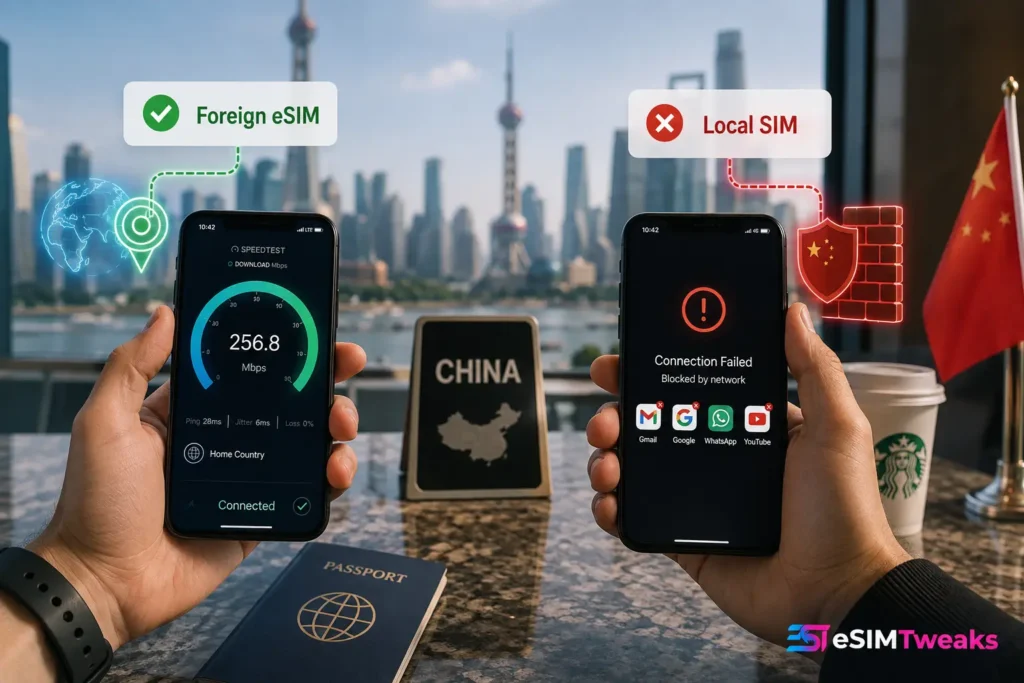
A local Chinese SIM card costs roughly ¥200 and gives you filtered internet.
A foreign travel eSIM costs $9 to $27 for the same trip and gives you Google, WhatsApp and Gmail without a VPN. That is the entire decision, and it turns on one piece of network architecture that almost no eSIM for China guide explains correctly.
This is a buyer’s guide for people going to China to work: an eSIM for Canton Fair, factory audits, supplier visits, trade delegations.
It prices nine providers and explains the mechanism that carries a foreign data plan around the Great Firewall.
| Provider | Best value plan | Cost per GB | Firewall position | Chinese carrier named | Coupon |
|---|---|---|---|---|---|
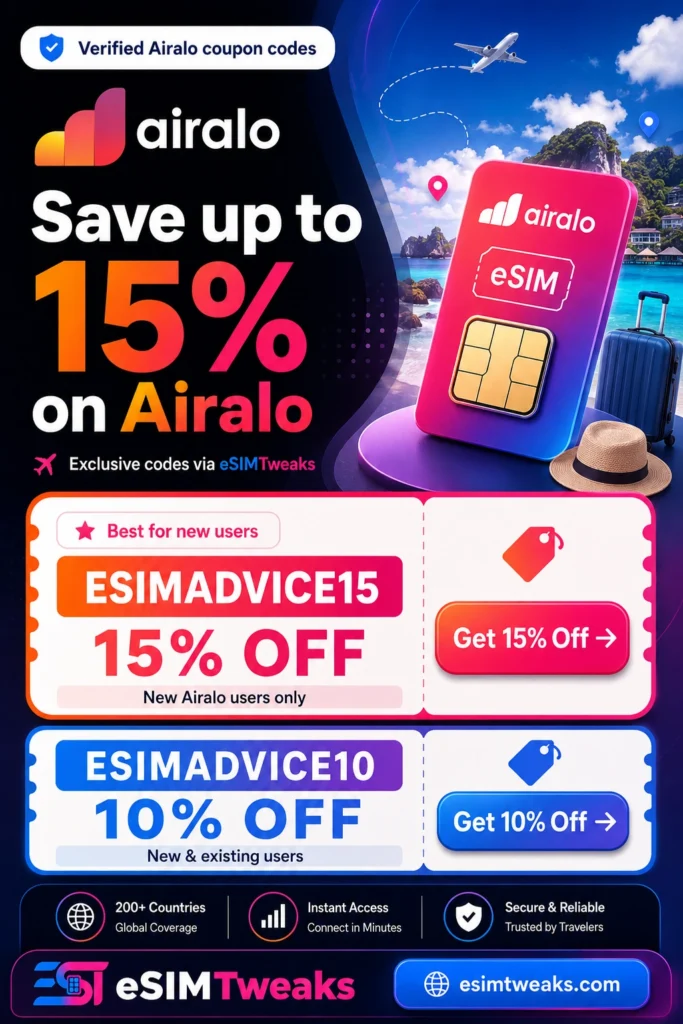
| Airalo | 50GB, 30 days, $49.00 | $0.98 | States plainly a VPN is not required | China Unicom | ESIMADVICE15 |
| Jetpac | 40GB, 30 days, $34.99 | $0.87 | Claims firewall bypass, caveats it | Unicom and Telecom | None in our register |
| MobiMatter | 50GB, 30 days, $29.99 | $0.60 | Contradicts itself, advises a VPN | Mobile and Unicom, brand level only | ESIMDUDE |
| SimOptions | 50GB, 30 days, $44.90 | $0.90 | Hedged claim, names the apps | China Unicom | None in our register |
| Saily | 20GB, 30 days, $39.99 | $2.00 | Hedged, then tells you to bring a VPN | No | ESIMDUDE |
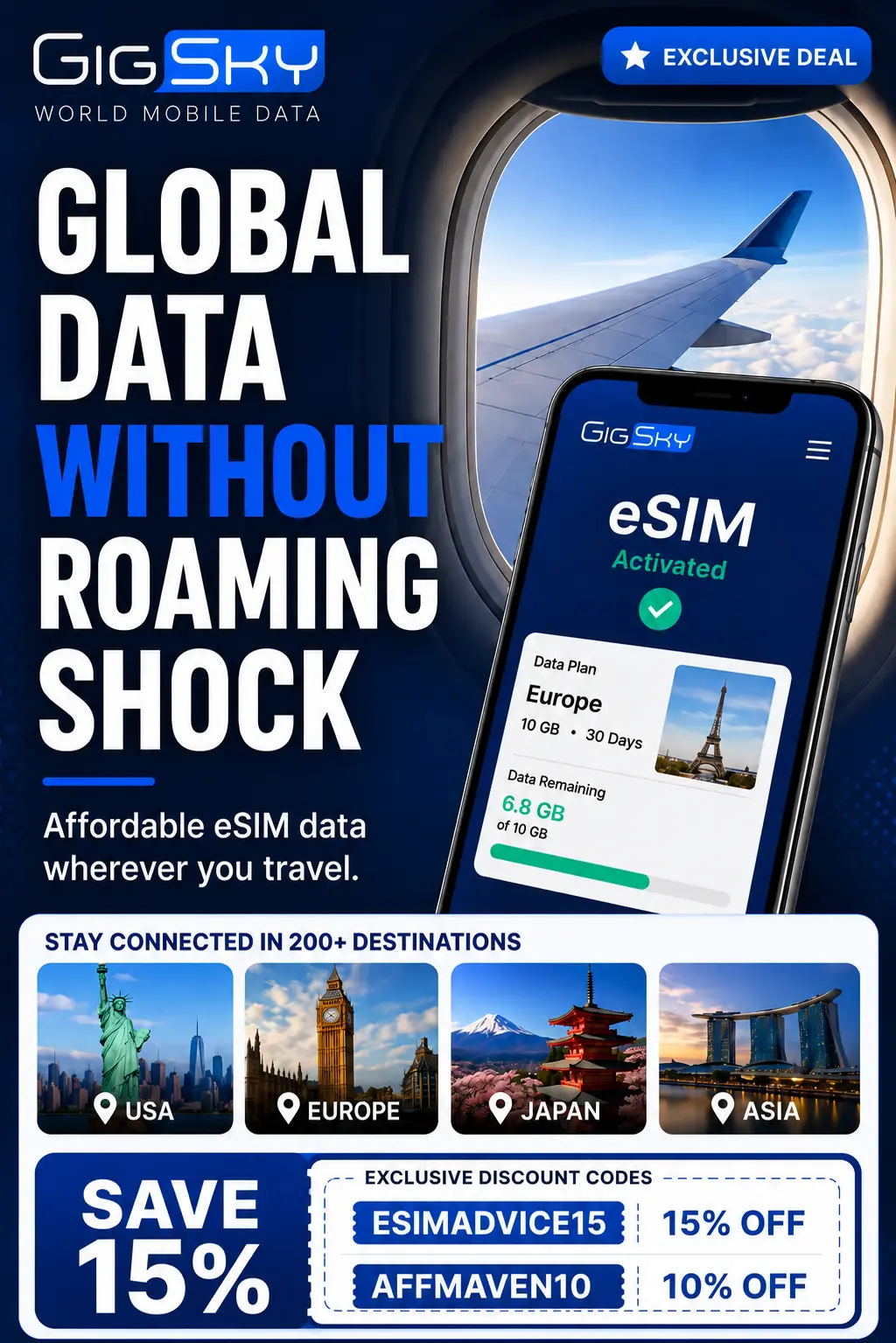
| GigSky | 20GB, 90 days, $69.99 | $3.50 | Claims bypass, but scoped and off-product | Mobile and Unicom | ESIMADVICE15 |
| Instabridge | 10GB, 30 days, $16.00 | $1.60 | Silent | No | None in our register |
| GoMoWorld | 18GB, 30 days, €29.99 | €1.67 | Bundled client VPN, not routing | No | None in our register |
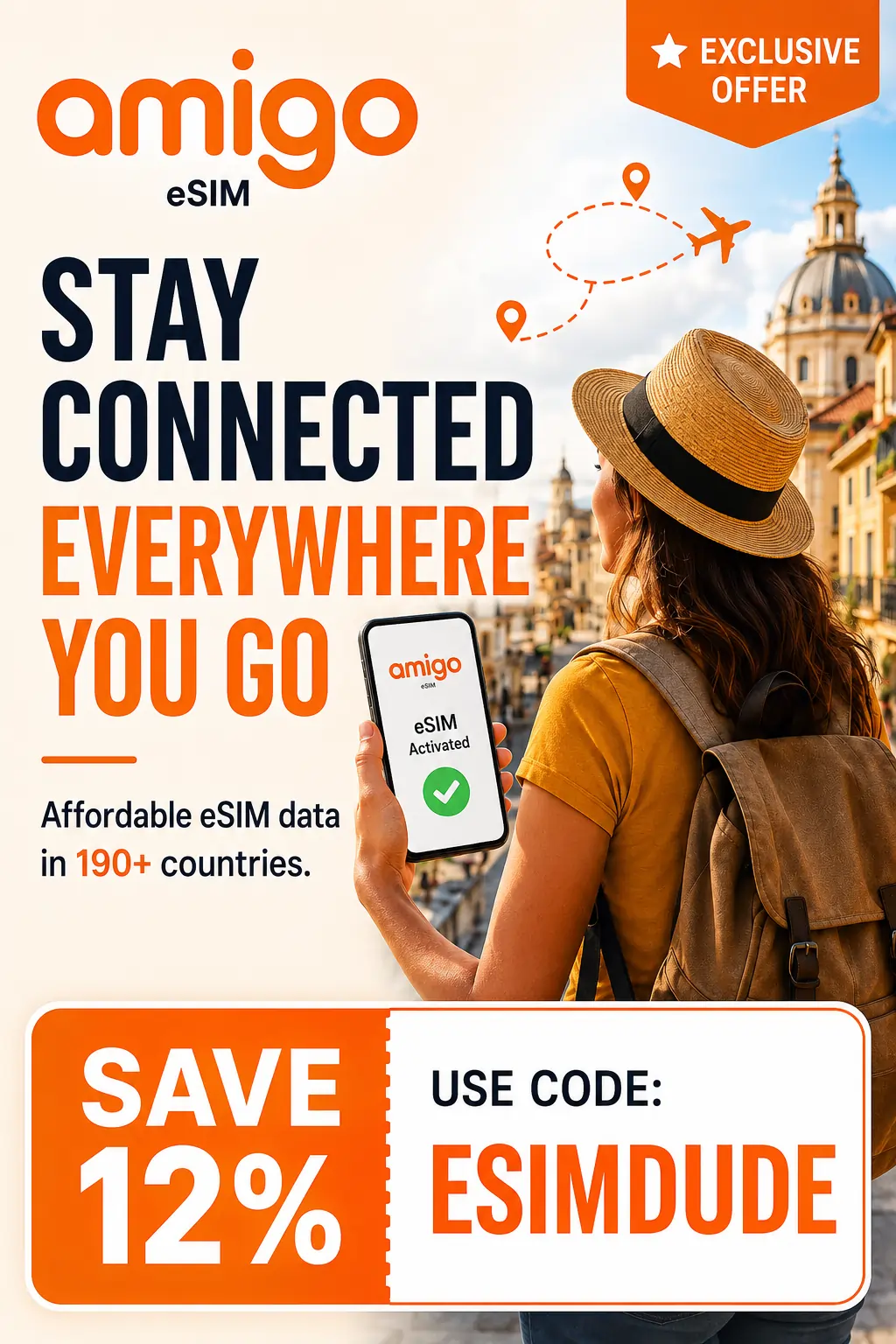
| Amigo | 20GB, 30 days, $48.00 | $2.40 | Silent, recommends a VPN for security | Unicom and Mobile | ESIMDUDE |
Prices in USD except GoMoWorld, which publishes only euros. Checked 18 August 2026.
Why a foreign eSIM works in China when a local SIM does not?
This is the mechanism, and it is worth understanding because it tells you which claims to trust.
When your phone roams onto a foreign network, the radio link is local but the packet gateway does not have to be. Under home-routed roaming the session is anchored at your issuing operator’s gateway in its own country: the visited network tunnels your traffic over the S8 interface using GTP back to that home gateway, and your data breaks out onto the public internet there rather than where you are standing.
The GSMA specifies this in IR.88, the EPS Roaming Guidelines.
The alternative, local breakout, anchors the session in the visited country. Ericsson’s technical review states that local breakout “is rarely used in EPS roaming today and not expected in early 5GS roaming”.
Home routing is the default, carried into 5G through the N9 inter-PLMN reference point. The observable consequence is documented: home-routed traffic geolocates to the home country regardless of where the user physically is, so a German phone in Spain still presents a German exit IP.
Apply that to China. Your phone attaches to a Chinese radio network for the air interface, but your packets are carried out of the country before they touch the open internet.
The Great Firewall sits on the domestic path and your traffic never enters it. That is why a foreign travel eSIM reaches Gmail and a ¥200 airport SIM does not.
Where I have to be honest about the evidence?
The architecture is authoritative. The step from “traffic exits abroad” to “therefore it is not filtered” is an inference, and I found no peer-reviewed measurement testing Great Firewall filtering against a home-routed roaming bearer inside China.
Travellers and vendors report it consistently. Nobody has measured and published it.
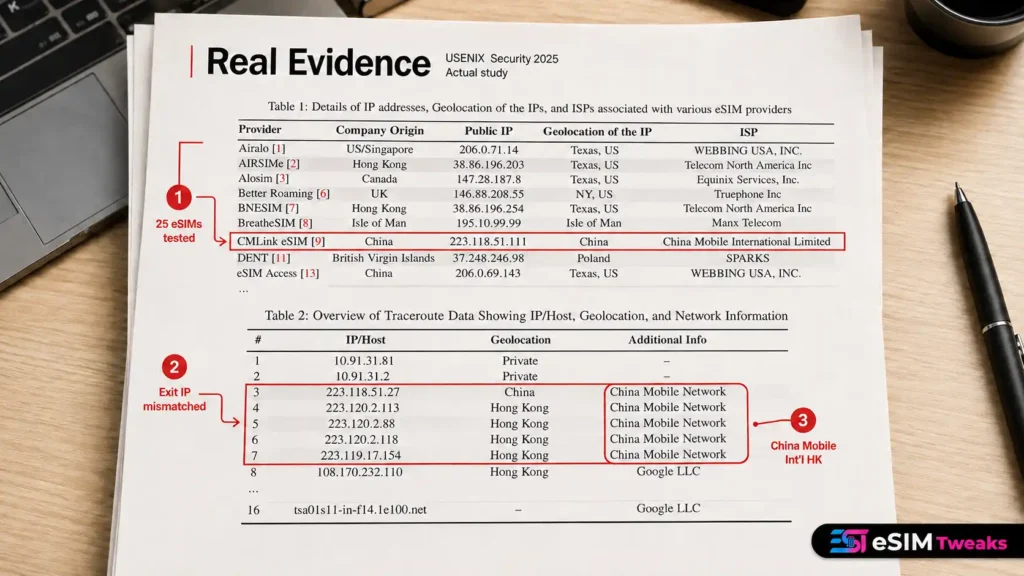
There is also a counter-finding. A study of 25 eSIM providers presented at USENIX Security 2025 found travel eSIMs frequently routing user data through third-party networks including Chinese infrastructure regardless of where the user is, with the device’s public IP almost never matching its physical location.
One produced a public IP registered to China Mobile International in Hong Kong.
Hong Kong sits outside the filtering, so that case still works. The point is narrower: you have no visibility into your exit point and no contractual guarantee of it.
What is actually blocked, and what quietly is not?
Most guides say “Google and WhatsApp are blocked” and stop. For a business traveller the more useful question is which of your work tools survive.
GreatFire’s analyser, monitoring from inside mainland China, gives a clear split.
| Service | Status on a local Chinese connection | Last tested |
|---|---|---|
| Google Search | Blocked, 100% of conclusive tests | 29 Jul 2026 |
| Gmail | Blocked | 21 May 2026 |
| Google Maps | Blocked | 8 Jul 2026 |
| Blocked, 43 tests | 27 Jul 2026 | |
| Blocked | 15 Apr 2026 | |
| X | Blocked | 28 Jul 2026 |
| YouTube | Blocked | 30 Jun 2026 |
| Blocked | 24 Feb 2026 | |
| Signal | Blocked | 26 Mar 2026 |
| Telegram | Blocked | 21 Jun 2026 |
| Dropbox | Blocked | 30 Jun 2026 |
| GitHub | Unreliable, interference on 60% of recent tests | 9 Aug 2026 |
| Microsoft 365 sign-in | Reachable | 22 Jun 2026 |
| Outlook web | Reachable | 4 Jun 2026 |
| Microsoft Teams | Reachable | 7 May 2026 |
| Zoom | Reachable | 2 Jul 2026 |
| Slack | Reachable, 4% of URLs disrupted | 9 Mar 2026 |
| Reachable | 1 Jul 2026 | |
| Bing | Reachable, results censored | 27 Mar 2026 |
GreatFire reports 26% of 711,066 analysed URLs currently blocked in mainland China.
The decision this table drives: a company on Microsoft 365, Teams and Zoom can largely function on a local Chinese SIM. A company on Google Workspace cannot.
If your team lives in Gmail, Drive and Meet, the eSIM is not a convenience purchase.
One caveat: reachable is not fast. These tests measure blocking, not latency, and international routes into China are congested.
The four different things providers mean by “no VPN needed”
Every provider here markets China connectivity. They are not making the same claim, and the differences matter more than the prices.
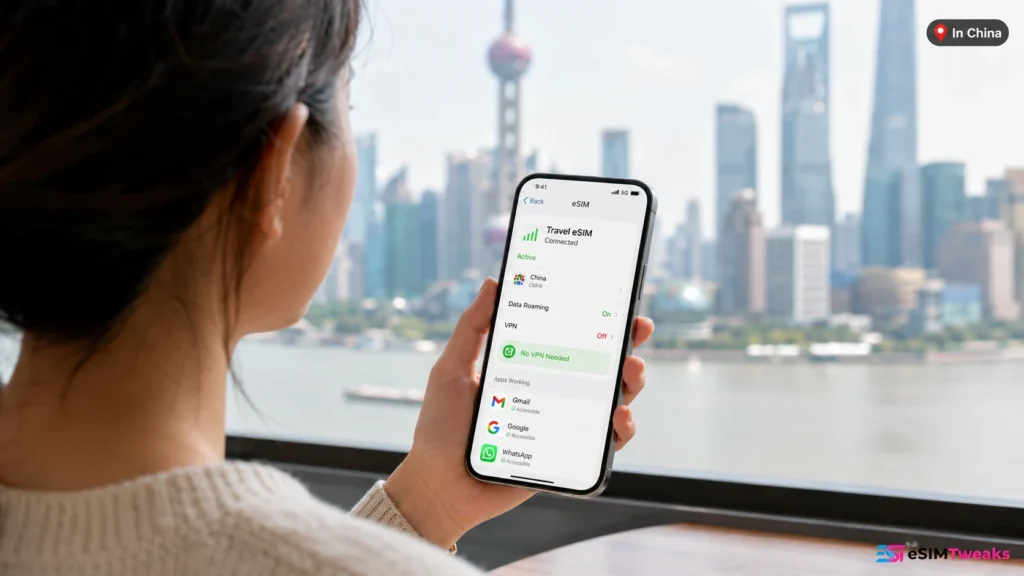
Position one: offshore routing, stated flatly. Airalo’s help centre is the clearest wording in the category, stating that a VPN is not required, that “your traffic is routed through secure gateways outside mainland China”, and that devices “appear as an international roaming user”.
Jetpac publishes a table marking firewall bypass yes and VPN needed no. SimOptions hedges slightly, saying its roaming data “typically allows you to access Google, Facebook, Instagram, and WhatsApp without needing a separate VPN”.
Position two: a bundled client VPN. GoMoWorld does something mechanically different and says so: its eSIM “includes a VPN feature that activates automatically”. That is software on your handset, not network routing, and it should not be compared like for like.
Position three: a bypass claim narrower than it looks. GigSky states that “because it routes through China Mobile or China Unicom and you’re using an international eSIM, your data bypasses the firewall restrictions that apply to local Wi-Fi”. Read that carefully.
It is scoped to local wifi rather than mainland traffic generally, and it sits in a blog post rather than the China product page or help centre, both silent on the subject. The claim is probably right. It is not the same as Airalo putting it in its help centre.
Position four: hedged, or silent. Saily says traffic exiting through international infrastructure “may avoid some of the restrictions”, then separately tells China travellers to install a VPN before arriving.
Instabridge publishes nothing at all. Amigo recommends a VPN on security grounds, saying nothing about censorship. MobiMatter says its access is “unaffected by the Firewall” and, on the same page, tells you to “pair with a reliable VPN”.
The pattern worth noticing: the most cautious wording in this comparison comes from the brand owned by a VPN company, and the boldest comes from a blog post rather than a product page.
Read the product page and the help centre, not the marketing, and test the specific apps you need on arrival before relying on them.
The 9 China eSIM providers ranked
Ranked on cost per gigabyte, weighted by carrier disclosure and firewall position.
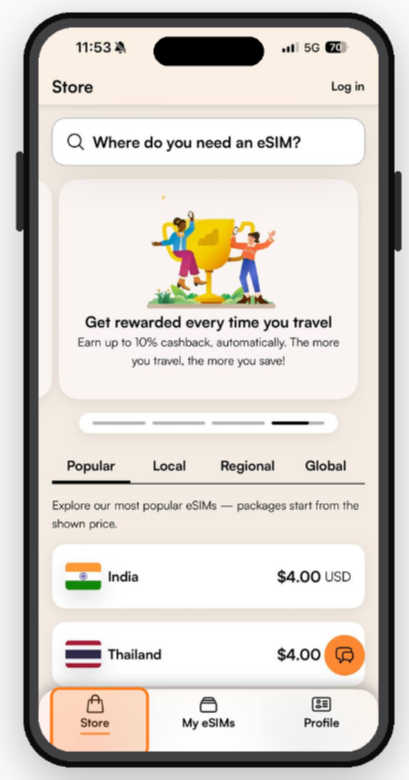
The reference point, and the focus of this guide. Airalo’s China product sells as Chinacom, with a metered ladder from 1GB for 3 days at $4.00 up to 50GB for 30 days at $49.00, normalising to $0.98 per GB.
Unlimited runs $11.50 for 3 days to $69.00 for 30, at 3GB per day before throttling to 1 Mbps for the rest of that 24 hours. The Asialink regional plan covers mainland China plus Hong Kong and Macau slightly cheaper.
It names its underlying carrier as China Unicom, publishes the clearest firewall statement in the category, allows tethering without restriction, and accepts Alipay through its mobile app. Refunds run on a 14-day withdrawal right that expires the moment the eSIM is activated.
The number that matters: $0.98 per GB with a named carrier and an explicit routing statement. See our Airalo promo code page.
Chinacom 50GB for 30 days: $49.00 becomes $41.65. Chinacom Unlimited 7 days: $27.00 becomes $22.95. Verified 18 August 2026.
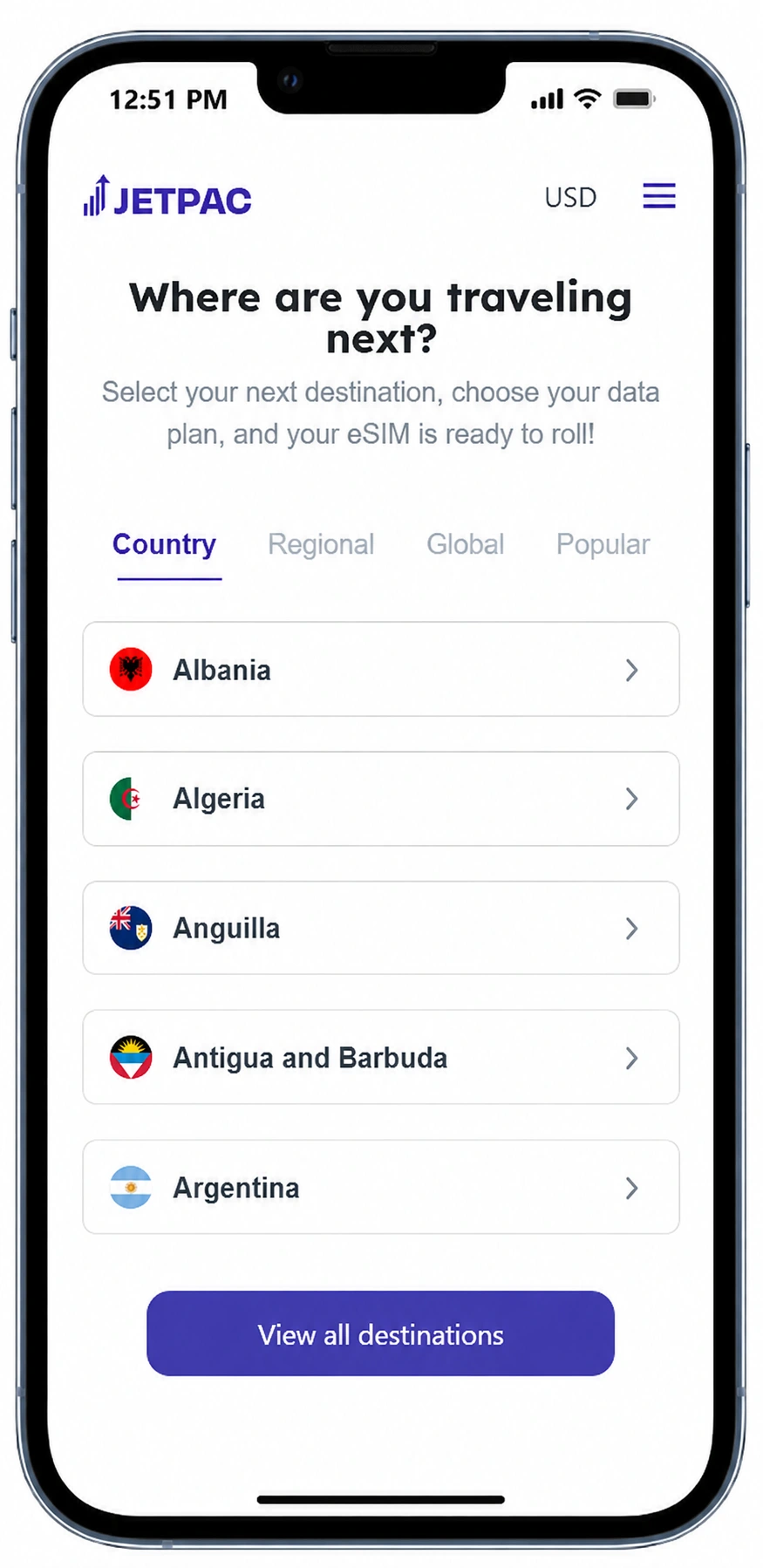
The best cost per gigabyte among providers that name a carrier. 40GB for 30 days at $34.99 normalises to $0.87 per GB, and the ladder is unusually granular at the short end: 3GB for one day at $6.00, 10GB for four days at $11.50, 15GB for seven days at $16.00.
That suits a Canton Fair phase visit better than anything else here, where most providers force you into 30 days.
Unlimited runs $12.99 for 3 days to $65.99 for 30, at 3GB per day before dropping to 1 Mbps. Carriers are published as China Unicom and China Telecom with automatic multi-network switching, and hotspot is uncapped.
A combined China, Hong Kong, Macau and Taiwan plan exists, though its pricing displays inconsistently.
The firewall claim is the most aggressive here and carries the most honest limitation: the bypass covers the eSIM’s mobile data only, not hotel wifi. Refunds end at installation.
The number that matters: $0.87 per GB, and one-day plans that no competitor matches.
No coupon code exists for Jetpac in our register. A comparison site runs a 15% partner code. We would rather tell you that than invent one.
The cheapest data here by a clear margin. MobiMatter is a marketplace rather than a network, reselling under vendor names, and its 50GB for 30 days at $29.99 works out at $0.60 per GB. A Greater China plan adding Hong Kong and Macau runs 10GB for $9.99 and 30GB for $23.99.
The trade-offs are structural. Each listing comes from a different underlying vendor, so carrier and refund terms vary by SKU and the China Mobile and China Unicom partnership named at brand level may not apply to what you buy.
The refund policy is the most restrictive here: genuine product malfunction only, after contacting support and allowing 24 hours, with partially used products excluded.
On the firewall it contradicts itself, claiming access unaffected by filtering while also advising a VPN. Treat that as advice to bring one.
The number that matters: $0.60 per GB, and 43,021 Trustpilot reviews, by far the largest evidence base of the nine. Full detail on our MobiMatter Review page.
On the 50GB plan at $29.99 that returns the $5 maximum, an effective $24.99, or $0.50 per GB. Verified 18 August 2026.
The most conservative option here, and the only one selling a voice-inclusive China product. The ladder runs 1GB for 7 days at $4.50 to 50GB for 30 days at $44.90, or $0.90 per GB, with steps at 10GB for $11.90 and 30GB for $29.90. A separate physical China SIM with calls and SMS starts at $49.90, the only route to a Chinese voice line here.
The carrier is published as China Unicom, and the firewall claim names the specific applications, saying its roaming data “typically allows you to access Google, Facebook, Instagram, and WhatsApp without needing a separate VPN”. Note the hedge. Tethering is fully allowed.
Two mechanics to plan around. There is no top-up on any plan, so the profile is single-use. And while the plan activates on first connection in China, the QR code expires 180 days after purchase on most tiers.
The number that matters: $0.90 per GB with a named carrier, and the only voice option on this page.
No coupon code exists for SimOptions in our register. A deals site runs a 10% partner code.
NordVPN’s travel eSIM brand, and the cheapest entry point of the nine at 1GB for 7 days at $4.49. The ladder runs 3GB for 30 days at $10.99, 5GB at $15.99, 10GB at $26.99 and 20GB for 30 days at $39.99, or $2.00 per GB. An Asia and Oceania plan covering 22 countries including mainland China, Hong Kong and Macau runs 10GB at $35.99.
The fair-use threshold is the most generous published here: 5GB per day at full speed before dropping to 1 Mbps or less, against 3GB at Airalo and Jetpac. Refunds are the best in this comparison too, full within 30 days if never installed and partial afterwards if more than 99% of the data is unused. Hotspot sharing is uncapped. No Chinese carrier is named.
Two things a China traveller needs to know. Saily warns that access to its own app may be limited inside China, so buy and install before you fly. And its China guidance tells you to install a VPN before entering, because the app stores may block VPN downloads once you are inside.
The number that matters: $2.00 per GB with the best refund terms here, from the one brand that declines to promise the firewall is not a problem. Detail on our Saily coupon code page.
China 20GB for 30 days: $39.99 becomes $35.99. China 10GB: $26.99 becomes $24.29. Verified 18 August 2026.
The most expensive per gigabyte here, included for what it discloses rather than what it charges. Fixed data runs 1GB for 7 days at $5.99, 5GB for 30 days at $23.99, 10GB at $36.49 and 20GB for 90 days at $69.99, which is $3.50 per GB. Daily-allowance plans run $17.99 for 3 days to $99.99 for 30.
Three things earn it a slot. It names China Mobile and China Unicom, which only three providers here do. It runs a free 100MB seven-day trial, reported as available for China though GigSky does not confirm that in writing. And it is one of very few providers whose top-up extends validity, though only where the top-up period runs past the original expiry. Most guides get that backwards.
Two cautions. The daily allowance is stated as 2.5GB in the help centre and 3.5GB on the product pages, the throttled speed behind either is never published, and refunds on pay-as-you-go plans are effectively nil.
The number that matters: two named carriers and a free trial that lets you test the thing this article says cannot be independently verified. More on our GigSky promo code page.
China 20GB for 90 days: $69.99 becomes $59.49. China 10GB for 30 days: $36.49 becomes $31.02. Verified 18 August 2026.
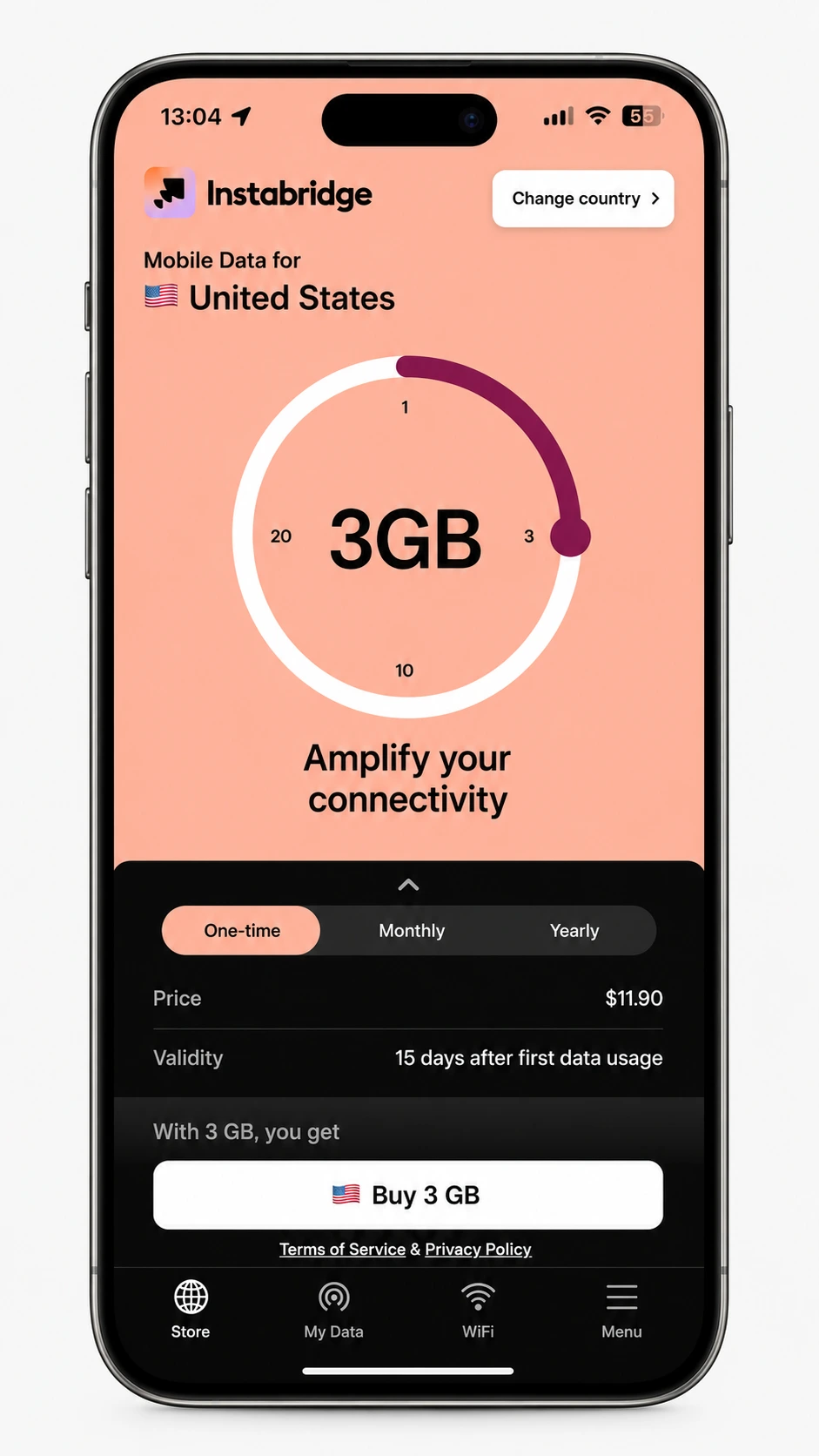
The cheapest way to get a China plan at all: 1GB for 7 days at $2.50, then 3GB for 15 days at $5.50 and 10GB for 30 days at $16.00, which is $1.60 per GB. There is no unlimited tier and no daily-allowance product.
That entry price is the whole case for it, with two caveats I am not going to bury. Instabridge publishes nothing about China’s filtering: no carrier, no routing statement, no VPN guidance. And its Trustpilot score for the eSIM business is 2.2 out of 5, rated Poor. Its app store ratings belong to its wifi-password app, not the data business.
The number that matters: $2.50 gets you online, and 2.2 out of 5 is the reason to keep the order small.
No coupon code exists for Instabridge in our register. A deals site runs a 20% partner code valid on the web store only, not in the app.
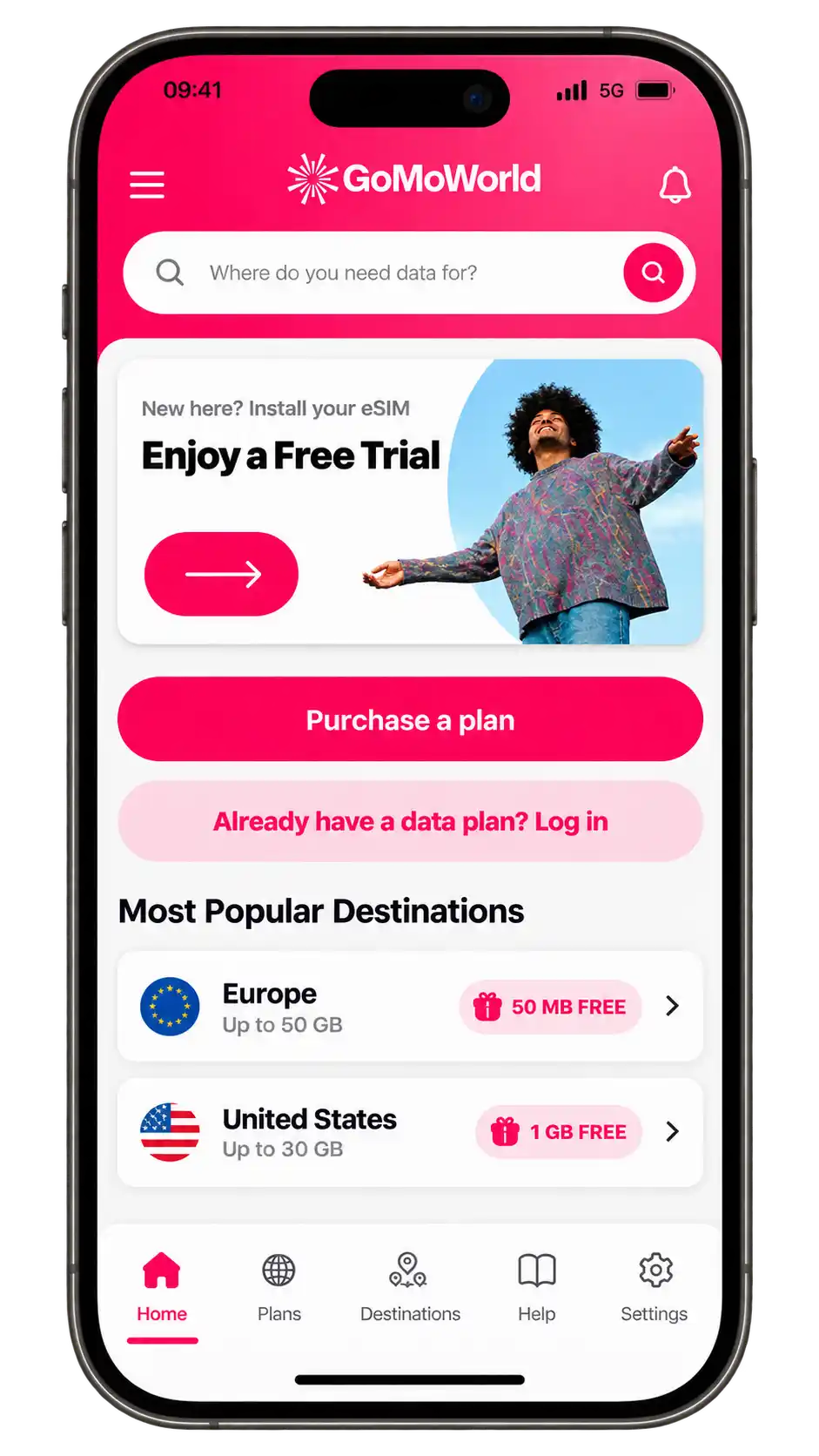
Included for one reason: a free 100MB one-day trial of its China product, so you can test the connection before committing money.
Paid plans are published in euros only, running €3.99 for 1.2GB over 7 days to €29.99 for 18GB over 30 days, about €1.67 per GB. Top-ups work in the app without reinstalling, so the eSIM is reusable, and activation is manual, which means you control when the validity period starts. The firewall mechanism is the bundled client VPN rather than offshore routing, no carrier is named, and refunds are possible before activation only.
The number that matters: 100MB free, the cheapest way to test a firewall claim nobody has independently measured.
No coupon code exists for GoMoWorld in our register. A comparison site runs a 10% partner code.
China plans run 5GB for 14 days at $16.00, 10GB for 30 days at $28.00 and 20GB for 30 days at $48.00, or $2.40 per GB, four times MobiMatter’s rate for the same country. There is no unlimited product.
What the premium buys is carrier disclosure, China Unicom and China Mobile, and unlimited hotspot. What it does not buy is a firewall position. Amigo recommends a VPN but frames it as protection from “hackers and unauthorized access” rather than a way past filtering, and says nothing about whether Google or WhatsApp work. For a China guide, that silence is the answer. Its Trustpilot presence is the thinnest here, roughly three pages of reviews.
The number that matters: $2.40 per GB, and no published position on the one question this article is about.
China 20GB for 30 days: $48.00 becomes $42.24.
China 10GB: $28.00 becomes $24.64. Verified 18 August 2026.
What the price spread actually tells you?
The range from $0.60 to $2.40 per gigabyte across nine providers selling the same country is not explained by network quality. They all roam onto the same three Chinese operators.
| Provider | Cost per GB | Carrier named | Firewall position stated |
|---|---|---|---|
| MobiMatter | $0.60 | Brand level only | Contradictory |
| Jetpac | $0.87 | Yes, two | Yes |
| SimOptions | $0.90 | Yes, one | Yes, hedged |
| Airalo | $0.98 | Yes, one | Yes, explicit |
| Instabridge | $1.60 | No | None |
| GoMoWorld | €1.67 | No | Client VPN |
| Amigo | $2.40 | Yes, two | None |
| GigSky | $3.50 | Yes, two | Yes, scoped |
| Saily | $2.00 | No | Hedged |
Two observations. Price does not buy disclosure: Amigo charges four times MobiMatter and publishes no firewall position. And disclosure costs nothing: Jetpac names two carriers, states its routing, and lands at $0.87.
For context: AT&T pay-per-use runs $2.05 per megabyte, roughly $2,100 per gigabyte, and AT&T and Verizon day passes both run $12 per day. A 10-day trip on a day pass is $120.
The same trip on Jetpac’s 10GB four-day plans, bought twice, is $23. That gap is why this category exists, and the GSMA estimates roughly 90% of mobile users never activate international roaming abroad.
Is eSIM illegal in China?
This is one of the most searched questions on the topic and it conflates two entirely separate things.
➡️ Question one: can Chinese consumers use eSIM on Chinese phones?
For a period, effectively no. All three operators suspended eSIM services in mid-2023. China Unicom resumed first in July 2025, for wearables and IoT only. Then in October 2025, MIIT authorised nationwide commercial eSIM trials for smartphones across all three operators.
The iPhone Air, China’s first eSIM-only iPhone, went to pre-order on 22 October 2025 at CNY 7,999, supporting domestic eSIMs only. Activation still requires in-person identity verification at a carrier store.
So eSIM was never illegal in China. It was suspended by the operators for roughly two years and re-authorised under tight conditions.
➡️Question two: may a visitor use a foreign travel eSIM roaming in China?
I found no Chinese law, regulation or MIIT statement prohibiting it. China’s real-name registration regime applies to Chinese-issued numbers, not foreign-issued ones.
One development is worth acting on. China Mobile’s 2026 5G handset white paper, published 8 November 2025, requires terminals identifying as being in mainland China to prohibit downloading eSIM profiles from overseas operators. That binds China-market handsets rather than visitors, but the practical advice writes itself.
Install and activate your eSIM before you enter mainland China. Do it at home on wifi, days ahead. QR code activation needs a working internet connection, and that connection is the thing you are trying to create.
China’s three networks, in numbers
| Operator | Mobile customers | 5G customers | PLMN |
|---|---|---|---|
| China Mobile | 1,011 million | 686.7 million | 460-00 |
| China Telecom | 440.55 million | 314.13 million | 460-03 |
| China Unicom | Not separately disclosed | 242.00 million | 460-01 |
China Mobile figures are Q2 2026, flagged by the company as unaudited internal data. Telecom and Unicom are 31 March 2026. China Unicom has stopped breaking out a standalone mobile subscriber figure, so none is given rather than a stale one.
MIIT national figures at end June 2026: 5.102 million 5G base stations, 39.1% of all mobile base stations.
1.844 billion mobile phone users, of whom 1.288 billion are on 5G, a penetration rate of 69.9%.
Average data use per subscriber is 23.57GB per month, a useful check against your own plan.
Ookla reports median mobile download at 164.94 Mbps through August 2025 and 162.67 Mbps for December 2025.
Note that Opensignal publishes no mainland China report, so anyone citing Opensignal for Chinese 5G coverage is citing something that does not exist.
Two structural points. China Unicom and China Telecom share their mid-band 5G radio network, so roaming onto either gives similar 3.4 GHz coverage and their base station counts must not be added. And China Mobile is far the largest by footprint, which matters outside the tier-one cities. There is no independent benchmark of the three from an inbound roamer’s perspective; every source ranking them is an eSIM affiliate.
The airport SIM alternative, priced
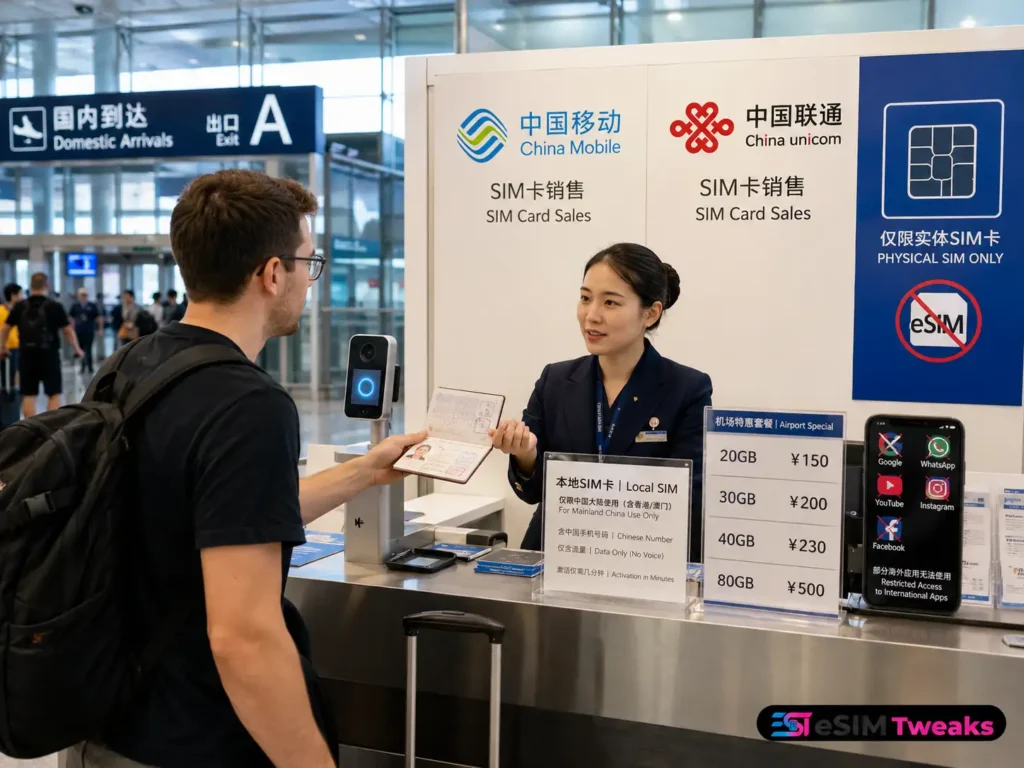
You can buy a local prepaid SIM on arrival. Counters operate in the arrivals halls at Beijing Capital and Daxing, Shanghai Pudong, Guangzhou Baiyun and Shenzhen Bao’an.
You will need your passport with a valid visa or entry stamp, and your face scanned, mandatory for new subscribers since 1 December 2019. The transaction takes 5 to 15 minutes, reported opening hours conflict, and the counters sell physical SIMs only, not eSIMs.
Published prices disagree substantially and no operator publishes an official airport tariff. The most reliable single data point is a first-hand report from Shanghai Pudong, June 2026:
| Plan | Price CNY | Approx USD | Data | Validity |
|---|---|---|---|---|
| China Mobile, Cheerway Easy Go | ¥150 | $20 | 20GB + 80 min | 30 days |
| China Unicom, arrivals counter | ¥200 | $27 | 20GB + 300 min | 30 days |
| China Mobile, arrivals hall | ¥230 | $31 | 30GB + 300 min | 30 days |
| China Unicom, high tier | ¥500 | $68 | 40GB + 700 min | 30 days |
Treat ¥150 to ¥300, roughly $20 to $42, for a 30-day plan with 20GB to 30GB as the range.
And here is what decides it. A local Chinese SIM is a domestic subscription. It breaks out locally, behind the filtering, exactly as the architecture predicts. Google, Facebook, Instagram, WhatsApp and YouTube are unavailable without a VPN, and VPNs are themselves intermittently blocked.
So the comparison is not $20 against $12. It is $20 for a Chinese phone number and filtered internet, against $9 to $27 for unfiltered internet and no phone number. Most business travellers should buy the eSIM. Anyone needing a Chinese number for deliveries, ride-hailing or supplier callbacks should buy both.
Canton Fair 2026, and why connectivity is the constraint
The 140th China Import and Export Fair runs 15 October to 4 November 2026 at the Canton Fair Complex, Pazhou Island, Guangzhou, in three phases.
| Phase | Dates | Focus |
|---|---|---|
| Phase 1 | 15 to 19 October | Advanced manufacturing: electronics, appliances, industrial automation, robotics, NEVs |
| Phase 2 | 23 to 27 October | Quality home life: ceramics, furniture, home furnishings, building materials |
| Phase 3 | 31 October to 4 November | Better life: toys, apparel, textiles, medical devices, food |
Changeover periods fall 20 to 22 October and 28 to 30 October.
The scale is the point. 1.55 million square metres, 75,700 booths and more than 30,000 exhibitors. The 139th session in spring 2026 drew a record 314,000 overseas buyers from 220 countries and regions, and the 138th reported US$25.65 billion in intended export transactions.
Three practical facts. Do not plan on venue wifi: any wifi at Pazhou terminates in mainland China and is filtered exactly like a local SIM. Second, the fair’s digital services include booth-level navigation across all 25 halls, an AI assistant and live shuttle tracking, all needing working prepaid data.
Third, unilateral visa-free entry expressly covers business purposes for 45 to 50 countries depending which notice you read, extended to 31 December 2026, and Guangzhou became a 240-hour visa-free transit port in November 2025.
Budget honestly. Three phase days of maps, WeChat, photographing spec sheets and video calls home runs 1GB to 2GB per day. A full phase is covered by 10GB.
Paying for things: Alipay, WeChat Pay and the cash rule
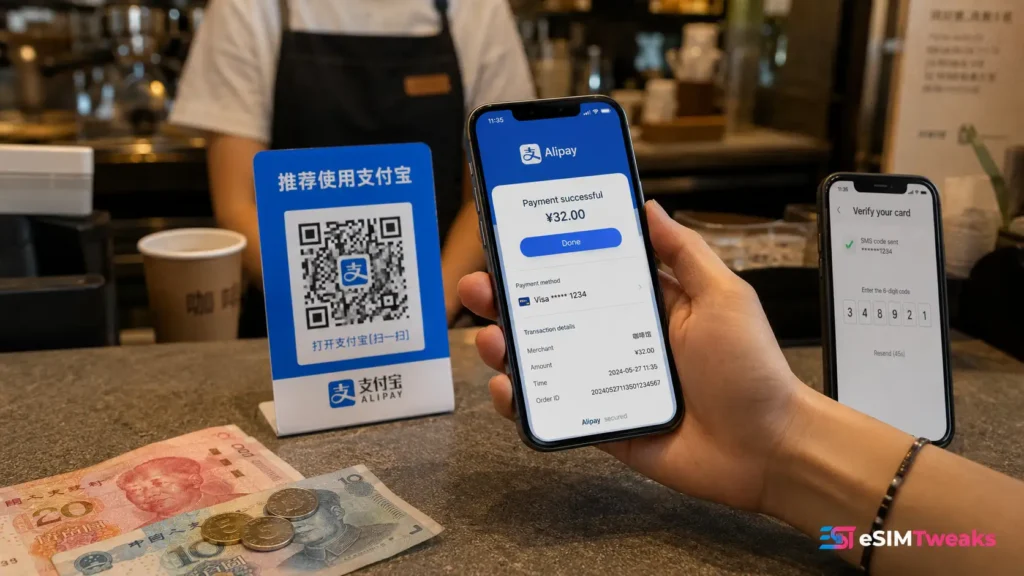
Both wallets now accept international Visa, Mastercard, Amex, Discover, JCB, Diners Club and UnionPay cards. The PBOC raised the single-transaction cap for foreigners from US$1,000 to US$5,000 and the annual cap to US$50,000.
Fees run 3% on international cards, with every transaction under CNY 200 exempt. Alipay’s Tour Pass wallet, still recommended by older guides, was discontinued in 2023 and replaced by direct card binding.
Cash is back, and it is now regulatory. The Regulations on Cash Receipt and Payment Services in Renminbi, issued jointly by the PBOC, NDRC and National Financial Regulatory Administration on 23 December 2025 and effective 1 February 2026, require businesses to accept cash and prohibit refusing it for convenience reasons. The PBOC publicly names violators.
The trap for eSIM buyers. Wallet setup and re-verification frequently send an SMS code to your phone number, and every plan here is data-only with no number and no SMS. Set up Alipay and WeChat Pay at home while your normal SIM can still receive the code. Then carry ¥500 to ¥1,000 in cash as the fallback.
A few lines of Chinese worth having
| Chinese | Pinyin | English |
|---|---|---|
| 流量 | liúliàng | mobile data allowance |
| 没有信号。 | Méiyǒu xìnhào. | There’s no signal. |
| 上不了网。 | Shàng bu liǎo wǎng. | I can’t get online. |
| WiFi密码是多少? | WiFi mìmǎ shì duōshao? | What’s the wifi password? |
| 能开热点吗? | Néng kāi rèdiǎn ma? | Can I use a hotspot? |
| 我要充值。 | Wǒ yào chōngzhí. | I’d like to top up. |
| 您好 | Nín hǎo | Hello (formal) |
| 这是我的名片 | Zhè shì wǒ de míngpiàn | This is my business card |
| 可以加个微信吗? | Kěyǐ jiā ge Wēixìn ma? | May I add you on WeChat? |
| 最小起订量是多少? | Zuìxiǎo qǐdìngliàng shì duōshao? | What’s the minimum order quantity? |
| 请多关照 | Qǐng duō guānzhào | I look forward to working with you |
Two notes. 请多关照 is the standard courteous closer to a first business introduction and lands disproportionately well from a foreign visitor. And 可以加个微信吗 beats offering an email address at Pazhou, because WeChat is the default channel for supplier follow-up.
What this means for you?
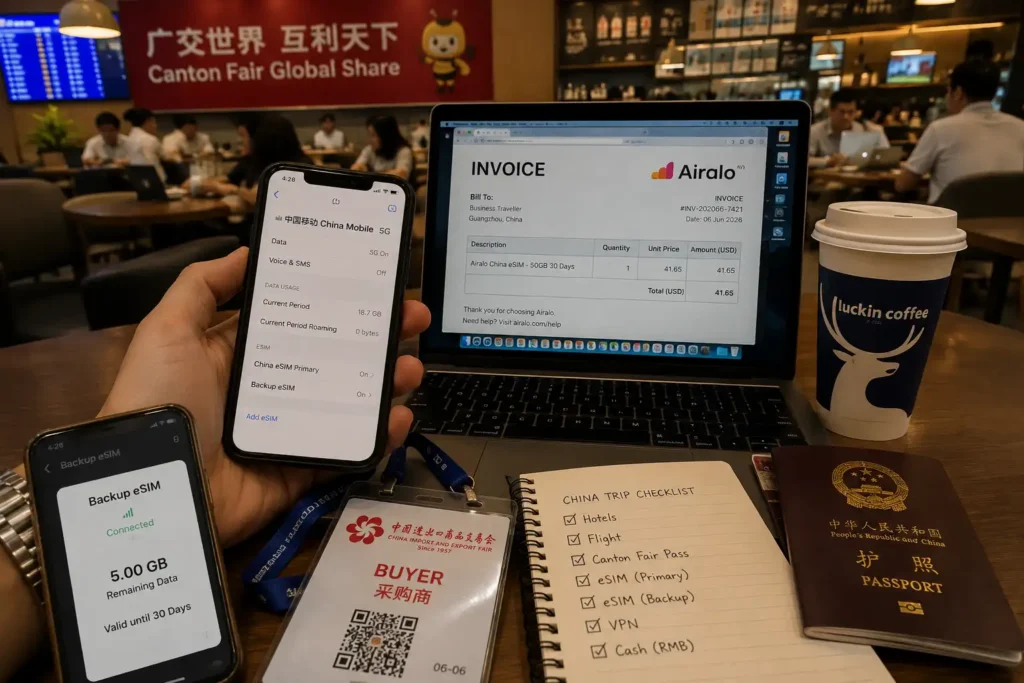
Jetpac’s 10GB for four days at $11.50, or Airalo’s Chinacom 5GB for 7 days at $14.50, which ESIMADVICE15 brings to $12.33. Both name a carrier and state a routing position.
MobiMatter’s 50GB for 30 days at $29.99, less the ESIMDUDE cashback, is the cheapest defensible option at $0.50 per GB. If you want a named carrier and a clear firewall statement, Airalo’s 50GB at $41.65 is the premium for that certainty.
Saily’s 20GB at $35.99 after ESIMDUDE is not the cheapest, but it has the only real refund route here and a 5GB daily allowance. Buy it if you want recourse more than the lowest price.
Ask three questions: where does traffic break out, which Chinese carrier do you roam onto, and can you issue one consolidated invoice with per-line usage.
Airalo and Jetpac answer the first two. None of the nine offers proper per-line corporate reporting, which for a delegation of twenty is a genuine gap.
Buy two providers, not one. A second 5GB plan costs under $15, the mechanism this category depends on has never been independently measured inside China, and being wrong about it in Guangzhou on a Monday morning costs far more than the backup.
FAQ’s Related to eSIM for China
What is the best eSIM for China in 2026?
On cost per gigabyte, MobiMatter at $0.60 per GB on its 50GB plan. On the combination of price, a named carrier and an explicit statement that traffic routes outside mainland China, Airalo’s Chinacom 50GB at $0.98 per GB, or $41.65 after ESIMADVICE15. For trips under five days, Jetpac’s one-day and four-day tiers have no equivalent.
Do I still need a VPN with an eSIM for China?
Providers using offshore roaming egress say no, and Airalo states it flatly. The mechanism is documented in the GSMA roaming specifications. But it has never been independently measured inside China, Saily hedges and tells you to bring one anyway, and you have no contractual guarantee of where traffic exits. Install a VPN before you fly as a backup.
How much does an eSIM for China cost?
Between $2.50 and $69.00 depending on size and duration. A realistic figure for a week of business travel is $9 to $16 for 10GB of mobile data abroad, or $27 for unlimited at 3GB per day. Compare that against $12 per day for a US carrier day pass.
Will Google Maps and WhatsApp work?
On a foreign travel eSIM using offshore routing, they are reported to work without a VPN. On a local Chinese SIM or hotel wifi they will not: GreatFire measures both as blocked 100% of the time. Microsoft 365, Outlook, Teams, Zoom, Slack and LinkedIn all measure as reachable even locally, so what breaks depends on which stack your company runs.
Can I buy an eSIM after I arrive in China?
Do not plan on it. QR code activation needs a working internet connection you will not have, and China Mobile’s 2026 handset specification requires terminals identifying as in mainland China to block overseas eSIM profile downloads. Install at home, on wifi, before you fly.
What is the best eSIM for China on Reddit?
Search eSIM for China Reddit and the recurring answers are Airalo, Nomad, Jetpac and the Hong Kong operators, with an upvoted preference for Hong Kong-issued products on value. Treat it as anecdote: nobody in those threads measures exit points, and the useful part is the consistency of the reports rather than any single one.
Is tethering allowed on a China eSIM?
Airalo, Jetpac, Saily, Amigo and GoMoWorld all permit hotspot use, and SimOptions states tethering as fully allowed. Confirm per plan, because a colleague tethering off your data allowance at a trade fair will exhaust 5GB in a day.
Should I get a Chinese phone number as well?
If you need deliveries, domestic ride-hailing accounts or supplier callbacks to a local number, yes. Every eSIM here is data-only. A local SIM costs roughly ¥150 to ¥300, needs your passport and a face scan, and gives you a number plus filtered data. Running both is where most frequent business visitors end up.
The short version
Four eSIM for China tips that matter more than price. Buy from a provider that names its Chinese carrier and states where traffic exits. Install at home before you fly.
Set up Alipay while you still have SMS. Carry ¥500 in cash, and take a second small plan as insurance against a mechanism that works reliably in practice and has never been properly measured.
祝您旅途顺利 (zhù nín lǚtú shùnlì), and good luck at Pazhou.
Why trust eSIMTweaks.
59 providers tested.
388 speed tests run.
20 countries covered.
More like this



About the author

Director of Research, Pricing & Coverage
I lead pricing and coverage research at eSIMTweaks and maintain the dataset behind every comparison we publish across 200+ destinations. My background is in telecommunications analytics, where I spent six years building rate and coverage models for carrier partners. My analysis determines which providers earn a recommendation.