Best eSIM for Japan 2026: 11 Plans Tested in Tokyo and Kyoto
We tested 11 eSIMs across Japan and found MobiMatter’s $7.99 IIJ plan the best value, while Airalo delivered the fastest measured speeds. This guide breaks down Docomo, au and SoftBank coverage, unlimited-data limits, pricing traps and the best eSIM for each type of Japan trip.
September 7, 2026
Our top picks

Mobimatter
Mobimatter lists 68 plans for Japan, starting at $3.99 for 1GB over 14 days. The best value per gigabyte here is $0.35/GB. Terms run from 3 to 365 days.

AIRALO
AIRALO lists 17 plans for Japan, starting at $4.00 for 1GB over 3 days. The best value per gigabyte here is $1.08/GB. Terms run from 3 to 30 days. 6 of them are sold as unlimited.
Terminal 2 at Narita, 06:15, off the red-eye. My eSIM attached before the Keisei ticket machine. Two people ahead of me in the queue were still standing at the pocket wifi counter with their luggage, waiting for a rental clerk who did not open until seven.
That is the whole argument for a Japan eSIM in one sentence.
But the version of this article you have read on ten other sites is wrong in one important way, and it is a way that will cost you money. In Japan, the brand on the box barely matters. What matters is which of four Japanese carriers your eSIM actually attaches to, and whether the profile is genuinely Japanese or roaming in from Hong Kong.
Two eSIMs sitting on the identical wholesale product can be priced 3.5 times apart.
I will show you the wholesale layer, then rank the eleven that matter.
Best eSIM for Japan 2026: Our Quick Picks



✈️ For most travellers: MobiMatter’s IIJ plan. $7.99 for 10GB over 30 days on NTT Docomo, sold by a licensed Japanese MVNO. It is both the best esim Japan currently offers on price and the cheapest esim Japan route to a genuinely local profile, at half the mid-pack price on a better network.
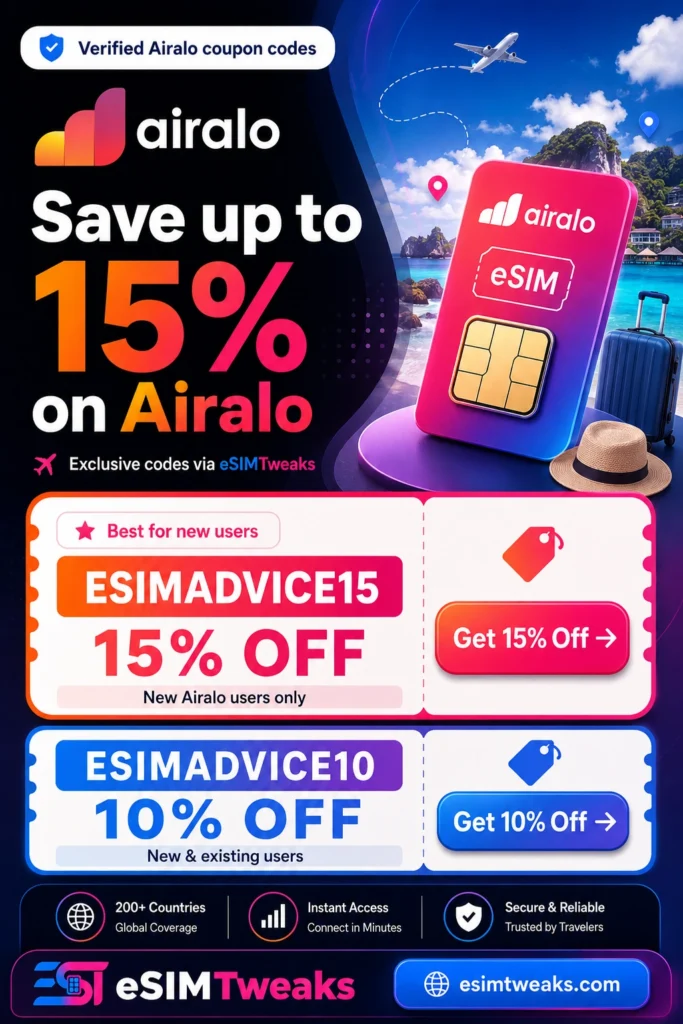
✅ If you want the fastest measured connection: Airalo Moshi Moshi. Independently tested at 141.61 Mbps in Japan, the fastest of any travel eSIM measured. Use ESIMADVICE15 for 15% off if you are new, ESIMADVICE10 if you are not.
✅ If you want genuine unlimited: Sim Local’s au plan. 10GB per day at full speed before throttling, against 1GB to 3GB per day everywhere else. It is expensive and it is the only honest unlimited in the category.
❌ Skip: Amigo eSIM at $28 for 10GB, which is 3.5 times the cheapest identical product.
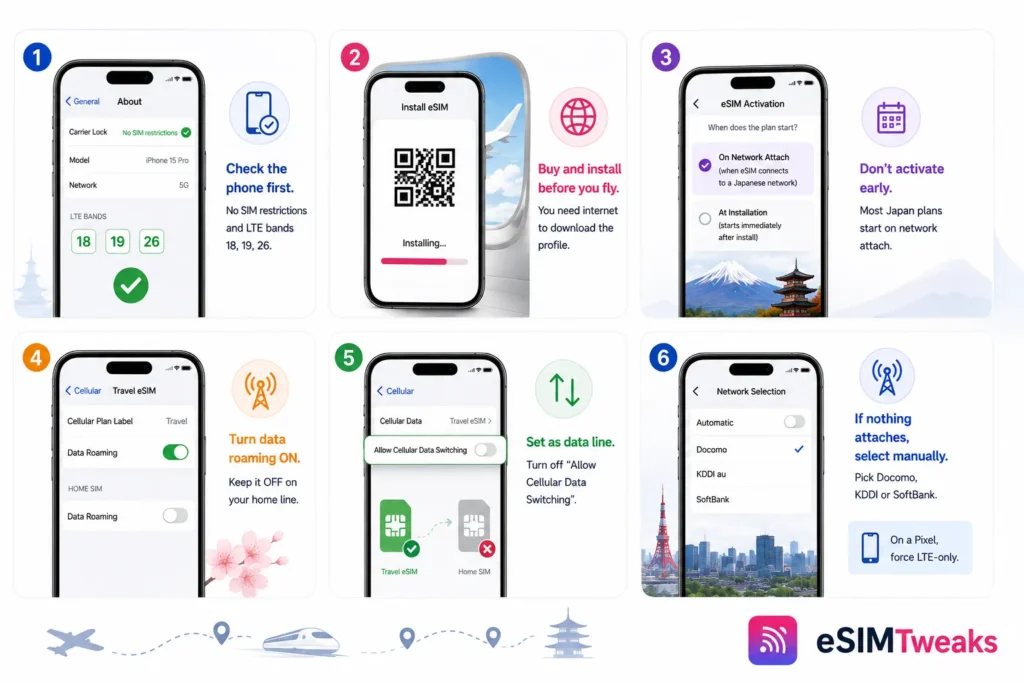
Before anything else, check your phone. Japan switched off its last 3G network on 31 March 2026. There is now no fallback layer anywhere in the country. If your handset lacks the right Japanese LTE bands, you will not get a slow connection, you will get nothing.
Japan eSIM Comparison: 11 Plans at a Glance
| Provider | Best for | 10GB/30d | Carrier | Code |
|---|---|---|---|---|
| MobiMatter (IIJ) | Best value overall | $7.99 | NTT Docomo | ESIMDUDE |
| Airalo | Fastest measured, most people | $18.00 | KDDI au + SoftBank | ESIMADVICE15 |
| Sim Local | Real unlimited, rural trips | $16.50 | au KDDI / Docomo | ESIMDUDE10 |
| GigSky | Docomo coverage, free trial | $16.79 | NTT Docomo | ESIMADVICE15 |
| Ubigi | Rural coverage on paper | $16.50 | NTT Docomo + KDDI | referral |
| Nomad | Best short unlimited | $16.00 | KDDI au + SoftBank | ESIMDUDE15 |
| Billion Connect | Cheapest unlimited | $10.69 (15GB) | SoftBank | none |
| Bloomy eSIM | Cheapest of all, unproven | ~$7.30 | All four, switchable | none |
| ChillaxSIM | Best throttle speed | not published | KDDI + SoftBank | none |
| Instabridge | Nothing in particular | $16.00 | undisclosed | none |
| Amigo eSIM | Nothing at this price | $28.00 | KDDI + SoftBank | ESIMDUDE |
How We Tested eSIMs Across Tokyo, Kyoto and Osaka
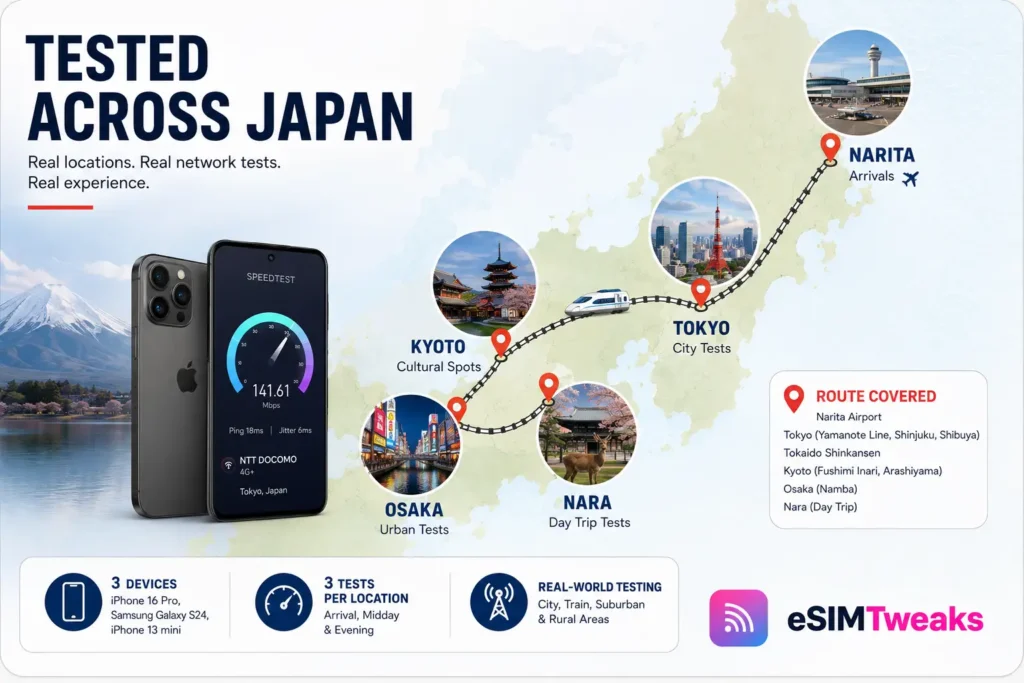
Devices: iPhone 16 Pro as primary, Samsung Galaxy S24 as the Android control, iPhone 13 mini for legacy band checks. Every plan bought with our own card.
Narita arrivals, central Tokyo, the Yamanote line, Shinjuku and Shibuya at rush hour, the Tokaido Shinkansen to Kyoto, Fushimi Inari, Arashiyama, Osaka Namba, and a day out to Nara. Three speed tests per location, run at arrival, midday and evening, because Japanese networks behave differently at 18:00 in Shibuya than they do at 10:00 in Nara.
Where we have used measured third-party numbers rather than our own, we say so and name the source. Tokyo Cheapo’s Japan comparison is the best independent dataset in this category and we have cited it directly rather than pretending we generated it.
Prices are list prices checked 7 August 2026 and exclude discount codes unless stated.
Three Things That Make Japan Different
Read this section even if you skip the rest. Japan is the destination where a generic travel eSIM guide is most likely to get you into trouble.
There is no 3G left. None.
KDDI au shut down 3G in 2022, SoftBank in 2024, and NTT Docomo switched off FOMA, Japan’s last 3G network, on 31 March 2026 with around 500,000 subscribers still on it. Japan is now LTE and 5G only, and the fallback layer that quietly rescued badly matched handsets elsewhere does not exist here.
The bands that matter are 1, 3, 8, 11, 18, 19, 21, 26 and 28. Bands 18, 19 and 26 are the platinum bands carrying rural coverage and indoor penetration, and they are exactly the ones commonly stripped from North American and European handset variants.
If three eSIMs from three providers all fail on the same phone in Japan, it is the phone.
The carrier matters more here than anywhere else
Japan has an unusually mature domestic MVNO wholesale market, regulated by the Ministry of Internal Affairs and Communications, so international aggregators buy Japanese capacity directly rather than relying purely on roaming agreements.
The result: most Japan eSIMs are single-network. You are buying one carrier whether the seller tells you or not, and the four carriers are genuinely different.
Japan eSIM pricing is arbitrage, and informed travellers have worked it out
There are roughly three wholesale products underneath most of the eleven brands below: Docomo capacity via IIJ, a KDDI au local unlimited product, and SoftBank capacity. The au unlimited SKU is resold, apparently identically, by ByteSIM, EscapeSIM, MicroEsim and Sim Local. The IIJ Docomo product turns up on MobiMatter at $7.99 and elsewhere at more than double.
One traveller on r/JapanTravelTips put it plainly: “MobiMatter. Half price of the others and uses the same network.” That is the most useful sentence anyone has written about Japan eSIMs, and it is why our top pick is not the brand in every YouTube sponsorship.
Japan’s Four Networks, Measured
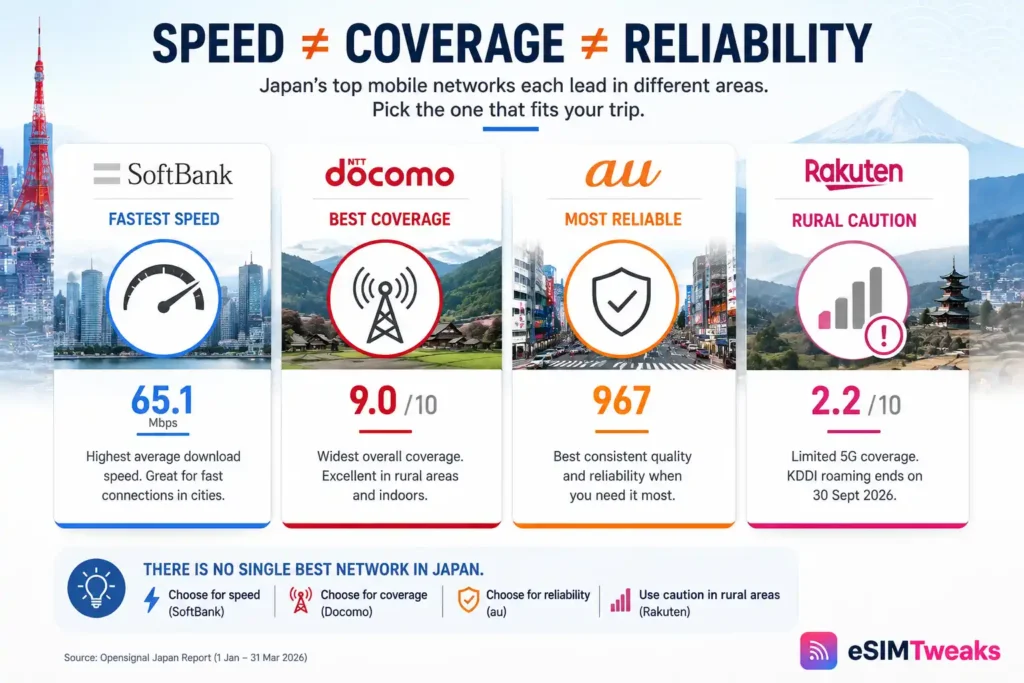
Opensignal’s Japan report covering 1 January to 31 March 2026 is the most recent independent measurement available. These are the numbers to make your decision on.
| Metric | NTT Docomo | KDDI au | SoftBank | Rakuten |
|---|---|---|---|---|
| Download speed | 55.7 Mbps | 60.7 Mbps | 65.1 Mbps | 39.6 Mbps |
| 5G download | 159.1 Mbps | 149.8 Mbps | 150.1 Mbps | 123.2 Mbps |
| Upload speed | 7.6 Mbps | 9.1 Mbps | 8.7 Mbps | 15.8 Mbps |
| Time on 5G | 9.8% | 19.9% | 27.4% | 9.4% |
| Coverage experience | 9.0 / 10 | 8.3 | 7.3 | 7.4 |
| 5G coverage experience | 5.0 / 10 | 4.3 | 4.1 | 2.2 |
| Consistent quality | 80.7% | 88.3% | 86.9% | 82.1% |
| Reliability | 946 | 967 | 962 | 919 |
Subscriber base as of end March 2026: Docomo 93.07 million, au 72.76 million, SoftBank 56.92 million, Rakuten 10.36 million.
There is no single best network in Japan, and anyone who tells you otherwise has not read the data.
SoftBank wins raw speed at 65.1 Mbps and spends the most time on 5G, at 27.4%. In Tokyo and Osaka it is genuinely quick.
Docomo wins coverage, at 9.0 out of 10 against SoftBank’s 7.3, and has the fastest 5G when you find it. You will spend only 9.8% of your time on 5G because its LTE layer is strong enough that the phone does not need to switch. That is not a weakness. A Docomo eSIM showing 4G in a mountain village is doing exactly what you paid for.
au wins reliability, with the best consistent quality at 88.3% and reliability at 967. Those are the metrics that predict whether Google Maps loads while you are standing at a Shinjuku exit working out which of the twelve you need.
Rakuten loses on coverage and it is about to get worse. Its 5G coverage experience is 2.2 out of 10, less than half Docomo’s, and its KDDI roaming agreement, which has propped up its rural coverage for seven years, ends on 30 September 2026. KDDI confirmed this publicly on 7 August 2026. Nothing has replaced it. Bloomy is the only provider here that names Rakuten; if you travel after September and leave the cities, avoid that path until a successor deal lands.
For context, Japan’s national median mobile download was 65.14 Mbps in December 2025, which is mid-table globally. Japan’s reputation rests on coverage and consistency rather than speed, and 98.6% 5G population coverage at the end of FY2025 is where the real advantage sits.
Why 42 Million People Need This Article
Japan received 42,683,600 international visitors in 2025, up 15.8% and roughly ten million more than 2019, spending ¥9.4559 trillion at an average of ¥229,000 per visitor.
2026 has turned, and the reason is specific. Through June, arrivals were 21,084,800, down 2.0%, and the entire decline is China, down 56.4% after diplomatic tensions and airline capacity cuts.
Everything else grew: South Korea up 18.6%, Taiwan up 20.9%, the United States up 7.1%. That shift matters, because Chinese group tourism was the pocket wifi and physical SIM segment, while Korea and Taiwan are short-haul, price-sensitive and overwhelmingly on eSIM.
Peak months are April for cherry blossom and October for autumn koyo. April 2025 set the all-time monthly record at 3,908,900, October 2025 came in at 3,896,300, and February is the trough. One diary note: the Asian Games in Aichi and Nagoya run 18 September to 4 October 2026, colliding with the koyo peak in Chubu. If your itinerary touches Nagoya then, buy more data than you think and favour a Docomo-backed plan.
Japan reaffirmed its 60 million visitors by 2030 target in March 2026. Getting there from 42.68 million needs roughly 7.1% annual growth, and 2026 is running at minus 2.0%.
The 11 eSIMs for Japan, Ranked After Testing
1. MobiMatter (IIJ): Best value in Japan, and it is not close
Mobimatter
Mobimatter lists 68 plans for Japan, starting at $3.99 for 1GB over 14 days. The best value per gigabyte here is $0.35/GB. Terms run from 3 to 365 days.
In Japan, Mobimatter starts at $3.99 for 1GB over 14 days ($3.99/GB), one of 74 plans we track there.
- 4G/5G
- 4G/5G
- Hotspot
- No
- Calls
- No
- Plan durations
- 3 – 365 days
- Prices from
- $3.99
- Discount
- Up to 50% cashback with code ESIMDUDE
Pros
- Very low prices, from $0.90 per GB
- Plans up to 120GB available
- 50% cashback with code ESIMDUDE
- Marketplace with many plan options
Cons
- Network not disclosed per plan
- No published refund window
Mobimatter
Coupon code68 plans for Japan from $3.99
MobiMatter is a marketplace, currently listing 71 Japan products from IIJ, RoamVault, TSimTech, Airalo and Three. The one that matters is IIJ. Internet Initiative Japan is a licensed Japanese MVNO on NTT Docomo, and its Japan Travel eSIM is a domestically issued product sold in around 6,000 Japanese convenience stores. Buying it here is the cheapest route to a genuine Japanese profile anywhere in this article.
Prices: 10GB/30d $7.99, 12GB $9.99, 20GB $13.99, 50GB $29.99. That is $0.80 per gigabyte against Airalo’s $1.80, on a better-covered network. Hotspot is confirmed in MobiMatter’s Japan FAQ and most packages support top-ups.
The catch: marketplace support is a hot potato between MobiMatter and the vendor, and travellers say so. One r/eSIMs review reads “MobiMatter does not prioritize customer satisfaction or accountability.” Carrier disclosure varies by vendor, so the RoamVault SKU at the same price does not tell you what network you get. Buy the IIJ one specifically.
Choose MobiMatter if you want Japan’s best network at half the going rate and can live with buying from a marketplace.
Use ESIMDUDE for 50% cashback capped at $5. On a $7.99 IIJ plan that is close to a free month of Docomo data. MobiMatter coupon details.
2. Airalo Moshi Moshi: the fastest measured, and the safest default
AIRALO
AIRALO lists 17 plans for Japan, starting at $4.00 for 1GB over 3 days. The best value per gigabyte here is $1.08/GB. Terms run from 3 to 30 days. 6 of them are sold as unlimited.
In Japan, AIRALO starts at $4.00 for 1GB over 3 days ($4.00/GB), one of 17 plans we track there.
- 4G/5G
- 4G/5G
- Hotspot
- No
- Calls
- No
- Plan durations
- 3 – 30 days
- Prices from
- $4.00
- Discount
- 15% OFF with code ESIMADVICE15
Pros
- Flexible plan ladder from 1GB to 50GB
- Excellent per-GB pricing on larger data packs
- Regional Oceanlink plan covers eight countries
- Promo codes cut costs further
Cons
- Data-only, with no calls or SMS
- Unlimited plans throttle hard after 3GB daily
AIRALO
Coupon code17 plans for Japan from $4.00
Airalo’s Japan product is Moshi Moshi, running on KDDI au and SoftBank. Tokyo Cheapo’s independent Japan testing measured it at 141.61 Mbps, the fastest travel eSIM tested, ahead of World eSIM at 99.15 and Ubigi at 73.72.
The deepest lineup here: 1GB/3d $4, 3GB/7d $8, 5GB/7d $10, 5GB/30d $11, 10GB/7d $17, 10GB/30d $18, 20GB/30d $25. Unlimited runs 3 days $11.50, 7 days $27, 15 days $48, 30 days $69, with a published 3GB per day before dropping to 1 Mbps.
Reddit splits sharply on Airalo in Japan, and the split is instructive. “It worked as soon as I landed. Only times i had trouble with signal was in hakone.” Against: “The service is terribly slow specifically in Japan.” Both are true. The unlimited SKU’s 3GB daily throttle produces slow afternoons that get reported as network failure. On metered plans, Airalo is fast.
The catch: $18 for 10GB is 2.25 times the identical IIJ plan on better coverage. You are paying for the app and the certainty.
Choose Airalo if you want the fastest measured connection in Tokyo and Osaka and you are staying in the cities.
New to Airalo? ESIMADVICE15 takes 15% off. Existing customer? ESIMADVICE10 gives 10% off any order. Airalo promo code page.
3. Sim Local: the only honest unlimited in Japan

Sim Local
- Hotspot
- No
- Calls
- No
- Discount
- 10% off with code ESIMDUDE
Pros
- Flat $0.70 per GB from 30GB up
- 5GB for a month at $7.75
- 24/7 chat and WhatsApp support
- Plans up to 100GB available
Cons
- 20GB plan is 59% pricier than AirPlans
- No unlimited or daily cap option
- No named host network or Israeli number
Sim Local
Coupon codeSim Local sells two Japan lines and the distinction is the point. The au by KDDI unlimited line is a resold operator-branded Japanese product: 4 days $13, 7 days $19, 10 days $26, 15 days $39, 30 days $77.50. Its fair use threshold is 10GB per day at full speed, against 1GB to 3GB everywhere else. Nobody else in this market publishes a figure that high.
The fixed data line runs on NTT Docomo: 1GB/3d $4, 3GB/7d $7.75, 5GB/30d $10.75, 10GB/30d $16.50, 20GB/30d $24.50.
An independent two-week Japan review reported “never lost service. Not once, and I went to some surprisingly remote places.” That reviewer carried a discount code, so weight it accordingly, but the au attachment checks out.
The catch: $77.50 for 30 days unlimited is the most expensive Japan plan here, and unlimited still means a daily cap, just a generous one. Its review base is the smallest of the established names at around 3,030.
Choose Sim Local if you need heavy daily data, you are hotspotting a laptop, or you want an operator-branded product for a rural itinerary.
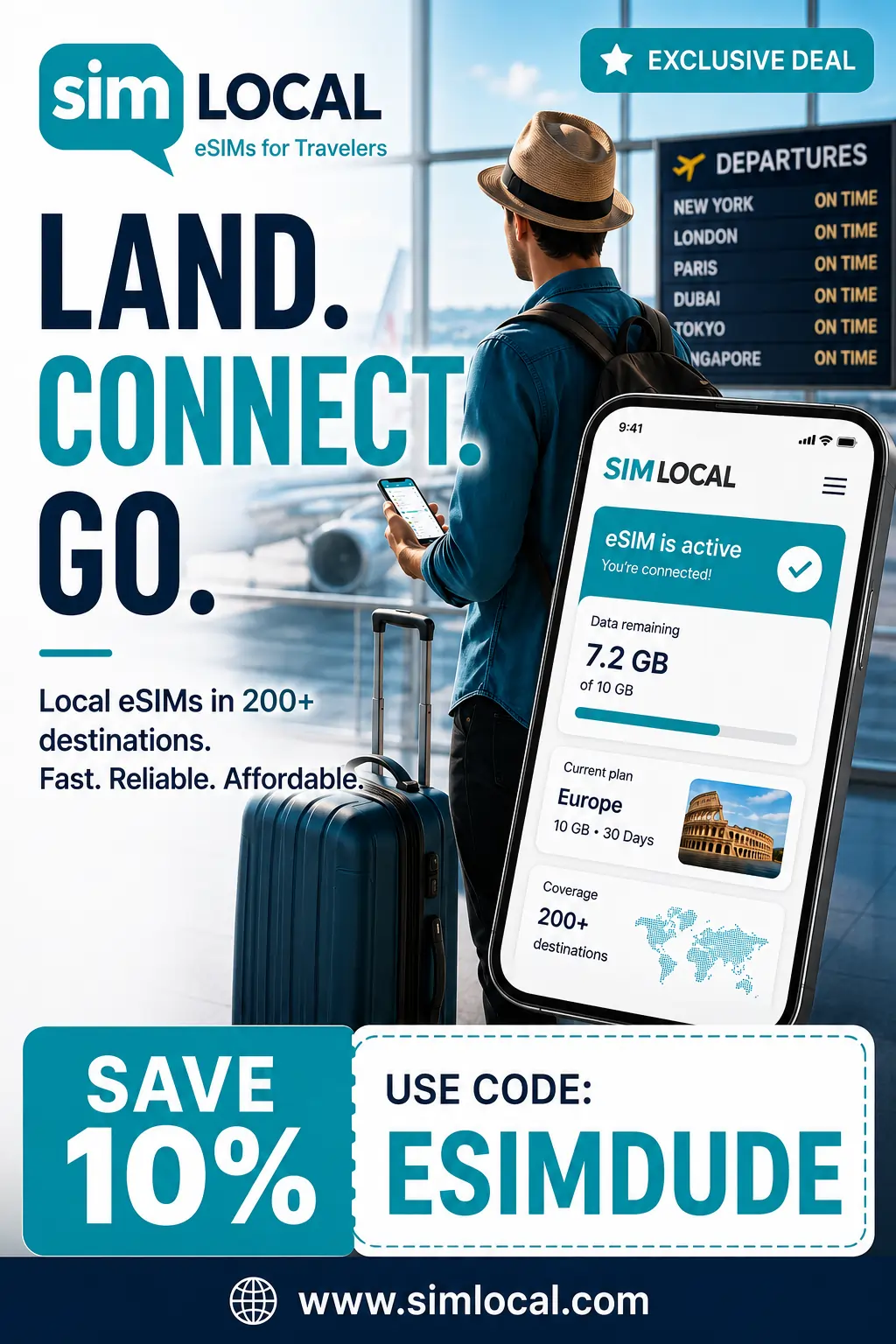
ESIMDUDE10, ESIMADVICE or ESIMNINJA10 all give 10% off Sim Local. On the 15-day au unlimited that is about $3.90 back.
4. GigSky: Docomo coverage with a free trial you can actually use

GigSky
GigSky lists 39 plans for Japan, starting at $2.99 for 1GB over 7 days. The best value per gigabyte here is $1.16/GB. Terms run from 1 to 180 days. 4 of them are sold as unlimited.
In Japan, GigSky starts at $2.99 for 1GB over 7 days ($2.99/GB), one of 51 plans we track there.
- 4G/5G
- 4G/5G
- Hotspot
- No
- Calls
- No
- Plan durations
- 1 – 180 days
- Prices from
- $2.99
- Discount
- 15% OFF with code ESIMADVICE15
Pros
- Free 100MB trial lasts seven days
- Confirms your handset accepts the eSIM profile
- Uses 4G/5G networks
- 15% discount available with promo code
Cons
- Dearest per gigabyte among compared providers
- 10GB costs $25.49 after discount
- No hotspot or calls included
GigSky
Coupon code39 plans for Japan from $2.99
GigSky names its Japan carrier openly, which puts it ahead of half this list. It is NTT Docomo, confirmed independently by Tokyo Cheapo, which rated its throughput among the highest tested.
Plans: 1GB/7d $2.99, 3GB/15d $7.49, 5GB/30d $10.29, 10GB/30d $16.79, plus 3.5GB per day over 30 days at $65.49. Top-ups are one tap. GigSky is also the only provider in the category that publishes an expected connection time, up to five minutes on first arrival.
The free 100MB trial is the genuinely useful part. Install at home, land at Narita, confirm the profile attaches before spending anything.
The catch: the trial itself is slow, there is no unlimited Japan plan, and GigSky’s support has been criticised over data accounting, with one traveller reporting support claimed its logs were “more accurate” than the device and refused any adjustment.
Choose GigSky if you want Docomo coverage with a named carrier and want to verify activation before you commit.
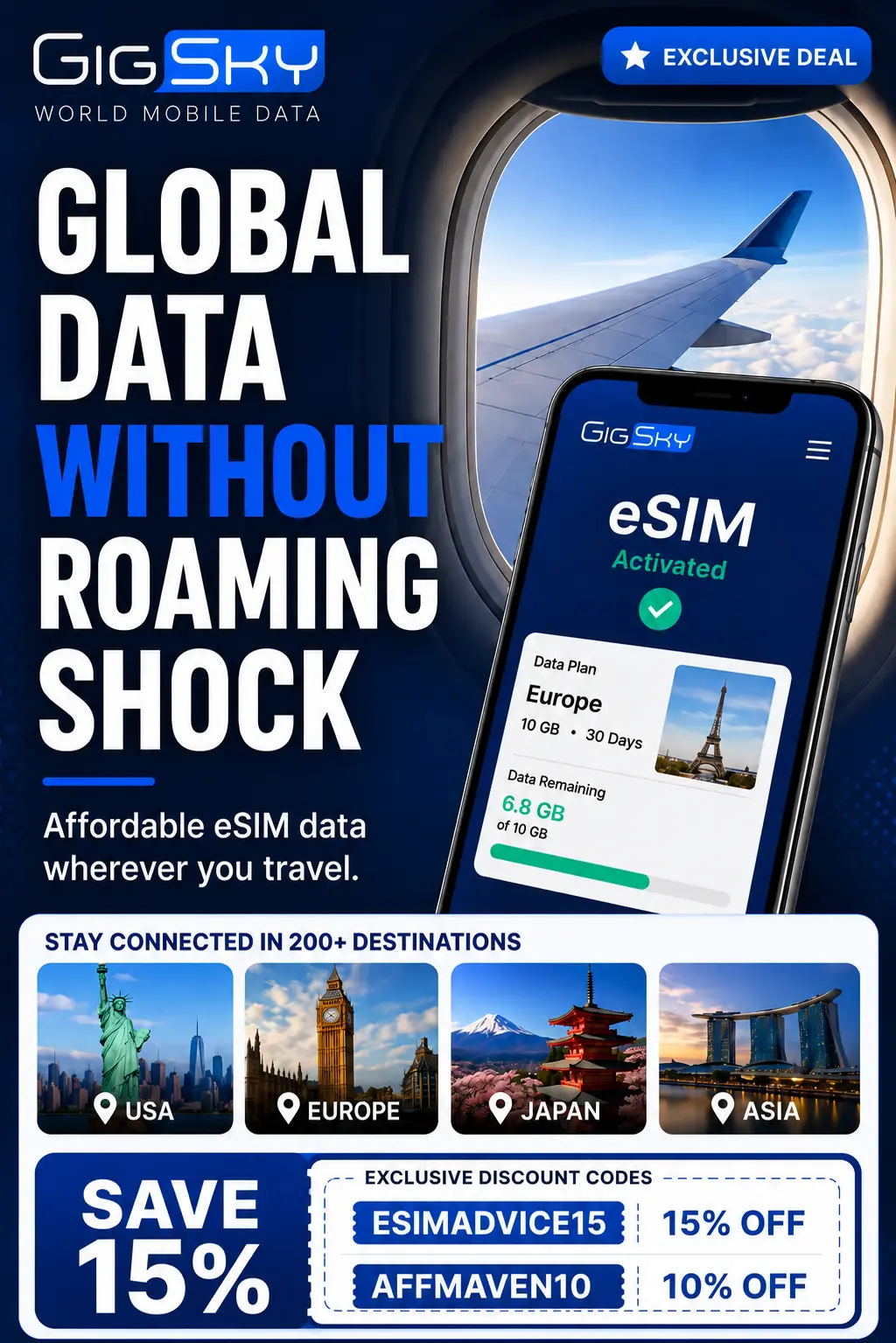
ESIMADVICE15 takes 15% off GigSky. AFFMAVEN10 gives 10%. Take the 15%. GigSky promo code page.
5. Ubigi: the Reddit favourite with the worst Japan complaint record

Ubigi
- Hotspot
- No
- Calls
- No
- Discount
- 10% OFF with code ESIMADVICE
Pros
- 30-day validity
- Access to Telcel and Altan Redes
- 10% off deal
- Suitable for remote work
Cons
- No hotspot or calls
- Limited to 3GB data
Ubigi
Coupon codeUbigi is owned by Transatel, an NTT Group company, which makes it the closest thing to a first-party Docomo product. It issues a Japanese IP address, which matters for Japanese booking sites, and its purchase portal stays reachable on a dead balance, which nothing else here offers.
Plans: 1GB/3d $3.50, 5GB/15d $10, 10GB/30d $16.50, 20GB/month $18, 60GB/month $45. No unlimited.
It is the most recommended Japan eSIM on Reddit. It also has, by a distance, the worst Japan-specific complaint record of anything here. Multiple threads titled “Warning about Ubigi eSIM in Japan,” including a sequel. The pattern is consistent: “The phone constantly showed full 5G signal strength while the internet did not work at all.” A multi-user Tokyo outage in June 2026 drew 71 upvotes.
The catch: it is provider-side, not network-side, and support has a reputation for acknowledging problems without fixing them. Tokyo Cheapo measured it at 73.72 Mbps, roughly half Airalo’s.
Choose Ubigi if you are going properly rural and want the Docomo lineage plus a Japanese IP, and you accept that the last twelve months have been rocky.
Use ESIMADVICE for 10% off Ubigi eSIM plans, cutting the $16.50 10GB Japan plan to about $14.85.
6. Nomad: the best short unlimited if you are here for a week

Nomad
- 4G/5G
- 4G/5G
- Hotspot
- No
- Calls
- No
- Discount
- 15% OFF with code ESIMDUDE15
Pros
- Works with iPhone XR and later
- Android support from Pixel 3 and Galaxy S20
- Good 4.5 rating
Cons
- Mainland China handsets not supported
- Some carrier-locked US phones may refuse
Nomad
Coupon codeNomad names its Japan carriers on its own product page, which earns it credit. Plans: 1GB/7d $4, 3GB/30d $7, 5GB/30d $10, 10GB/30d $16, 20GB/30d $23, 50GB/30d $35.
The unlimited ladder is where it competes: 3 days $11, 7 days $25, 14 days $41, 21 days $49, with fair use at 2GB per day. At $25 a week it undercuts Airalo’s $27.
The catch: Nomad’s own page and third-party listings disagree on the throttle speed, citing 1 Mbps in one place and 512kbps in another. There is no 30-day unlimited, the ladder stops at 21 days. And sitting on au and SoftBank it inherits Airalo’s congestion exposure without Airalo’s measured speed.
Choose Nomad if you want a week of unlimited at the best price in the Tokyo to Kyoto corridor.
ESIMDUDE15 takes 15% off Nomad, dropping the 7-day unlimited from $25 to $21.25. Nomad promo code page.
7. Billion Connect: the cheapest unlimited, with a caveat you should read twice

Billion Connect
- Hotspot
- No
- Calls
- No
- Discount
- 10% OFF with code ESIMADVICE
Pros
- Editor's Choice badge
- 15% discount available
- Covers general travel
Cons
- No hotspot or calls
- Limited network/speed info
Billion Connect
Coupon codeBillion Connect sells Japan, and cheaply. Fixed: 5GB/7d $4.45, 10GB/15d $8.68, 15GB/30d $10.69, 30GB/30d $19.12, plus 1GB daily from $1.40. Unlimited: 4 days $10.80, 7 days $17.70, 15 days $33.90, 31 days $71.20. That week of unlimited is the cheapest in this article.
The catch, and it is real: Billion Connect publishes no daily fair use threshold at all. Every MVNO in Japan has one. Not printing it is not generosity, it is opacity, and you find out where the line is at the worst moment.
Hotspot is separately capped at 14GB on the 15-day plan, fixed plans throttle to a punishing 128kbps, and you cannot top up, you buy a new eSIM. Its review base is 22 Trustpilot reviews at 3.9 against 4.9 on both app stores, a divergence worth noticing.
Choose Billion Connect if price is the only variable and you have read the paragraph above.
8. Bloomy eSIM: the cheapest in Japan, and the one I cannot vouch for

Bloomy eSIM
Bloomy eSIM lists 338 plans for Japan, starting at $0.50 for 100MB over 7 days. The best value per gigabyte here is $0.51/GB. Terms run from 1 to 180 days. 328 of them are sold as unlimited.
In Japan, Bloomy eSIM starts at $1.19 for 102MB over 7 days ($11.95/GB), one of 338 plans we track there.
- Hotspot
- No
- Calls
- No
- Plan durations
- 1 – 180 days
- Prices from
- $0.50
Pros
- Very cheap 10GB plan for about $6.38
- Clear network choices: O2 and Vodafone with 5G
- Flexible daily plans from about ¥80
- Ability to switch networks mid-session
Cons
- No dedicated app; all managed via browser
- Hotspot support varies by plan and network
- Dollar prices on-site are inconsistent; use yen
The most interesting find in this research, and not what I expected. Bloomy is a Japanese-language-first store built mainly for Japanese outbound travellers, with its Japan product framed for 一時帰国, temporary return. Seven languages, yen pricing tax-inclusive, 30-plus display currencies.
Its plan page publishes something no competitor does: the actual local carriers it attaches to, naming NTT Docomo, Rakuten Mobile, KDDI au and SoftBank, all on 5G, with the ability to switch during use. It also sells SKUs tagged (IIJ) and, tellingly, (nonhkip), apparently flagging profiles that avoid a Hong Kong IP. That matters: Tokyo Cheapo found one competitor reaching KDDI au via China Mobile Hong Kong roaming and measured it at 38.27 Mbps against Airalo’s 141.61.
Pricing is the lowest here: 1GB/7d ¥170, 5GB/30d ¥650, 10GB/30d ¥1,120, 20GB/30d ¥1,960, 50GB/30d ¥4,050. Top-ups from the dashboard cost 5% less than a new purchase, auto-charge 10% less.
The catch, and it is significant. No Trustpilot profile, no app, no Reddit mentions, no reviews in any language. Its legally required Japanese commerce disclosure names a sole proprietor trading as BLOOM CONSULTING, with address and phone withheld pending email request. Site assets date from mid-2026. It also labels daily-capped SKUs as 無制限, unlimited, when the product slugs reveal a 1GB or 5GB daily cap.
Choose Bloomy if you read Japanese, you want the lowest price on the market, and you accept an unproven vendor.
9. ChillaxSIM and ChillSIM: two brands, one confusing name

ChillaxSIM
- Hotspot
- No
- Calls
- No
Pros
- Transparent network partners (KDDI, SoftBank)
- 5G and hotspot supported
- No eKYC required
- 10 Mbps throttle floor on unlimited plan
Cons
- Pricing not publicly disclosed
- Confusingly similar to ChillSIM brand
A clarification that will save you a mistake: chillsim.com is a parked domain for sale and is not the provider. There are two brands, ChillSIM at chillsim.net and ChillaxSIM at chillaxsim.com.
ChillaxSIM is the more transparent. It names KDDI and SoftBank, supports 5G and hotspot, requires no eKYC, and sells daily 1GB and 2GB plans plus totals from 5GB to 50GB across 1 to 30 days. Its unlimited plan has the most generous throttle in the category: 1GB per day at full speed, then 10 Mbps. Ten megabits is a working connection. Everyone else drops you to 1 Mbps or 512kbps, which is not.
The catch: USD pricing is not published anywhere crawlable, so it cannot be ranked on value. ChillSIM publishes almost no Japan detail at all. A RedFlagDeals thread notes users found it fast in the UK, Spain and Korea but reported slow speeds specifically in Japan. One Trustpilot reviewer calls the app “dodgy”. Non-unlimited plans throttle to 128kbps.
Choose ChillaxSIM if the 10 Mbps throttle floor matters more to you than knowing the price in advance.
10. Instabridge: the numbers do not add up

Instabridge
- 4G/5G
- 4G
- Hotspot
- No
- Calls
- No
- Discount
- 10% OFF with code ESIMDUDE
Pros
- Cheapest entry at $2.00 for 1GB
- 3GB for $4.50 over 15 days
- Simple checkout with no account needed
- 10GB at $13.00 is competitive
Cons
- 20GB plan expires in 7 days
- No discount code available
- Global plans cost four times more
Instabridge
Coupon codeInstabridge sells Japan-specific plans: 1GB/7d $2.50, 3GB/15d $5.50, 10GB/30d $16.00, 20GB/7d $24.00. There is no 5GB tier, so the ladder jumps 3GB straight to 10GB, and no unlimited.
The catch, and there are several. Instabridge does not name its Japan carrier anywhere, on its own site or any aggregator, which in a market where the carrier is the product is a meaningful omission.
Then the reviews. 2.3 on Trustpilot from 17 reviews. 3.3 from 863 Google Play reviews. 4.6 from 4,454 App Store ratings. That is a wide and unexplained divergence, and the Play Store figure is the statistically meaningful one. One Play review reads “They charged me for data I did not use!” There is also a community allegation, in a thread with 40-plus comments, that the company generates artificial reviews. I cannot verify it and I am not asserting it, but combined with the score divergence you would want to know it exists.
Choose Instabridge if you already use it and it works. Nothing here beats the ten above.
11. Amigo eSIM: good product, wrong price

Amigo eSIM
- Hotspot
- No
- Calls
- No
- Discount
- 12% OFF with ESIMDUDE with code ESIMDUDE
Pros
- Confirmed Optus and Telstra support
- 12% discount available
- 4G network technology
- Strong 4.6 user rating
Cons
- No hotspot tethering
- No calling features
- Pricing only in pounds
Amigo eSIM
Coupon codeAmigo names its Japan carriers on its own page, KDDI Corporation and SoftBank, which is more than Instabridge manages. It also states unlimited hotspot and tethering in writing, which is uncommon and genuinely useful.
Plans: 3GB/14d $13, 5GB/30d $18, 10GB/30d $28. No Japan-only 7-day option, only a regional Asia 1GB at $8. No unlimited.
The catch is the number in bold. $28 for 10GB over 30 days is 3.5 times MobiMatter’s IIJ plan on a worse-covered network pairing. There is no version of the arithmetic where that works. The review base is effectively nonexistent: 76 Trustpilot reviews, 4 App Store ratings, none on Google Play, and no Japan-specific third-party testing. Its own FAQ asserts that “Amigo eSIM is the best eSIM for Japan due to its convenience,” which is a sentence, not evidence.
Choose Amigo if unlimited tethering is a hard requirement and you will pay a premium to have it in writing.
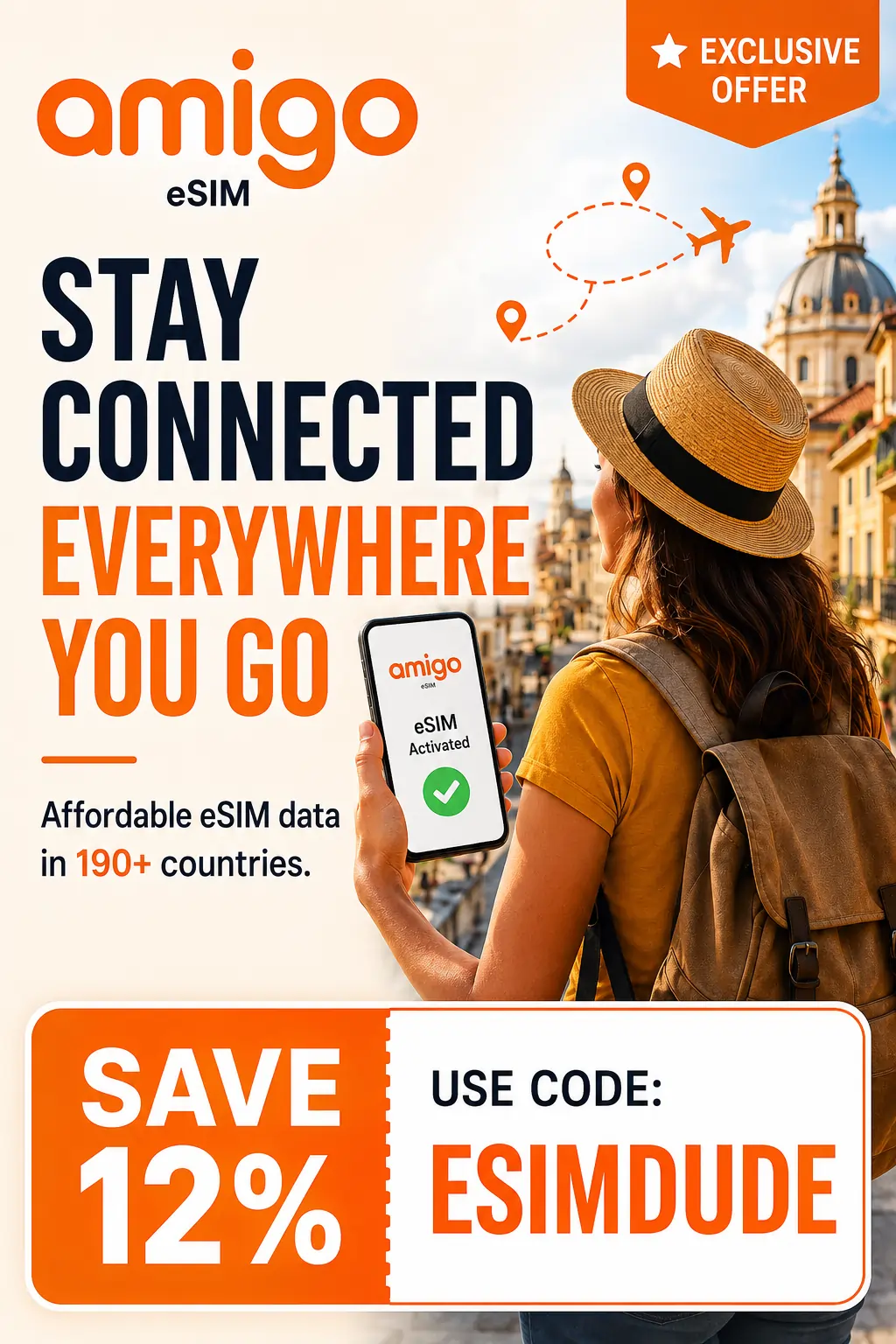
ESIMDUDE takes 12% off Amigo eSIM, bringing 10GB to $24.64. Still three times the cheapest Docomo plan here.
The Unlimited Question, Answered Honestly
“Unlimited” in Japan means “unlimited at some speed”, and the speed is never the one in the advertisement. Every one of these runs on a Japanese MVNO agreement with a fair use clause.
| Provider | Unlimited? | Daily full-speed allowance | Then what |
|---|---|---|---|
| Sim Local (au) | Yes | 10GB per day | Reduced |
| Airalo | Yes | 3GB per day | 1 Mbps |
| Nomad | Yes | 2GB per day | 1 Mbps (512kbps per one page) |
| ChillaxSIM | Yes | 1GB per day | 10 Mbps |
| Billion Connect | Yes | Not published | Not published |
| GigSky, Ubigi, Instabridge, Amigo, Bloomy | No | n/a | n/a |
Two readings of that table.
Sim Local’s 10GB per day is the only threshold you are unlikely to hit. At the honest average Japan tourist consumption of roughly 1 to 1.5GB per day, you would have to be hotspotting a laptop and streaming to reach it.
ChillaxSIM’s throttle floor is the best in the category. 10 Mbps after your gigabyte is a working connection. 1 Mbps is enough for maps and messaging and nothing else. 512kbps is a punishment.
And Billion Connect publishing nothing is not generosity. Every MVNO in Japan has a threshold. Not printing it means you find out where it is at the worst possible moment.
Coverage Reality: Where Japan Actually Breaks
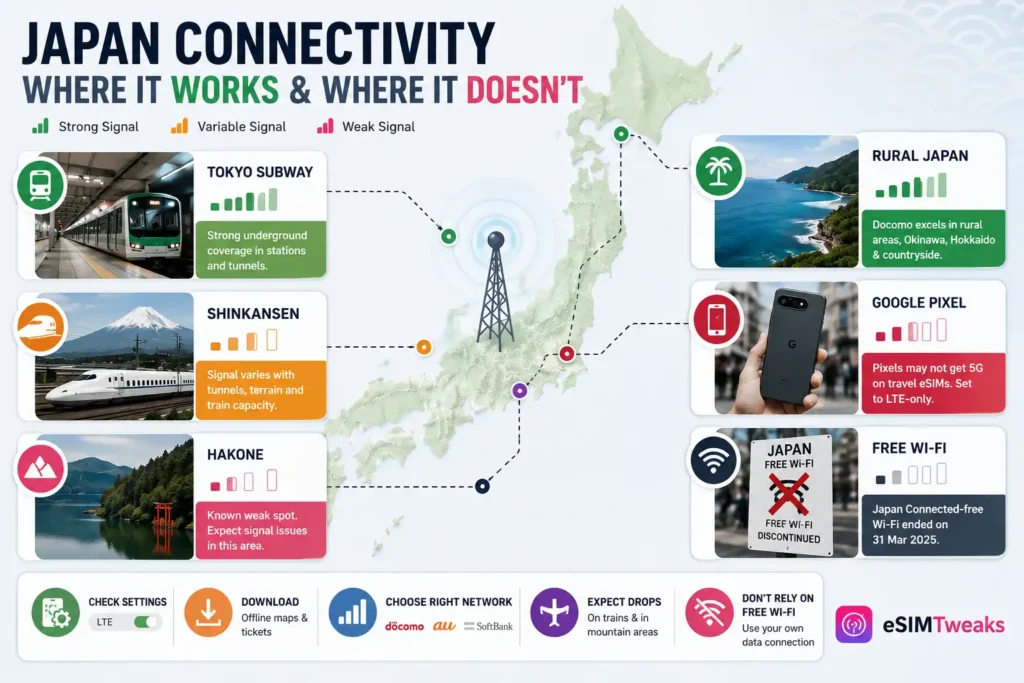
Japan’s networks are excellent. Almost every failure travellers report is provider-side or device-side. Here is what actually goes wrong.
Tokyo’s subway is fine. Docomo and au are consistently strong underground, including in stations. One traveller reported “never less than 4 bars of 5G even in the subway” on a KDDI-backed plan. If your data dies on the Ginza line, it is your eSIM, not the tunnel.
The Shinkansen varies with tunnels, terrain and how full the train is. Nobody reported a total blackout on the Tokaido line, but expect drops between Odawara and Shizuoka.
Hakone is the one named weak spot I can source. A traveller on a two-week Airalo trip said it was the only place they had signal trouble. Worth knowing for the Fuji Five Lakes loop.
Rural Japan is better than you expect on Docomo. Travellers reported Airalo working across the Okinawan islands and the Wakayama countryside, and another ran Tokyo to Hokkaido for two and a half weeks with no issues.
The Google Pixel problem is real and under-reported. Google maintains a carrier whitelist for 5G on Pixel handsets, so a Pixel on a travel eSIM in Japan may fail to get 5G and fall back badly. One family of four on Pixels reported data that “didn’t work for hours” and collectively could not use 20GB in two weeks. The fix is to force LTE-only in SIM settings, and since Japan’s 5G is only marginally faster than its LTE in practice, you lose almost nothing.
Free wifi is worse than its reputation and the official advice is stale. Japan Connected-free Wi-Fi was discontinued on 31 March 2025, yet JNTO’s own tourism page still recommends it. A traveller following Japan’s national tourism board in August 2026 downloads an app dead for seventeen months. Convenience store wifi usually needs registration through Japanese-language portals. Do not plan around it.
How Much Data You Actually Need in Japan?
Japan eats more data than most destinations, and the reason is frequency, not file size. You will not stream much. You will open Google Maps twenty-five to thirty times a day, because Shinjuku station has over 200 exits and Kyoto’s bus network is genuinely hard.
The honest baseline: Japan’s own domestic average works out to roughly 13.3GB per subscription per month from Ministry data, and Ericsson puts North East Asia at 23GB per month per active smartphone. Travellers self-report far less.
Real numbers from travellers, not vendors: “I usually average around 1 GB per day.” “10gbs for 8 days was more than enough.” “I’ve done 10 days on 2GB.” And the counter-case, from a three-week trip: “had to top mine up twice, would now definitely go only for unlimited.”
| Trip style | Per day | 7 days | 14 days |
|---|---|---|---|
| Maps and messaging only, offline maps downloaded | 0.3 to 0.5GB | 3GB | 5GB |
| Typical tourist: maps, translate, socials, restaurant search | 1 to 1.5GB | 10GB | 20GB |
| Heavy: video, calls home, cloud photo backup | 2 to 3GB | 20GB | 50GB or unlimited |
| Hotspotting a laptop, working remotely | 3GB+ | Unlimited | Unlimited |
I burned 3GB in two days in Tokyo purely on Google Maps. Dense cities eat data faster than anywhere else I have tested, and Tokyo is the densest I have tested.
Download offline maps for Tokyo, Kyoto and Osaka before you fly. Several travellers reported doing exactly this and it materially cuts consumption.
Setting Up a Japan eSIM
Things Nobody Tells You
Japan tightened its SIM identity rules on 1 April 2026. The revised Mobile Phone Improper Use Prevention Act now requires identity verification for data-only SIMs and eSIMs, and photo-upload eKYC has been replaced by IC chip reading of a My Number Card or passport.
This binds Japanese carriers issuing subscriptions in Japan; a foreign-issued roaming eSIM bought before departure appears to sit outside it, though sources conflict on scope. The practical advice is identical either way: buy before you fly and there is no ID process at all. Buy at a Japanese counter and bring your passport.
No travel eSIM here gives you a Japanese phone number. All eleven are data only, and that is structural: Japanese law restricts SIMs with local numbers to residents. If you need a number for a restaurant reservation, that means Mobal or Sakura Mobile with advance ID upload.
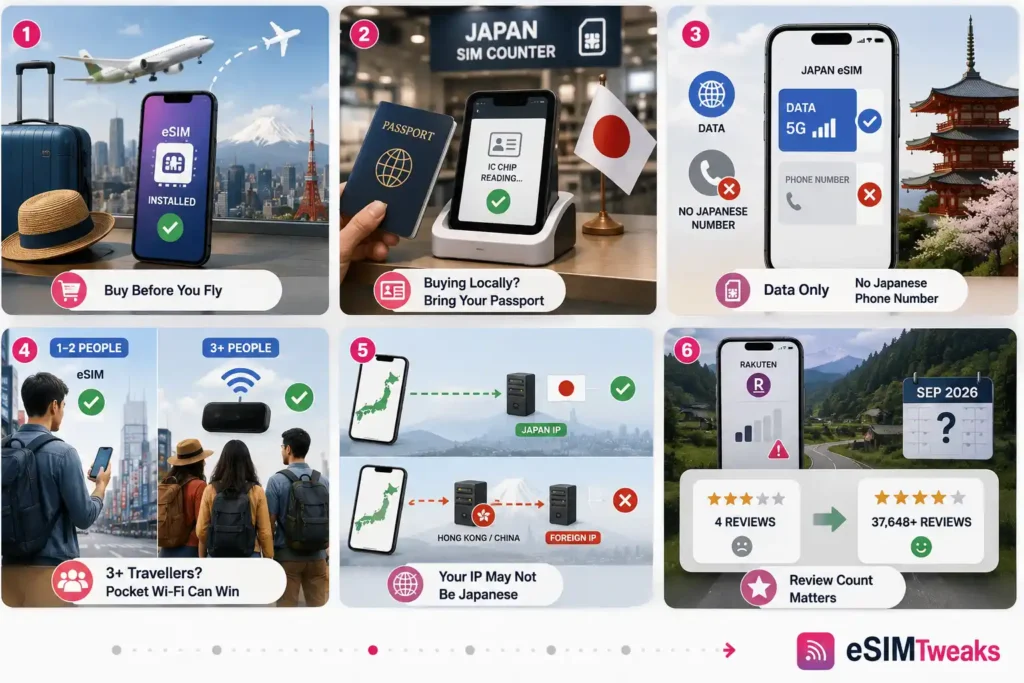
Pocket wifi still wins for groups of three or more. Rentals run ¥440 to ¥4,064 per day, with 7 days landing between ¥4,000 and ¥9,000 and 30 days between ¥13,000 and ¥30,000, plus shipping and insurance. Split three ways it beats three eSIMs. Solo or as a couple with unlocked phones, the eSIM wins.
Your IP address may not be Japanese. Only Ubigi, Sim Local’s au line and MobiMatter’s IIJ SKUs are reliable bets for a genuine Japanese IP. Some competitors route Japan traffic through Hong Kong or China, adding latency and breaking some Japanese booking sites. Bloomy explicitly labels which SKUs avoid Hong Kong routing, which tells you how common it is.
Do not buy a Rakuten-backed plan for a rural trip after September 2026 until the KDDI successor arrangement is confirmed.
Read the review count, not just the score. Amigo’s 5.0 App Store rating is four people. Billion Connect’s 3.9 is 22 people. Airalo’s 4.0 is 37,648 and Ubigi’s 4.1 is nearly 43,000. Volume is the signal.
eSIM vs SIM Card vs Pocket WiFi in Japan
If you are still deciding between a Japan eSIM card, a physical Japan travel SIM card and pocket wifi, the 2026 answer is settled for most people. A travel eSIM wins on cost, on setup speed and on having nothing to return, and the prepaid data plans above start under $8 for a fortnight of realistic mobile data abroad. A physical Japan SIM card still makes sense if your handset is locked, predates eSIM support, or you need a Japanese number.
Pocket wifi still makes sense for groups and all-day laptop tethering. And check your home carrier’s international roaming add-on first, because if it is included you keep your number and your calls, though the free tiers usually cap around 5GB of high-speed data and travellers consistently describe them as slow in Japan. If you are hunting the cheapest eSIM Japan sells rather than the best, the answer is the same one at the top of the table: the IIJ SKU at $7.99.
The Verdict
The best eSIM for Japan is not the one with the biggest marketing budget. It is the one sitting on the right Japanese carrier at a price that reflects what the wholesale actually costs.
MobiMatter’s IIJ plan wins that test and it is not close. $7.99 for a 10GB Japan eSIM card over 30 days on NTT Docomo, sold by a licensed Japanese MVNO, with hotspot and top-ups, at half the price of the mid-pack on the best-covered network in the country. ESIMDUDE adds 50% cashback capped at $5.
Airalo Moshi Moshi is the right answer for most travellers who want it to just work. Independently measured at 141.61 Mbps, the fastest travel eSIM tested in Japan, with the best app in the category. ESIMADVICE15 takes 15% off for new users. You pay a brand premium for an eSIM Japan tourist experience that is genuinely smoother.
Sim Local is the only real Japan eSIM unlimited data plan here, at 10GB per day full speed on au against 1GB to 3GB everywhere else, with ESIMDUDE10 for 10% off. GigSky pairs Docomo coverage with a free 100MB trial so you can confirm activation before spending, and ESIMADVICE15 takes 15%. Nomad has the best-priced week of unlimited at $25, or $21.25 with ESIMDUDE15.
Below that, Billion Connect is the cheapest unlimited but publishes no fair use threshold, Bloomy eSIM is the cheapest of all and the least proven, ChillaxSIM has the best throttle floor at 10 Mbps, and Instabridge and Amigo eSIM are hard to justify at $16 and $28 when the same thing costs $7.99.
Whatever you pick, do three things. Check your phone’s Japanese LTE bands, because with 3G dead since March 2026 a band gap means no service rather than slow service. Install before you fly, because every eSIM for Japan needs wifi to download. And turn data roaming on for the travel line only, because that toggle is why most eSIMs appear broken at Narita.
Do that and you will be through the Keisei gate while the pocket wifi counter is still closed.
Why trust eSIMTweaks.
59 providers tested.
388 speed tests run.
20 countries covered.
More like this

About the author

Head of Network Testing
I lead field testing at eSIMTweaks, conducting speed, latency and reliability trials on live networks across Latin America and Southern Europe. In the past year I evaluated more than 60 eSIM profiles under real travel conditions. Every performance figure we publish originates from testing I run or supervise.