How Does an eSIM Work? A Simple Technical Guide
September 7, 2026
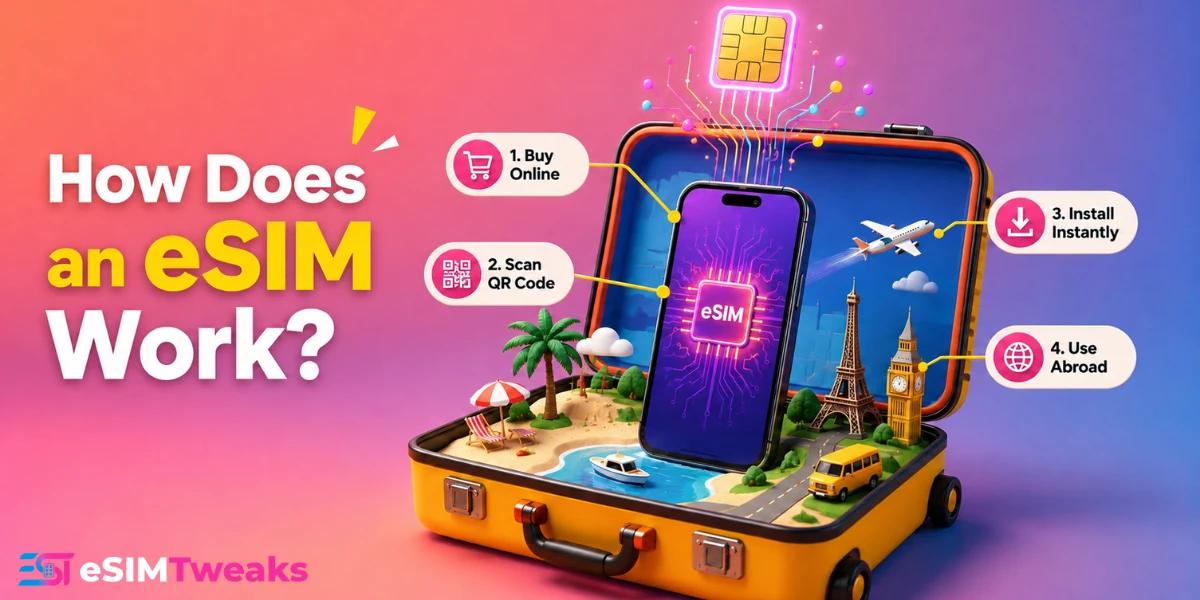
There is a specific moment that makes people distrust eSIMs. You scan a QR code, a progress bar crawls for ninety seconds, and a mobile network you have never heard of appears in your status bar.
Nothing was inserted. Nothing was removed. It feels like something happened to your phone rather than something you did to it.
The Short Version:
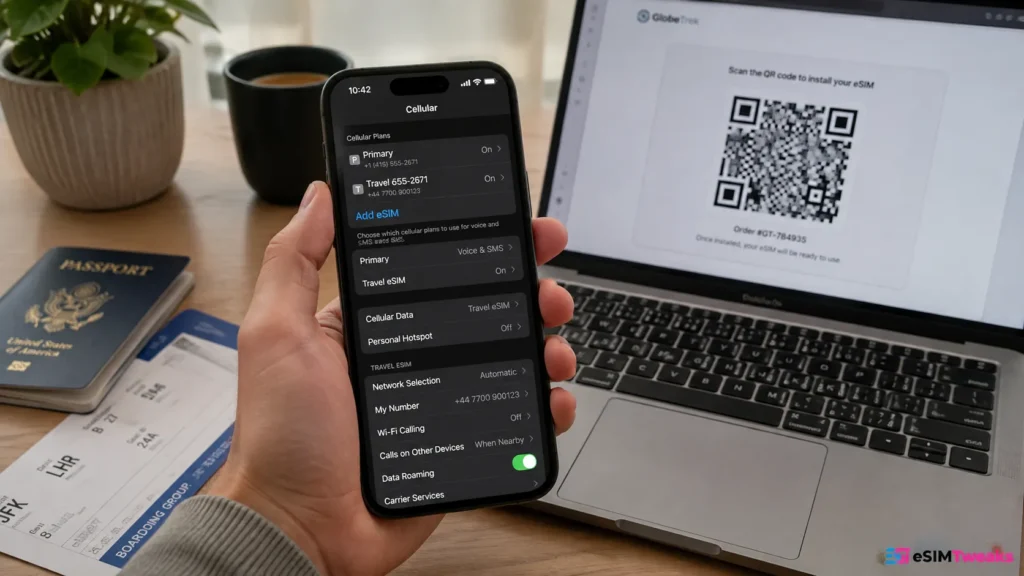
Your phone contains a small rewritable chip called an eUICC, soldered to the board.
When you scan a QR code, your phone’s Local Profile Assistant contacts a server called an SM-DP+, the two of them prove to each other cryptographically that they are genuine, and the server encrypts a profile using a one-time key that only your specific chip can unwrap.
That profile contains the IMSI, the ICCID and the secret authentication key that lets you onto a network. It downloads in roughly 30 seconds to two minutes, and it can only ever be installed on the one chip it was encrypted for.
The Four Parts Behind Every eSIM Activation
| Part | Where it lives | What it does |
|---|---|---|
| eUICC | Soldered inside your phone | The rewritable secure chip. Holds the profiles |
| LPA (Local Profile Assistant) | Your phone’s software | The “Add eSIM” screen. Fetches and installs profiles |
| SM-DP+ | Your provider’s server | Prepares, encrypts and delivers the profile |
| SM-DS | A shared industry directory | Tells your phone a profile is waiting, with no QR code needed |
The Hardware: What is Actually Inside Your Phone?
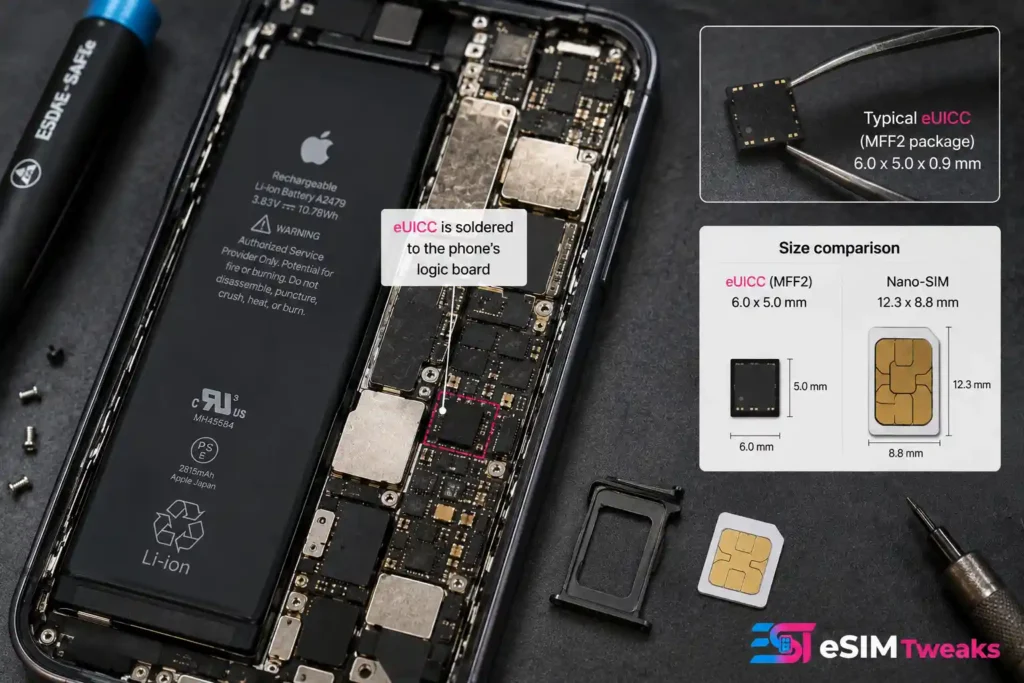
An eSIM is not a card. It is an eUICC, an embedded Universal Integrated Circuit Card, and in most phones it takes the MFF2 form factor: a surface-mount chip measuring 6.0 by 5.0 by 0.9 mm, soldered to the board at manufacture. A nano-SIM is 12.3 by 8.8 mm.
That is 30 square millimetres of board area against 108, before the tray, the ejector mechanism and the waterproofing gasket. Apple has said the space reclaimed from deleting the tray on eSIM-only iPhone 17 models goes to battery.
The chip is rewritable, and how many profiles it holds is a memory question rather than a rules question. Apple states supported iPhones store eight or more eSIMs and keep two active at once. Samsung says a Galaxy device downloads up to 20 profiles, with the real ceiling depending on their size.
Four identifiers get used interchangeably and only one of them is permanent.
| Identifier | Length | What it identifies | Changes when you switch plan? |
|---|---|---|---|
| EID | 32 digits | The eUICC chip | No. Permanent for the life of the chip |
| IMEI | 15 digits | The handset | No. Fixed at manufacture |
| ICCID | 19 to 20 digits | The profile | Yes. New profile, new ICCID |
| IMSI | Up to 15 digits | You, as a subscriber on a network | Yes. New profile, new IMSI |
One device, one chip, one permanent EID, and as many ICCIDs and IMSIs over time as you buy plans. When a provider asks for your EID, it is asking which chip to encrypt the profile for.
What Happens After You Scan the QR Code?
The QR code is not magic and it is not a link to a download. It is a short text string in a format the GSMA defines, and it looks like this:
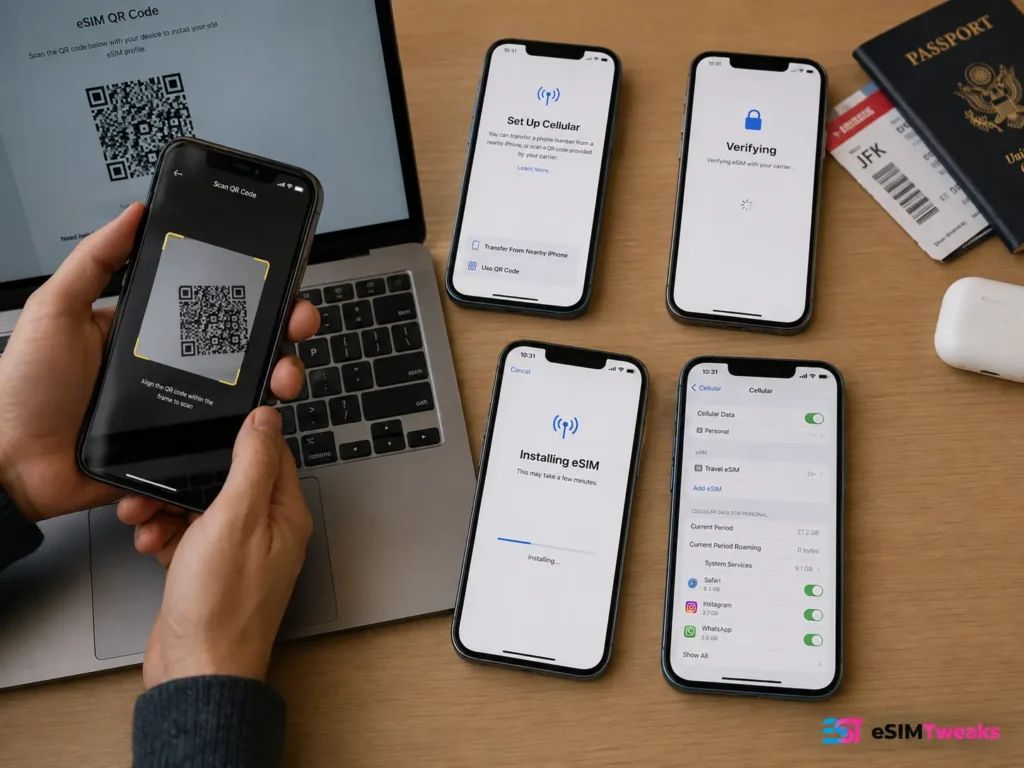
LPA:1$rsp.example.com$K2-4B7X-9QMZ8
Three useful fields. LPA:1 is the format version. rsp.example.com is the address of the SM-DP+ server holding your profile.
The last part is a MatchingID, a single-use token that identifies which reserved profile is yours. That is the whole payload. There is no data in the QR code, and there is no confirmation code in it either, whatever some explainers claim.
From there, five things happen in sequence.
Two consequences follow, and they explain most real-world eSIM disasters.
A QR code works exactly once. The MatchingID is spent the moment the server releases the profile. Rescanning returns an error.
Deleting a profile destroys it permanently. There is no local copy, no cloud backup and no undo. Recovery means the provider issuing a completely new profile against a new MatchingID, which many travel eSIM resellers will not do free. Treat the delete prompt as final, because it is.
Why a Travel eSIM Can Be Slower Than a Local SIM
This is the part almost nobody explains, and it is the most useful thing on this page.
A travel eSIM provider does not own a network. It is an aggregator holding an IMSI range sublicensed from a sponsor operator in one country, and it roams that identity everywhere else.
Researchers publishing at the ACM Internet Measurement Conference in 2025 traced one of the largest providers to six sponsor operators, including Play and Polkomtel in Poland, Singtel in Singapore, Telecom Italia and Orange in France. Of 24 country plans tested, 21 were international roaming rather than native.
Where your mobile data abroad physically exits to the internet is then an architectural choice, and it costs you.
| Routing | What it means | Measured latency penalty |
|---|---|---|
| Native / local breakout | Traffic exits in the country you are standing in | Comparable to a physical local SIM |
| IPX Hub Breakout | Traffic crosses a private inter-operator backbone and exits at a shared gateway, often Amsterdam or Virginia | Around 64% higher |
| Home Routed | Traffic returns to the sponsor operator’s home country before exiting | Around 621% higher |
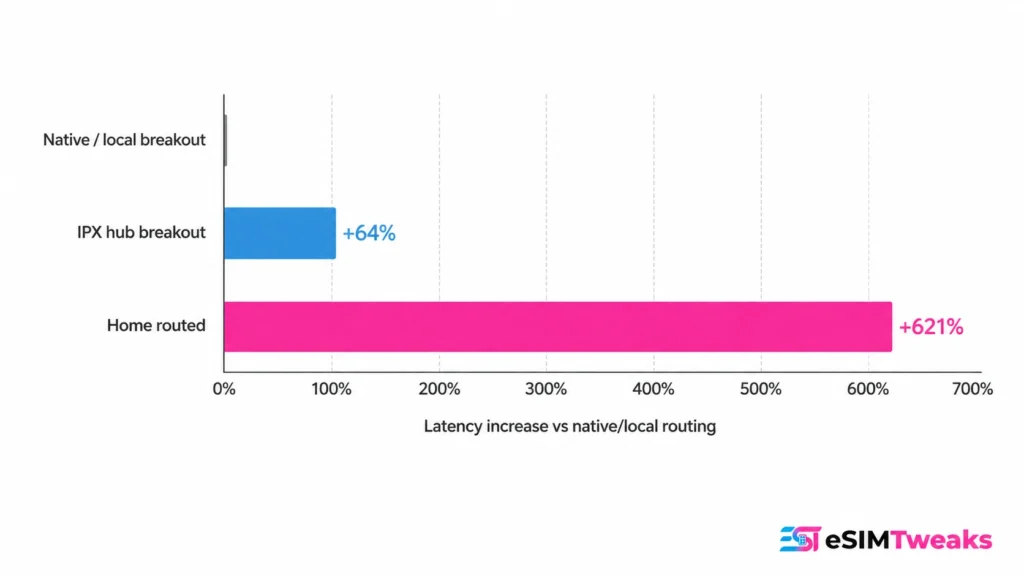
Hub breakout is the dominant travel eSIM architecture. The same study found half of those connections exited at a geographically poor gateway, including plans used in France and in Uzbekistan that both broke out in Virginia, and that 78.8% of roaming eSIM measurements delivered 15 Mbps or less.
The conclusion is not that eSIMs are slow. Native plans performed like physical SIMs. The penalty comes from roaming architecture, and you pay it in exchange for one data plan that works in 190 countries. Often a fair trade. Just not a free one.
The same architecture explains two things travellers find baffling. Travel eSIMs are usually data-only, because voice on a modern network needs an IMS core and per-country VoLTE roaming agreements, which is an order of magnitude more work than buying wholesale data.
And they usually cannot give you a local phone number, because numbers are national resources allocated by each country’s regulator to licensed local operators. An aggregator roaming a Polish or Singaporean identity has no numbering allocation in Spain.
Travelling there? Our eSIM Spain guide compares the options for staying connected across Spain.

- Save 12% with coupon code ESIMDUDE.
- Amigo names host networks including AT&T, KDDI, SoftBank, AIS and DTAC.
- Selected European plans include minutes, texts and a UK number.
What an eSIM Costs Compared With Roaming
Here is the comparison that matters, using published August 2026 rates.
| Option | Headline price | Effective cost per GB |
|---|---|---|
| AT&T pay-per-use, no plan | $2.05 per MB | ~$2,099 |
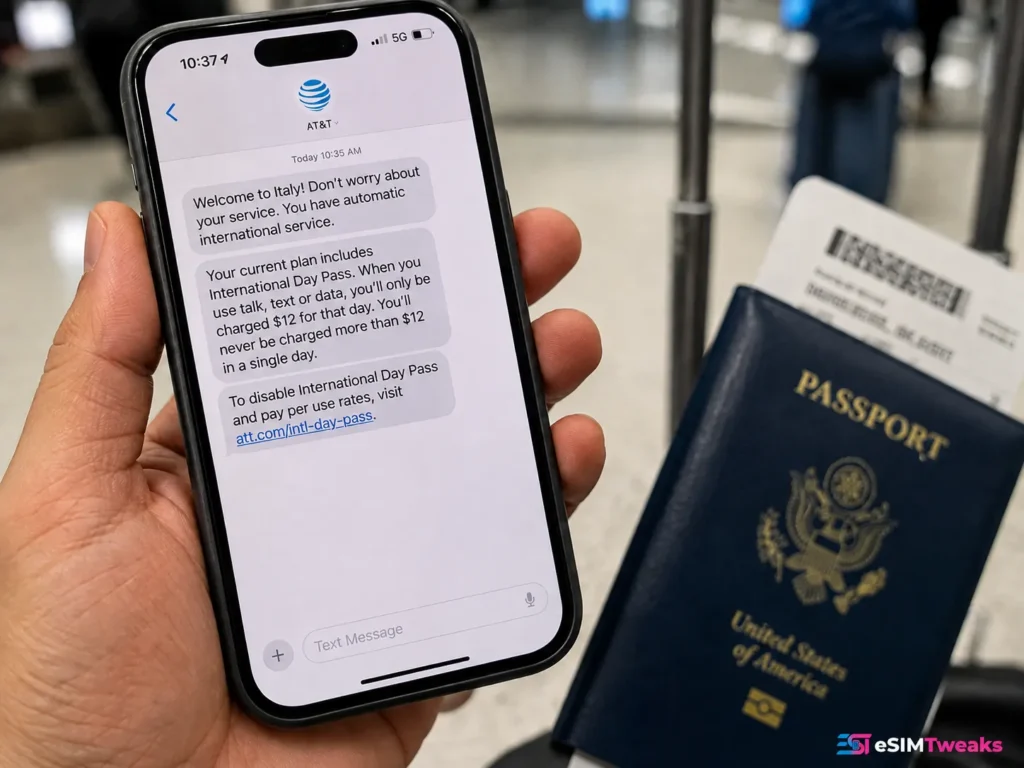
| AT&T International Day Pass | $12 per day | Depends on use; $12 for a 1GB day |
| Verizon TravelPass | $12 per day, 5GB then 3G | $2.40 at the full 5GB |
| T-Mobile International Pass | $75 for 30GB / 30 days | $2.50 |
| Typical travel eSIM, single country | $8 to $20 for 10GB / 30 days | $0.80 to $2.00 |
| Typical travel eSIM, global plan | $35 to $62 for 10GB / 30 days | $3.50 to $6.20 |
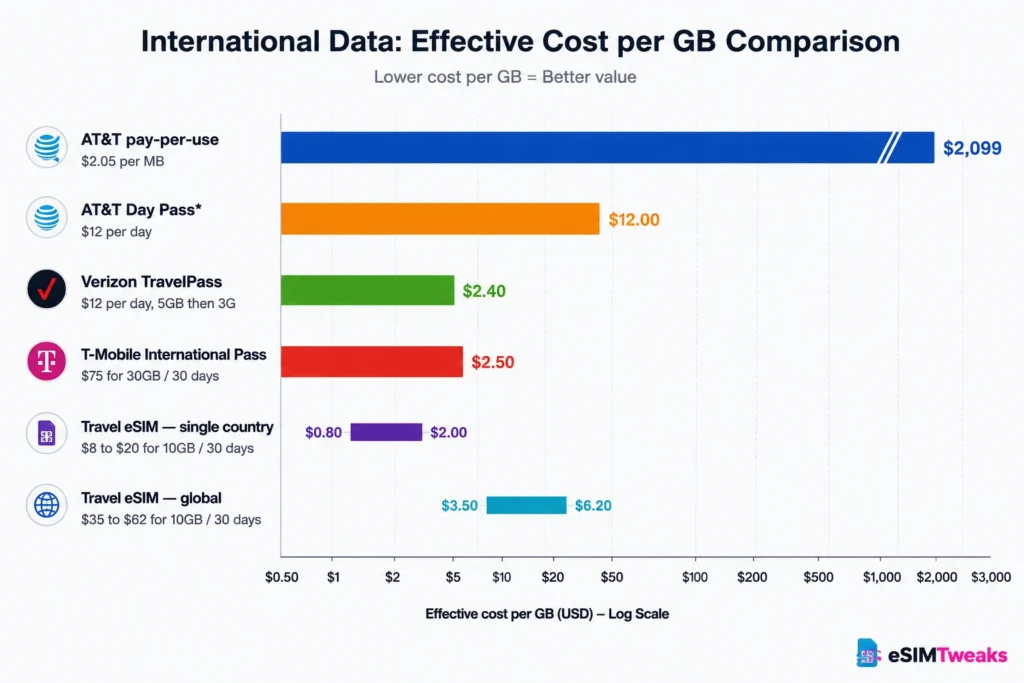
Two observations. The single-country travel eSIM is the cheapest data on the table by a wide margin, and the global plan carries a two to four times premium over a local one, which is the price of not having to think about it.
Juniper Research put traditional international roaming at $8.57 per GB against travel eSIM at $5.50 in its 2024 analysis, and has since reported travel eSIM revenue per gigabyte falling from $3.20 in 2023 to $2.78 in 2025.
One number to treat with suspicion. You will see it claimed everywhere that the GSMA found 68% or 90% of travellers switch roaming off entirely. The GSMA has published no such figure.
It traces to a 2014 Starhome Mach release with no stated sample size and has been recycled for twelve years. What GSMA Intelligence actually reported in March 2026 is that 12% of people who took an international trip in the previous year used an eSIM abroad.
To size a plan, work from what you consume. Ericsson puts the global average at 22GB per month per smartphone at the end of 2025, roughly 0.7GB a day.
Netflix publishes about 0.3GB an hour on low quality, 1GB on standard definition and 3GB on HD. Spotify at 160 kbit/s runs about 72MB an hour. Navigation is trivial, around 5MB.

- New users get 100MB free with no card required.
- Free data rises to 500MB across 42 European countries.
- The free plan runs for seven days from activation , giving you time to confirm the eSIM installs and connects.
We tested those features in more detail in our GigSky review
Five Things to Do Before You Travel
Common eSIM Questions, Answered
How does an eSIM work, in one sentence?
A rewritable chip soldered inside your phone downloads an encrypted subscriber profile from your provider’s SM-DP+ server, containing the IMSI, ICCID and secret authentication key that identify you to a mobile network, and that profile is cryptographically bound so it will only install on that one chip.
Does an eSIM need internet to activate?
Yes, for the download. The profile arrives over wifi or an existing mobile data connection. Once installed, it attaches to the mobile network on its own with no internet needed. This is why you install before you fly.
Can I use the same eSIM QR code twice?
No. The MatchingID inside the code is single-use, and the profile is encrypted specifically for the first chip that claims it. Rescanning returns an error, and no other device could decrypt that package even if it captured it.
What happens if I delete my eSIM?
It is gone permanently. There is no local copy and no cloud backup, and the activation code that summoned it has been spent. The provider has to issue an entirely new profile. Disable rather than delete if there is any chance you will want it back.
How many eSIMs can my phone hold?
Apple states supported iPhones store eight or more and keep two active simultaneously. Samsung states Galaxy devices download up to 20, with the real limit depending on profile size. It is a memory constraint, not a specification limit.
Is my phone eSIM compatible?
iPhone XS and newer, Pixel 3 and newer, Galaxy S20 and newer, and most flagships from 2019 onward, and it must be carrier-unlocked. Dial *#06# and if an EID appears alongside the IMEI, your handset has an eUICC.
Why is my travel eSIM slower than the local network?
Because your traffic is probably not exiting in the country you are standing in. Measured research puts hub-breakout routing at roughly 64% higher latency than native, and home-routed at around 621% higher. It is an architecture cost, not a fault.
Can a travel eSIM give me a local phone number?
Almost never. Phone numbers are national resources allocated by each country’s regulator to licensed local operators, and a travel eSIM aggregator holds no numbering allocation in the country you are visiting. A small number of providers include a number from the sponsor operator’s country instead.
Does an eSIM support tethering and mobile hotspot?
On most travel plans, yes, though it varies and some providers hedge in their fair use policy while advertising it as unlimited on the product page. Tethering consumes your data allowance far faster than phone use, because laptops download at desktop resolution and run background sync.
Is an eSIM more secure than a physical SIM?
For most threats, yes. There is nothing to remove from a stolen phone, the profile cannot be read out of the secure element, and an independent analysis presented at Black Hat Europe concluded the provisioning protocol is adequately secured against network attackers when both endpoints are honest. It does not protect against SIM-swap fraud, which attacks your carrier rather than the chip.
Can I move my eSIM to a new phone?
Sometimes. iPhone to iPhone works over Bluetooth on iOS 18.4 and later. iOS 26.3 supports transfer to Android 17, but only across eight carriers in five countries. Most travel eSIM resellers do not support transfer at all, because every transfer requires the provider to re-issue a fresh profile bound to the new chip.
What’s Worth Remembering
An eSIM is a rewritable secure chip plus a cryptographic delivery system, and once you accept that the profile is mathematically locked to your specific chip, the strange behaviour becomes predictable. The QR code works once. Deleting is permanent. Moving it needs the carrier’s cooperation, not just yours.
The part worth remembering when you buy is the routing. A native local plan performs like a local SIM. A roaming aggregator plan costs you between 64% and 621% in latency depending on where it breaks out, in exchange for one product that works nearly everywhere.
For a two-week holiday that trade is almost always worth it. For a video call you cannot afford to drop, buy locally.
Why trust eSIMTweaks.
59 providers tested.
388 speed tests run.
20 countries covered.
More like this
About the author

Director of Research, Pricing & Coverage
I lead pricing and coverage research at eSIMTweaks and maintain the dataset behind every comparison we publish across 200+ destinations. My background is in telecommunications analytics, where I spent six years building rate and coverage models for carrier partners. My analysis determines which providers earn a recommendation.